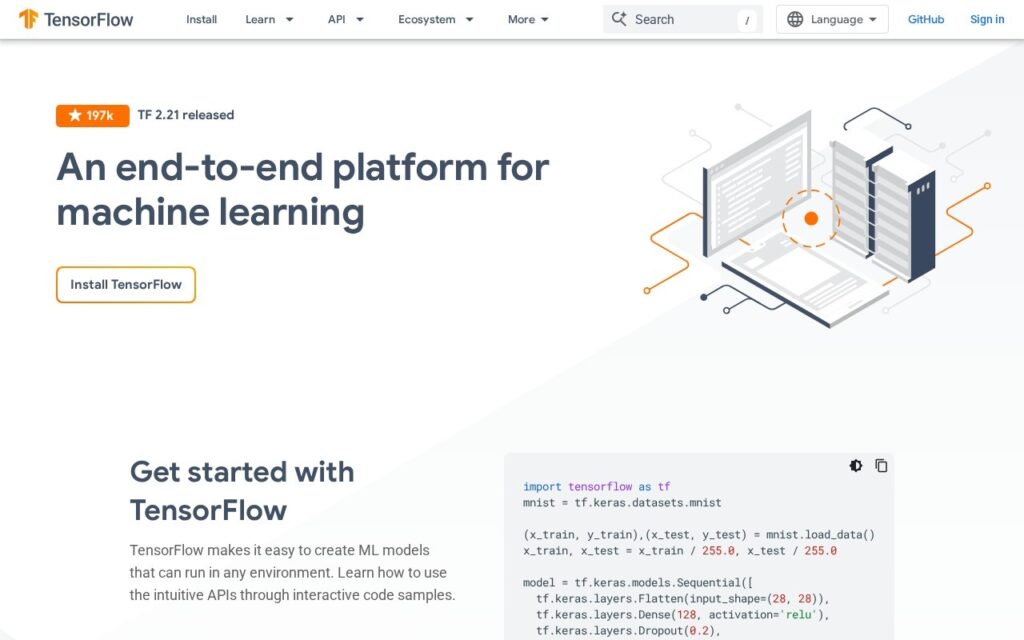
TensorFlow covers the whole path from experiment to production. tf.keras is the high-level model API, tf.data builds input pipelines, TensorBoard visualises training, LiteRT deploys to mobile and edge, TensorFlow.js runs models in a browser, and TFX handles production pipelines and MLOps.
Deployment breadth is what has kept it in production estates. Research frameworks compete on training ergonomics; TensorFlow’s argument has always been the other end, that a model trained here runs on a server, a phone, a browser or an embedded device without being rewritten, and TFX exists because production ML is mostly pipeline work rather than modelling.
It is open source with pre-trained models, TensorFlow Datasets, Kaggle integration, graph neural networks and reinforcement learning agents, free to use. Two honest caveats: PyTorch has taken most of the research community over the last several years, so newer papers and tutorials land there first, and the API has accumulated considerable history, which shows.