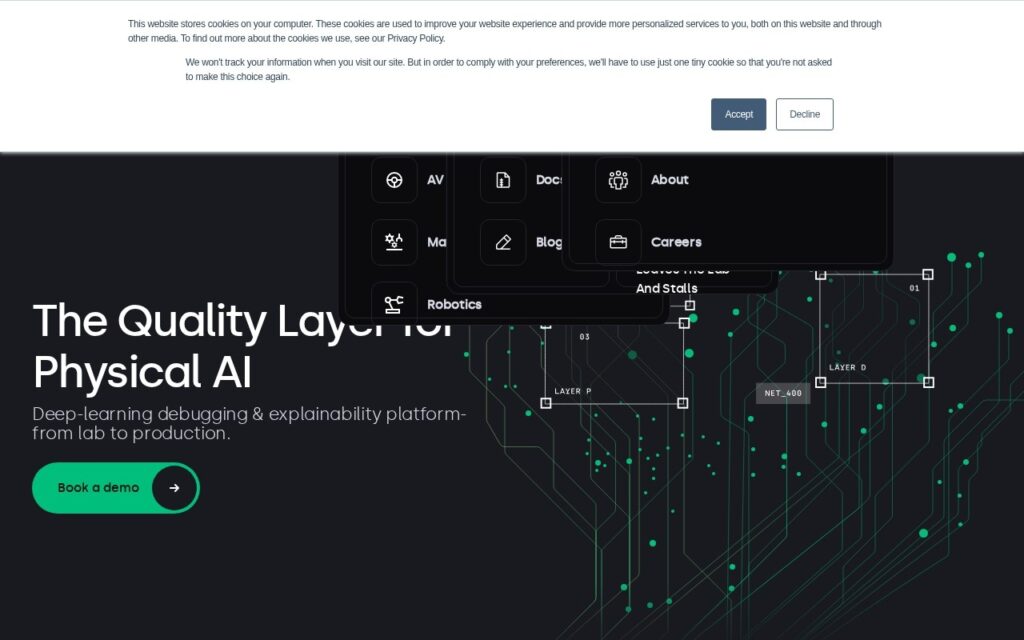
Tensorleap works on why a model fails. It detects failure modes and edge cases, curates the dataset in response, guides optimisation, and then monitors production for drift and regressions, in one workspace rather than four tools.
The market it names explains the design: robotics, autonomous vehicles, semiconductors, healthcare and defence, where a failure is an event rather than a percentage point. In those settings knowing the model is 94 percent accurate is useless; knowing it fails on a specific class of input at dusk is actionable, and curating data against that finding is the loop that actually improves things.
It is model-agnostic and integrates with PyTorch, TensorFlow, Weights & Biases, MLflow and the major object stores. No pricing is published. Deep-learning explainability is a hard research area where tooling gives leads rather than answers, the workflow assumes teams training custom networks rather than calling APIs, and dataset curation is expensive work the platform surfaces rather than performs.