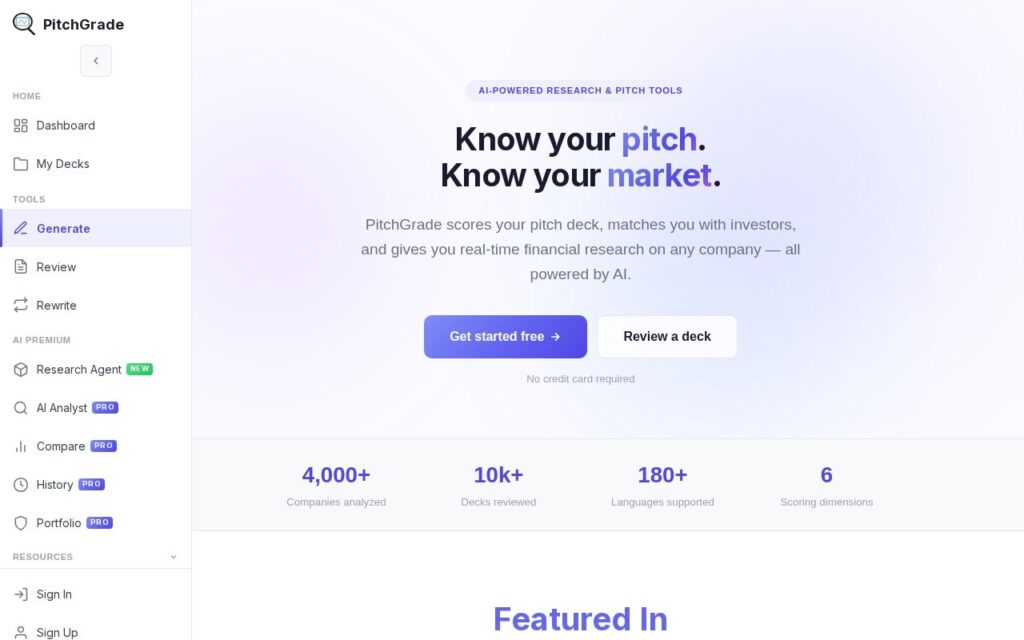
PitchGrade generates, reviews and rewrites pitch decks, with a research layer alongside it: an analyst agent working through SEC filings, comparison tooling and automated DCF models.
Pairing deck creation with underlying research is a sensible combination, because a pitch deck is downstream of analysis that most founders do badly or not at all. Market sizing, comparable companies and a defensible set of financial assumptions are what an investor probes, and they are exactly the slides that fall apart under questioning when the deck was built first and justified afterwards.
Treat generated financial models as a starting structure, not an answer. A DCF is almost entirely determined by its assumptions – growth rate, discount rate, terminal value – and automation is precisely where those get chosen without anyone noticing they were chosen. Read every input before presenting the output, and note that none of this is investment advice, for you or for anyone you show it to.
PitchGrade has no advertised paid tier. Among the 28 priced tools we list in Finance & Fintech AI, the median entry price is $29 a month.
22% of Finance & Fintech AI tools in the directory offer a free tier, and this is one of them.
Compared against every priced listing in Finance & Fintech AI, recalculated as the catalogue changes. Method and the full market breakdown are in our AI tool pricing study.
Financial data platform with an AI-powered stock research terminal, a data feed API and MCP connectors, the rebrand of FinChat.
Ask OnestaBot a finance question and get an answer, then search a database of financial advisors verified against their actual SEC registration data – not just self-reported credentials.
AI data infrastructure that extracts fundamental financial data from filings and feeds it straight into analyst models.
"Ask anything about your portfolio, get answers in seconds" – AI extracts metrics from board decks and cap tables, with MCP integration into Claude and ChatGPT.