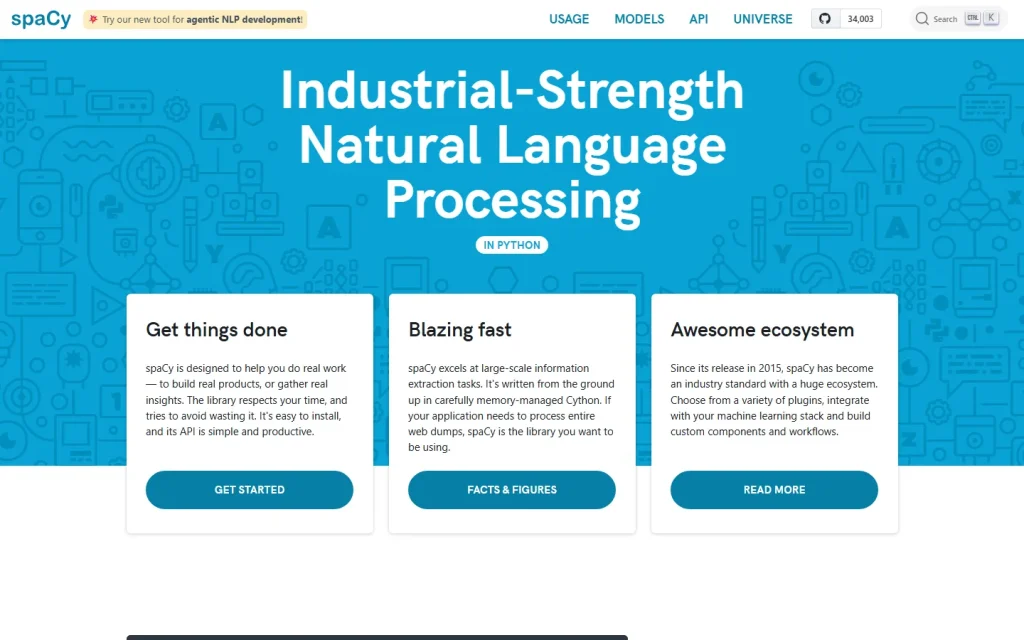
spaCy is a free, open-source Python library for natural language processing. It turns raw text into structured data: tokens, parts of speech, grammar relations and named entities like people, companies and places. It's built for developers who need fast, predictable NLP inside a real application.
What spaCy Is and Who It's For
spaCy is a Python NLP library maintained by the company Explosion, aimed at production use rather than classroom exploration. You install it, load a trained pipeline, and pass text through it to get annotated documents back.
It suits engineers building search, document processing, data extraction or content classification. Think of pulling company names out of thousands of contracts, or routing support tickets by topic. It doesn't suit anyone who wants a point-and-click app.
How a spaCy Pipeline Works
A spaCy pipeline is an ordered chain of components that each add annotations to a document. Text goes in, a Doc object comes out, and every component, such as the tagger, parser or entity recognizer, writes its results onto it.
That design is the library's best idea. You can swap, disable or add components, including your own Python functions, without rewriting the rest. The rule-based Matcher lets you combine hand-written patterns with statistical models, which is often the fastest route to a reliable extractor.
Training follows a config-file approach, so experiments are reproducible. You'll still need labelled examples. Explosion's annotation tool, Prodigy, exists for that job and is sold separately (check the Prodigy page for current pricing).
Where spaCy Fits Against NLTK and Transformer Libraries
spaCy sits between teaching-oriented toolkits and large-model frameworks. NLTK offers a wide range of algorithms and corpora suited to learning and research. spaCy offers fewer choices, but each is tuned for speed and a consistent API.
Hugging Face Transformers gives you access to many pretrained language models. spaCy doesn't compete head-on: its spacy-transformers package lets you use transformer models inside a spaCy pipeline. A sensible rule: use spaCy when you need structured extraction in a larger system, and reach for a transformer library directly when the model itself is the product.
Who Should Skip spaCy
Skip spaCy if you need text generation, chat or summarization. Those are large language model jobs, and spaCy's pipelines are built for analysis, not writing.
Also skip it if nobody on your team writes Python. And for small, one-off text tasks, a general chatbot may be quicker than setting up an environment. For anything repeated at volume, spaCy's speed and control pay off.
Browse more language and data tools in the AI tools directory before you commit.