Freemium Verified

Liner

Started as a web highlighter in 2015, later added AI research search

4.2 Research
4.2 Very good 4.2

Bottom line: Liner is a strong research tool, best known for browser-based highlighting and annotation across general web content and PDFs. It has a free plan.

Broader scope than academic-only competitors, covers general web reading too Less specialized for formal academic citation workflows than research-specific tools
Reviewed by Challenging Voice Editorial · Updated Jul 2026 How we rate
PricingFrom $12/mo
Free planYes
CompanyLINER
PlatformsAndroid, Chrome Extension, iOS, Web
Best forResearch
Founded2015
Visits16
Last reviewedJul 2026
UpdatedJul 2026
Ask AI about Liner ChatGPT Claude Perplexity

Overview

LINER, founded in 2015 in South Korea, predates most tools in this category by several years and began as a browser-based highlighting and annotation tool for any web page or PDF, not an academic-specific product, before layering AI-powered search and question-answering on top of that annotation foundation more recently.

That highlighter-first origin still shows in the product: annotations and highlights sync across a user's own browsing and reading, general web content included, rather than being scoped only to uploaded academic PDFs the way several younger competitors in this category are. The AI search layer then answers questions grounded in a user's own saved highlights alongside broader search.

A free tier covers standard use, and paid plans start around $12 a month for more features. For someone who wants highlighting and annotation across general web reading, not only academic PDFs, with AI search layered on top of their own saved material, LINER's broader scope and longer operating history address a different need than the academic-only tools surrounding it in this category.
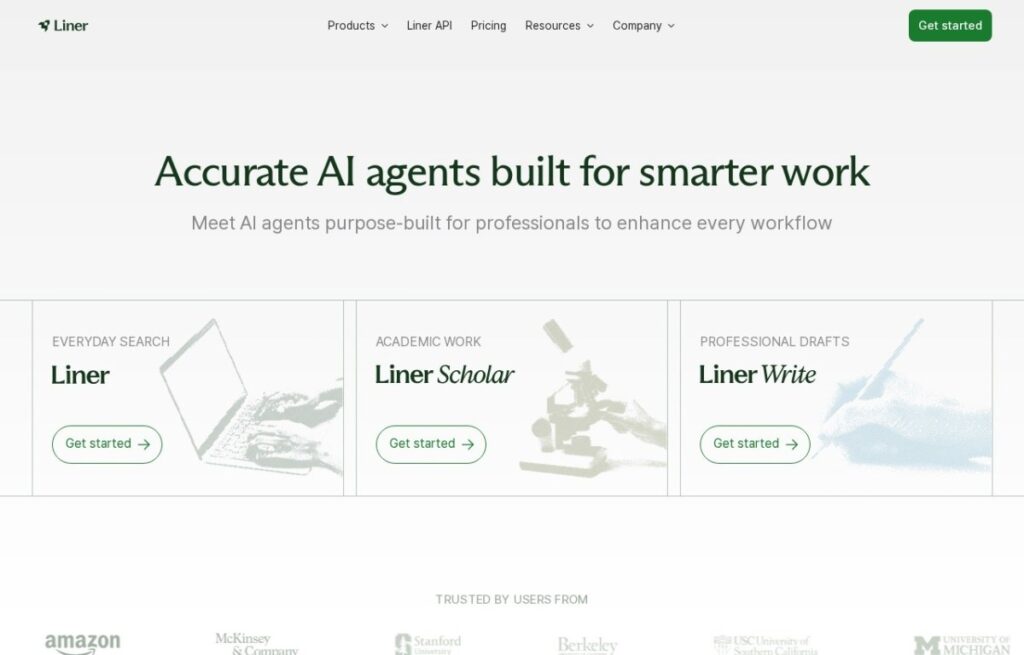

Key features

  • Browser-based highlighting and annotation across general web content and PDFs
  • AI search grounded in a user's own saved highlights
  • Free tier for standard use
  • Operating since 2015, older than most competitors in this category
  • Not scoped only to academic content
  • Annotation sync across browsing sessions

Screenshots & demo

Demo video

Screenshots

Liner screenshot 1

Pricing

Free
$0/mo
  • Unlimited advanced search
  • Image generation and deep research access
  • 1 file upload/day (up to 25MB)
  • Ads shown in answers
Pro
$17.99/mo
  • One plan across Liner, Scholar and Write
  • Unlimited advanced search
  • 20 file uploads/day (up to 100MB each)
  • Access to ChatGPT, Gemini, Claude models
  • Ad-free search
Max
$35.99/mo
  • Unlimited daily file uploads (up to 200MB each)
  • Access to major AI models
  • Ad-free search
  • 2,500 agent credits/month

Is Liner expensive?

Liner starts at $12, which is right at the Research median of $11.5 a month across the 42 priced tools we list in that category.

The cheapest paid option in Research starts at $1 and the most expensive at $20,000.

66% of Research tools in the directory offer a free tier, and this is one of them.

Compared against every priced listing in Research, recalculated as the catalogue changes. Method and the full market breakdown are in our AI tool pricing study.

Pros & cons

Pros

  • Broader scope than academic-only competitors, covers general web reading too
  • Long operating history refining the annotation experience specifically
  • Free tier available for standard use
  • AI search grounded in a user's own saved material, not just generic web results

Cons

  • Less specialized for formal academic citation workflows than research-specific tools
  • More features require a paid plan
  • Highlighter-first design may feel less structured than a dedicated research platform

How it compares

ToolRatingFreeFromBest known for
Liner (this tool)4.2Yes$12/moBrowser-based highlighting and annotation across general web content and PDFs
Semantic Scholar4.6YesFreeFree academic search and citation index covering 200+ million papers
ResearchRabbit4.6YesFreeContinuously updating recommendations based on a growing paper collection
Connected Papers4.3Yes$5/moVisual graph of papers connected by shared citations

Alternatives to Liner

6 tools our editors picked as direct alternatives to Liner.

Our verdict

4.2 / 5 4.2

Liner is a strong research tool, best known for browser-based highlighting and annotation across general web content and PDFs. It offers a free plan, with paid upgrades from $12/mo.

What makes it different: Liner stands out for browser-based highlighting and annotation across general web content and PDFs.

How we score it
Overall 4.2
Value for money 4.7
Feature depth 4.9
Popularity 4.0
Best for ProfessionalsTeamsCreatorsCurious learners

Frequently asked questions

What is Liner?
Liner is a research tool listed in the Challenging Voice directory. Started as a web highlighter in 2015, later added AI research search.
Is Liner free?
Yes, Liner offers a free plan. Paid plans unlock more features and higher usage limits, starting at $12/month.
How much does Liner cost?
Liner starts at $12 per month. See the pricing plans above for full details.
What are the best Liner alternatives?
Popular alternatives to Liner include VenturusAI, TinEye, and Ancestry. Browse them all in the Research category.
Is Liner any good?
Liner scores 4.2 out of 5 based on our editorial review.

Reviews

4.2 No reviews yet
  • Neal E. Caron 4.0 July 27, 2026
    The AI assists with summarising complex content, highlighting essential passages, and organising useful references in one convenient place.
  • Julius C. 5.0 July 27, 2026
    Compared with traditional search engines, Liner offers a more focused approach to finding and understanding information.
  • Benjamin 4.0 July 27, 2026
    Clear AI explanations combined with efficient highlighting make Liner a dependable platform for research and learning.
  • Samantha Morris 5.0 July 27, 2026
    Reliable summaries and organised highlights help Liner simplify reading across articles, reports, and research papers.

Write a review

Similar tools you might like