ChatGPT cites pages it can reach, understand and trust, so to optimize a website for ChatGPT citations you start with access, clarity and evidence, not magic phrases. Let OpenAI’s search crawler in, put the answer at the top of each page, and publish something other pages don’t have. No checklist guarantees a citation, and these habits make your site more useful to human readers too.
Can ChatGPT Reach Your Pages?
ChatGPT can only cite a page that OpenAI’s crawlers are allowed to fetch. OpenAI documents separate user agents for separate jobs in its crawler documentation, so a robots.txt rule written for one doesn’t cover the others.
| User agent | What OpenAI uses it for | If you block it |
|---|---|---|
| OAI-SearchBot | Finding and surfacing pages in ChatGPT search | Your pages aren’t shown in ChatGPT search answers, though they can still appear as navigational links |
| GPTBot | Collecting content that can be used to train OpenAI’s models | Your content stays out of training; search visibility is a separate setting |
| ChatGPT-User | Fetching a page when a user’s request calls for it | User-initiated fetches follow different rules, since robots.txt rules may not apply |
The decision rule is short. If you want citations but don’t want to feed model training, allow OAI-SearchBot and disallow GPTBot.
Check your CDN and firewall too. A bot-blocking setting that targets AI crawlers can override a permissive robots.txt, and you won’t see it in the file.
How Should a Page Answer the Question?
A page earns citations when its answer sits near the top and its purpose is obvious from the title and headings. Give each page one job. A page about choosing a project-management tool shouldn’t bury its comparison criteria beneath the history of workplace software.
Use descriptive headings, define specialized terms on first use, and answer the central question in the first paragraph. Then give the reasoning, context and limits a reader needs to judge that answer.
Clear structure helps machines parse a page. But clarity isn’t the same as cutting every subject into short claims, and complex topics still need enough explanation to avoid misleading shortcuts.
Credibility comes from evidence a reader can see. Name the author and their relevant experience, separate original research from commentary, and say how any figure was gathered.
Link each claim to its supporting material at the point where it’s made. Keep dates accurate on fast-moving subjects, and update or delete stale advice instead of leaving it to circulate.
What Makes a Page Worth Citing?
A page worth citing contributes something a model can’t assemble from familiar points: original data, a clear framework, an interview, or a carefully reasoned comparison. Generic summaries are easy to reproduce and hard to tell apart, so they give an assistant little reason to point to you.
Even a small business can add value. Describe a real process you ran, including the limits and the surprises.
Specificity beats breadth. “Improve customer service” is a slogan; an account of how a team cut response delays, what it measured and what failed gives readers something to assess.
First-hand detail only helps when it’s honest. Don’t invent case studies, credentials or statistics to look authoritative. A fabricated number that gets quoted spreads the error with your name attached.
Hard to Cite vs Easy to Cite
The same point can be written in a way an assistant can lift cleanly or in a way it has to work around.
| Element | Hard to cite | Easy to cite |
|---|---|---|
| Answer placement | The answer appears after several paragraphs of background | The answer sits in the first two sentences under the heading |
| Subject naming | “It works well for this” | Names the tool, task or standard in the sentence |
| Evidence | “Studies show” with no link | Names and links the specific source |
| Scope | “Best for everyone” | States who it suits and who it doesn’t |
Treat any citation checklist, this one included, as a starting point, not a promise of visibility. Citation behavior varies by query, by product and by the sources available to the system at that moment.
Remove Rendering and Architecture Obstacles
Rendering problems stop a page from contributing even when crawlers are allowed in. A page that depends on broken scripts, loads its main text only after a click, or returns an error gives a crawler little to read.
Put the main text in the HTML your server sends, since not every crawler runs JavaScript. Uptime alerts from dedicated website monitoring tools catch errors before a crawler does.
Information architecture matters too. Use meaningful titles and headings, merge near-duplicate pages that compete for the same question, and group related material into a coherent set.
Structured data can clarify an article’s author or publication date when it matches visible content. It can’t turn weak material into a trusted source, and markup alone doesn’t earn a citation.
How Do You Know If ChatGPT Is Citing You?
ChatGPT referrals show up in analytics, but attribution is incomplete. Links in ChatGPT search results can carry a UTM parameter identifying ChatGPT as the source, so filter for it alongside chatgpt.com in referrer reports.
Some visits still land as direct traffic, and a citation can shape a reader’s view without a click. Server logs answer the first question: is OAI-SearchBot fetching your pages at all?
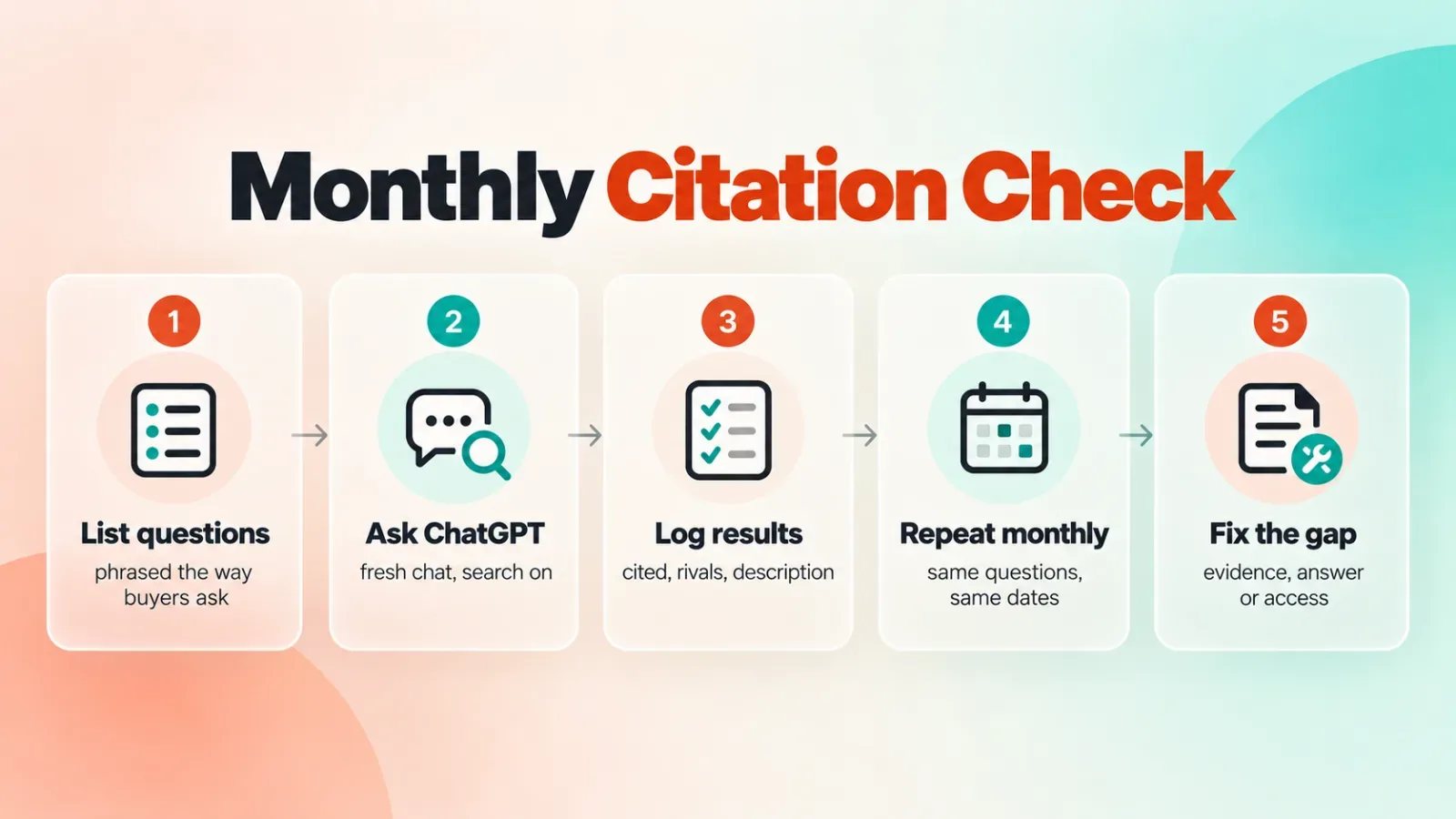
Manual checks fill the gap analytics leave. A simple monthly routine covers most sites:
- List the questions each key page should answer, phrased the way a buyer would ask them.
- Ask each question in ChatGPT with search turned on, in a fresh chat so earlier conversation doesn’t steer the answer.
- Record whether your page is cited, which sources appear instead, and how your content is described.
- Repeat with the same questions on the same dates each month, because one answer isn’t a trend.
- Fix the gap the log points to: missing evidence, an unclear answer, or a blocked page.
Run the same questions through a couple of popular ChatGPT alternatives as well, since each assistant picks sources differently. Use the log to find gaps, not to rewrite every page around one model’s latest response.
Where Automation Helps and Where It Doesn’t
Improving a site for AI citations can involve editorial work, analytics, engineering and sometimes custom AI development tools. Define the task before you buy or hire: are you building a retrieval system, connecting data sources, or checking outputs for accuracy?
Scope decides cost and fit more than any job title does. Compare vendors and candidates against a concrete brief, not a label.
Human review stays non-negotiable. An automated content pipeline scales errors as fast as useful material, especially when it generates unsupported claims or repeats pages you already have.
Set standards for sourcing, fact-checking, privacy and editorial sign-off before you increase output.
Start With One Page This Week
Pick the one page you’d most like ChatGPT to cite. This week, check three things: OAI-SearchBot can fetch it, its answer sits in the first two sentences, and every figure links to a source.
Fix whatever fails before you write anything new. If an assistant cites the page later, that should follow from its usefulness, not be the only reason it exists.
Frequently asked questions
Can You Pay to Be Cited by ChatGPT?
Paying isn’t how organic citations in ChatGPT answers work. Citations come from pages OpenAI’s search crawler can reach and the system judges relevant to the question. Ads on ChatGPT are a separate product from the answer itself, and OpenAI uses a distinct crawler, OAI-AdsBot, only to check pages submitted as ads.
How Long Does It Take for a New Page to Be Cited?
OpenAI doesn’t publish a timeline. A page has to be fetched by OAI-SearchBot before it can appear, and your server logs show when that happens. After that, whether it’s cited depends on the question and the competing sources.
Is Optimizing for ChatGPT Different From SEO?
Most of the work overlaps with good SEO: crawlable pages, clear answers and credible evidence. AEO (answer engine optimization) and GEO (generative engine optimization) are names for tuning content so AI assistants can quote it. The main additions are allowing AI crawlers by name and writing passages that make sense when lifted out of the page.
Does an llms.txt File Help ChatGPT Cite a Site?
There’s no confirmation that OpenAI uses llms.txt when choosing citations. OpenAI’s crawler documentation covers robots.txt controls for its bots and does not mention llms.txt. The file is a proposed convention for pointing AI systems to a site’s key content. It’s quick to add, but it won’t fix a blocked crawler or a page with no clear answer.