Getting cited by AI takes three things: crawler access, a plain answer near the top of the page, and facts other pages don’t have. ChatGPT search, Perplexity and Google’s AI Overviews each pick sources from their own index, so there’s no single switch to flip. And no markup, file or prompt guarantees a citation.
The practice has two common names. AEO (answer engine optimisation) means shaping pages so AI assistants can lift a direct answer. GEO (generative engine optimisation) is the same goal applied to AI-written answers. Both rest on ordinary search basics, so be wary of anyone selling a separate “AI ranking” trick.
Which AI Crawlers Need Access to Your Site?
AI crawlers are the bots each AI product sends to fetch pages, and you can’t be cited if yours is blocked. Google says a page must be indexed and eligible to show with a snippet before it can appear as a link in AI Overviews or AI Mode. Check each row below against your robots.txt and your firewall.
| AI product | Where it finds pages | What to check |
|---|---|---|
| Google AI Overviews and AI Mode | Google Search index, crawled by Googlebot | The page is indexed and has no nosnippet rule on the passages you want quoted |
| ChatGPT search | OAI-SearchBot | robots.txt and firewall rules allow OAI-SearchBot |
| Microsoft Copilot | Bing index, crawled by Bingbot | The page is indexed in Bing, not only in Google |
| Perplexity | PerplexityBot | robots.txt and firewall rules allow PerplexityBot |
| Claude (web search) | Anthropic’s search crawler (see Anthropic’s crawler documentation for the current user agent name) | robots.txt and firewall rules allow it |
The firewall is the check people skip. Bot settings in Cloudflare and other CDNs can stop AI crawlers before robots.txt is ever read, so open the bot rules, not only the robots file.
Blocking training is a separate decision from blocking citations. OpenAI documents GPTBot and OAI-SearchBot as independent crawlers, so you can refuse model training and still appear in ChatGPT search. Google-Extended works the same way: it governs Gemini training, not whether you show up in AI Overviews.
How Should You Write Pages AI Assistants Can Quote?
AI assistants get asked direct questions: which option suits a small team, what a plan includes, how two tools differ. A page that answers that question in its first two sentences gives readers and AI systems a passage they can lift. That doesn’t mean turning every article into one-line Q&A.
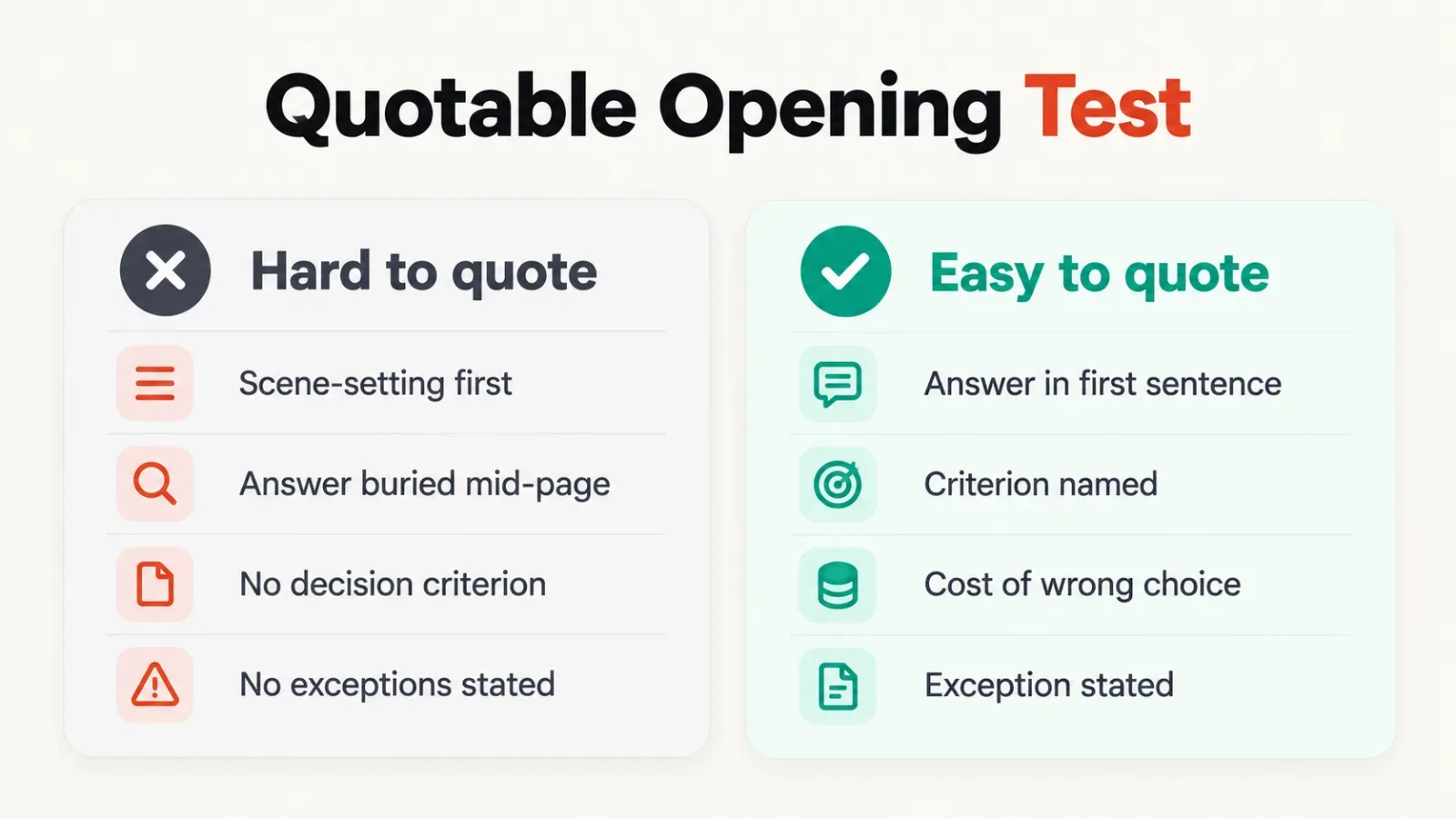
Start with the decision your reader is trying to make. Give the answer first, then the reasoning, the limits and the exceptions.
Use headings that say what the section covers, and define unfamiliar terms before you lean on them. A reader who scans the headings should be able to guess every answer’s location.
A Weak Opening Versus a Quotable One
Take the question “Which AI voice generator suits a two-host podcast?” A weak opening reads: “Voice technology has come a long way in recent years, and creators now have plenty of options.”
A quotable opening reads: “Pick a generator that handles several distinct voices in one script and exports separate tracks. A single-voice tool forces you to stitch files together by hand.”
The second version names the decision, the criterion and the cost of getting it wrong. An assistant can quote it without the rest of the page. If you’re making that exact choice, the comparison of AI voice generators lays out the options.
How Do You Make Expertise Visible and Checkable?
Fluent writing isn’t evidence, and AI systems produce fluent writing for free. A page earns trust when it shows how its claims were reached: name the experience behind them, separate observation from opinion, and date anything that changes.
For a comparison, state the criteria so the reader can check the conclusion without taking your word for it.
Accuracy also means saying what you don’t know. If a result depends on industry, location or budget, say so instead of presenting one answer as universal.
Correct outdated pages, remove claims you can’t support any more, and make authorship and editorial responsibility clear. Never show an “updated” date on a page nobody reviewed. A fake freshness signal costs more trust than an old date.
Use evidence, not manufactured authority
Original data, informed analysis and documented examples give a page a reason to exist beyond what’s already online. A modest contribution counts: a pricing table pulled from vendor pages with the date you checked, a case study with its method, or a comparison built on stated criteria.
When you quote research, represent it accurately and say why it matters to your reader.
AI writing assistants can tidy a draft, but they can’t supply the facts that make it worth citing. Use them for structure and editing, and bring the evidence yourself.
Skip invented statistics, padded FAQs and near-identical pages for every keyword variant. Those tactics make a site look busy while giving readers nothing new, and search engines treat them as spam.
The same goes for text aimed at AI systems: hidden instructions, planted self-praise or lines telling assistants to recommend you. That’s manipulation, and one such page can drag down a whole site.
Does Structured Data Help You Get Cited by AI?
Structured data helps machines read a page, but it won’t earn a citation on its own. Google’s guidance for its AI features explains what it expects from sites (check Google’s AI features page for the current wording), and any schema you add has to match the visible text.
Keep key information in page text rather than images, and use lists only where steps or options are easier to compare that way. An AI SEO tool can flag missing or broken markup. It can’t make an unsupported claim reliable.
Do You Need an llms.txt File?
llms.txt is a proposed plain-text file that lists a site’s key pages for language models. Check Google’s AI features documentation for its current position on AI-specific text files. Adding one costs little, but don’t count on it to produce citations.
How Do You Know If AI Assistants Cite You?
You track AI citations through referral traffic, server logs and manual checks. No single report covers every assistant, so combine them.
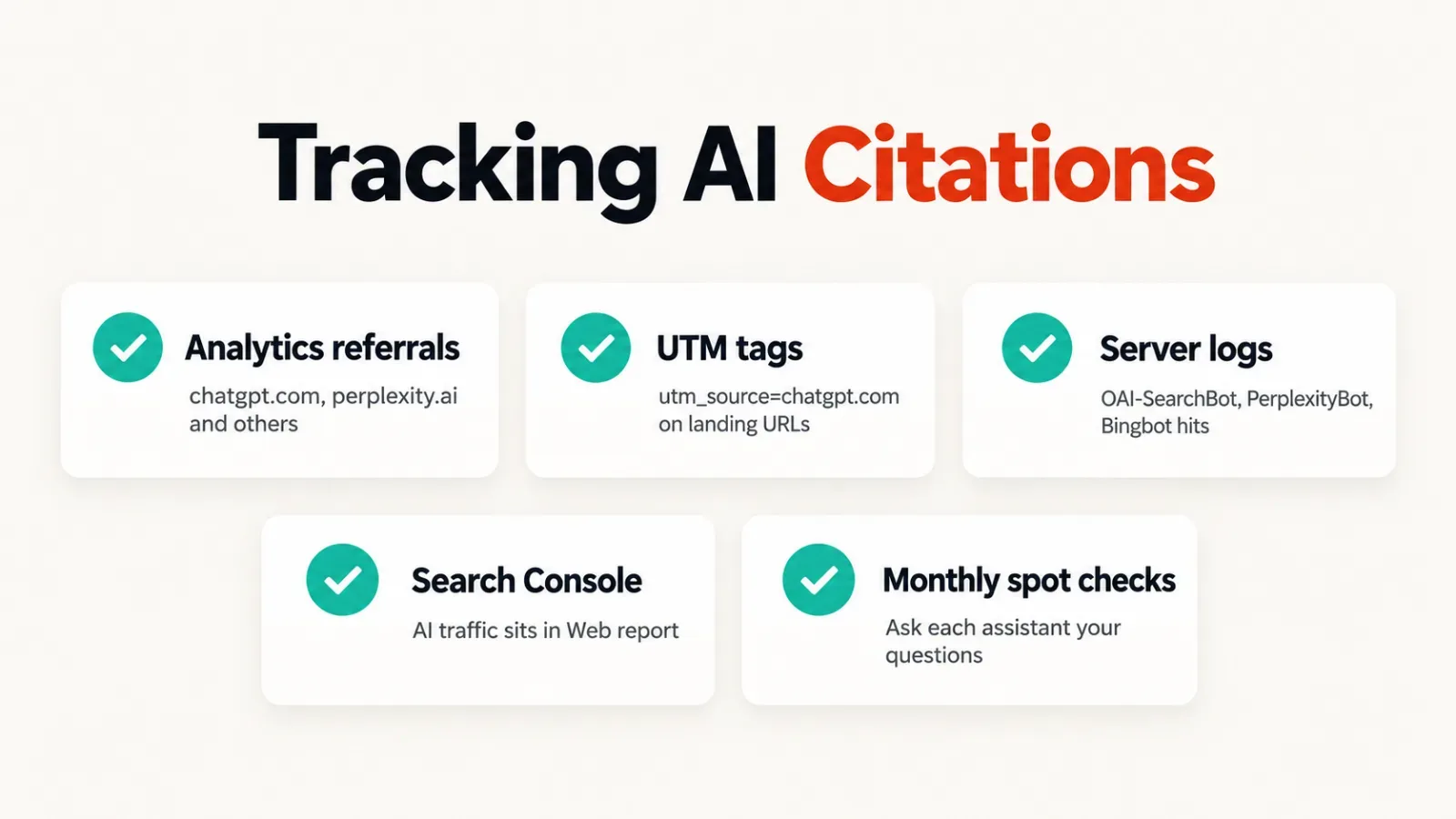
- Filter your analytics referrals for chatgpt.com, perplexity.ai, copilot.microsoft.com and gemini.google.com.
- Look for utm_source=chatgpt.com on landing URLs, which ChatGPT adds to many links it sends.
- Check server or CDN logs for OAI-SearchBot, PerplexityBot and Bingbot hits on the pages you care about.
- Read Google Search Console knowing that AI Overviews and AI Mode traffic may not be separated out from other Search traffic; check Google’s Search Console documentation for the current reports and filters.
- Once a month, ask each assistant the 5 to 10 questions your page answers and log which sources it cites.
A page can shape an answer without being linked, and each product refreshes its sources on its own schedule. Judge the work by reader trust and engagement too, not only by whether one assistant shows a link.
Fix One Page This Week
Choose the page that answers the question your readers ask most, then run it through the checks above. Confirm the crawlers can reach it, rewrite the first two sentences as the answer, and add one fact only you can supply.
Then make it routine: every new page starts from a reader question, gets a fact-check, and carries a review date someone owns.
Read the result as a skeptical reader would. If the answer’s easy to find and the details are specific, you’ve given people and AI systems a reason to rely on the page. When you need tools for the drafting, audits or tracking, the A to Z directory of AI tools is a good place to start.
Frequently asked questions
How Long Does It Take for AI to Cite a New Page?
No AI assistant publishes a timeline. A page has to be crawled and indexed first, and each product refreshes its index on its own schedule. Linking the new page from your strongest existing pages helps crawlers find it sooner.
Do Backlinks and Brand Mentions Help You Get Cited by AI?
Ordinary search signals carry over, because Google’s AI features and Copilot draw on the same indexes as regular search. No AI vendor publishes how much links or mentions weigh in source selection. Earn them with pages worth referencing, and treat anyone selling a “citation boost” from bought links as a risk.
Can You Pay to Be Cited by ChatGPT or Google AI Overviews?
No. Organic citations in ChatGPT search and Google’s AI Overviews aren’t for sale. Where an AI product runs ads, check the product’s own ad policy for how they’re labelled and presented.
Should You Block AI Crawlers to Protect Your Content?
Block training crawlers if you object to model training, and allow search crawlers if you want citations. GPTBot and Google-Extended govern training, while OAI-SearchBot and Googlebot govern whether you can appear in answers. Blocking everything protects your content and removes you from AI answers at the same time.
Does AI-Written Content Get Cited Less?
How a page is produced matters less than what it adds. Google’s stated position is that it rewards helpful content however it’s made, while mass-produced pages that add nothing count as spam. A page that rewords what already ranks gives an assistant no reason to pick it over the original.