If you want one AI SEO tool to start with, Scalenut is the strongest in our catalogue at $39 a month. Koala AI is the one that costs nothing to try, with 5,000 words free and no card.
The fifteen below share one trait: the software does a job a person used to do by hand. That means grading a draft, clustering a keyword list, or pushing a fix onto a live page. What separates them is which job, and what happens to your bill.
How this list is ordered, and what it leaves out
These fifteen are ordered by our editorial rating, then by whether a free plan exists, then by starting price. That rating comes from reviewing each product’s features, pricing and positioning against the rest of our SEO tools catalogue.
We don’t run these tools against a shared test site, so you won’t find a ranking uplift figure from us. Every price and limitation below is drawn from the listing for that product, and each listing carries its own last-reviewed date.
The exclusions matter more than usual here. Our four highest-rated SEO listings are Screaming Frog, Ahrefs, SE Ranking and Rank Math, and not one of them is an AI product. They’re crawlers and classic suites, so they sit this one out.
Semrush is the same story at 4.5. A tool that added an AI feature isn’t the same purchase as a tool built around one, and mixing the two is how these lists stop being useful.
One more group sits out. Tools that track how a brand appears inside chat answers do a different job, and our roundup of AI visibility tools covers those seven properly.
| Tool | Rating | Free plan | From | Best for |
|---|---|---|---|---|
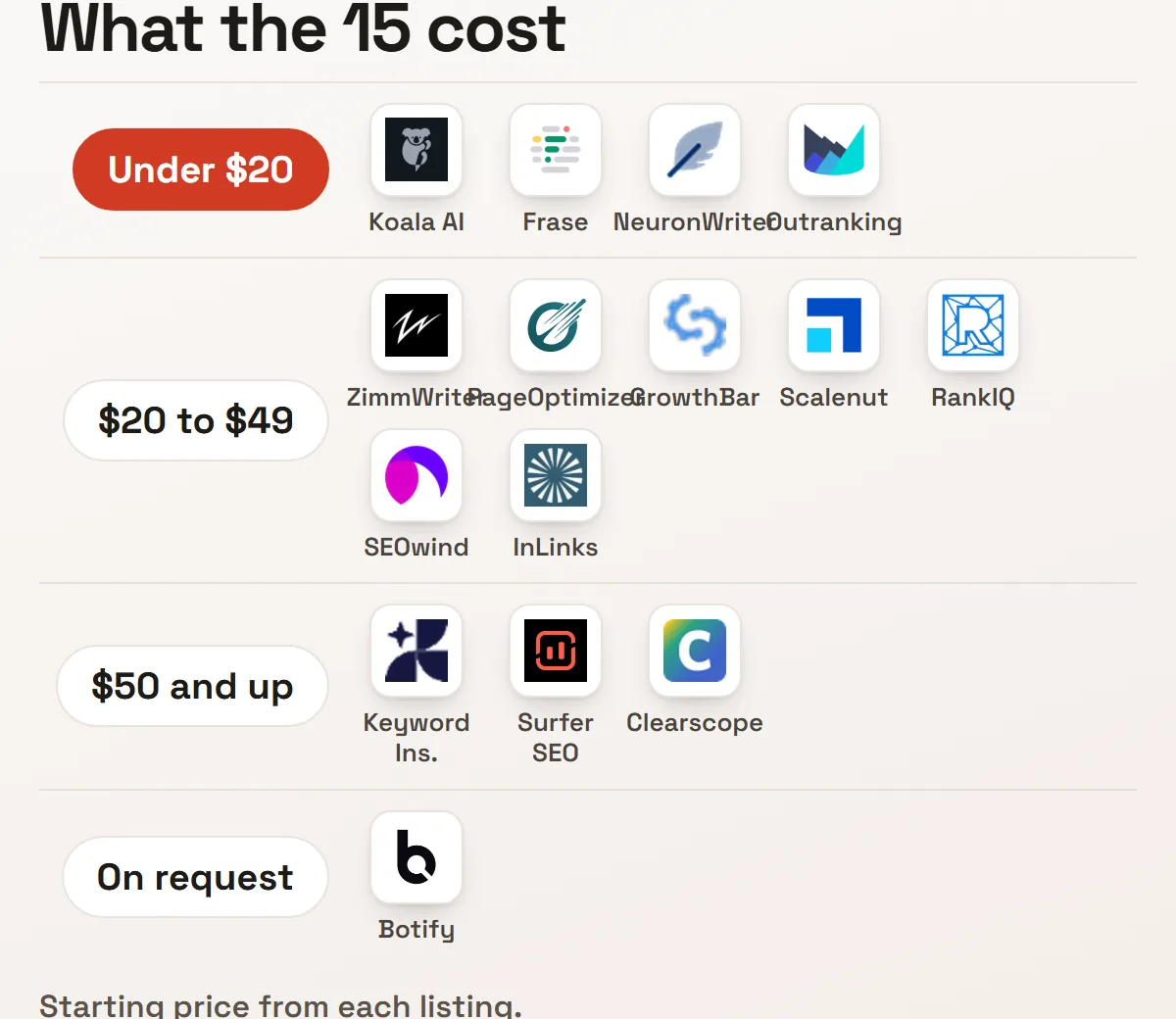
| Scalenut | 4.5 | No | $39 | Research through to draft |
| Keyword Insights | 4.5 | No | $58 | Deciding what to publish |
| Surfer SEO | 4.5 | No | $79 | Scoring plus drop alerts |
| Koala AI | 4.4 | Yes | $9 | Cited drafts on a budget |
| ZimmWriter | 4.4 | No | $25 | Bulk output, own model keys |
| PageOptimizer Pro | 4.4 | No | $34 | Research-backed page scoring |
| GrowthBar | 4.4 | No | $36 | Newcomers to SEO tooling |
| RankIQ | 4.4 | No | $49 | Individual bloggers |
| SEOwind | 4.4 | No | $49 | Agencies reselling content |
| Clearscope | 4.4 | No | $189 | Editorial teams in Google Docs |
| Botify | 4.4 | No | On request | Enterprise technical work |
| Frase | 4.3 | Yes | $15 | Brief and draft in one place |
| InLinks | 4.3 | Yes | $49 | Internal links and schema |
| NeuronWriter | 4.3 | No | $19 | Scoring at a low price |
| Outranking | 4.3 | No | $19 | Scores you can show a client |
1. Scalenut
Scalenut connects keyword research, planning and writing into one sequence through a feature it calls Cruise Mode. You pick a topic, it builds an outline, and the outline carries into a full draft without changing tools.
Scoring against live search results sits inside that same flow, so research findings reach the draft instead of a separate document. It’s been running since 2021 out of India, and it handles content in more than one language.
Plans start around $39 a month with no free tier to test first. The guided sequence is also the limitation: if you’d rather mix a brief from one tool with a draft from another, a step-by-step flow gets in the way.

2. Keyword Insights
Keyword Insights takes a large unsorted keyword list and groups it by what the searcher wants, then turns those groups into briefs. It’s the spreadsheet job nobody enjoys, done automatically.
That puts it a stage earlier than the scoring tools further down this list. Clearscope and Surfer both assume you’ve picked your keyword; this one helps decide which pages should exist.
Pricing starts around $58 a month and there’s no free plan. The limit follows from the design: with a single target keyword already chosen, clustering has nothing to do, so smaller sites get less from it.
3. Surfer SEO
Surfer SEO built its name on a live content score in its editor, guiding term use and structure as you write. Founded in 2018, it sits in the same space as Clearscope and NeuronWriter below.
Its newer half is alerting. Surfer flags ranking drops, and it names the competitor being cited by a chat assistant instead of you. That’s a signal the older scoring tools don’t watch.
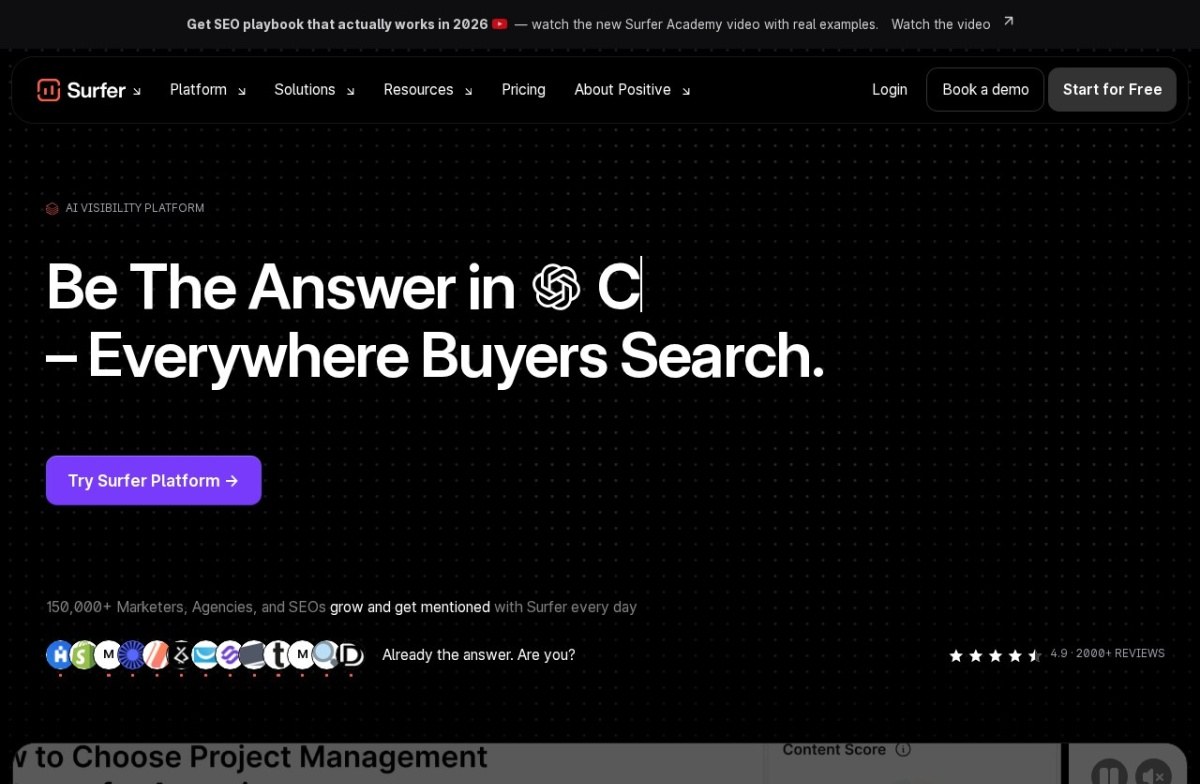
A free trial gets you in, though the price list lives on a separate page rather than the homepage. Our listing records $79 a month as the entry point. The visibility features are newer than the scoring engine and less proven.
4. Koala AI
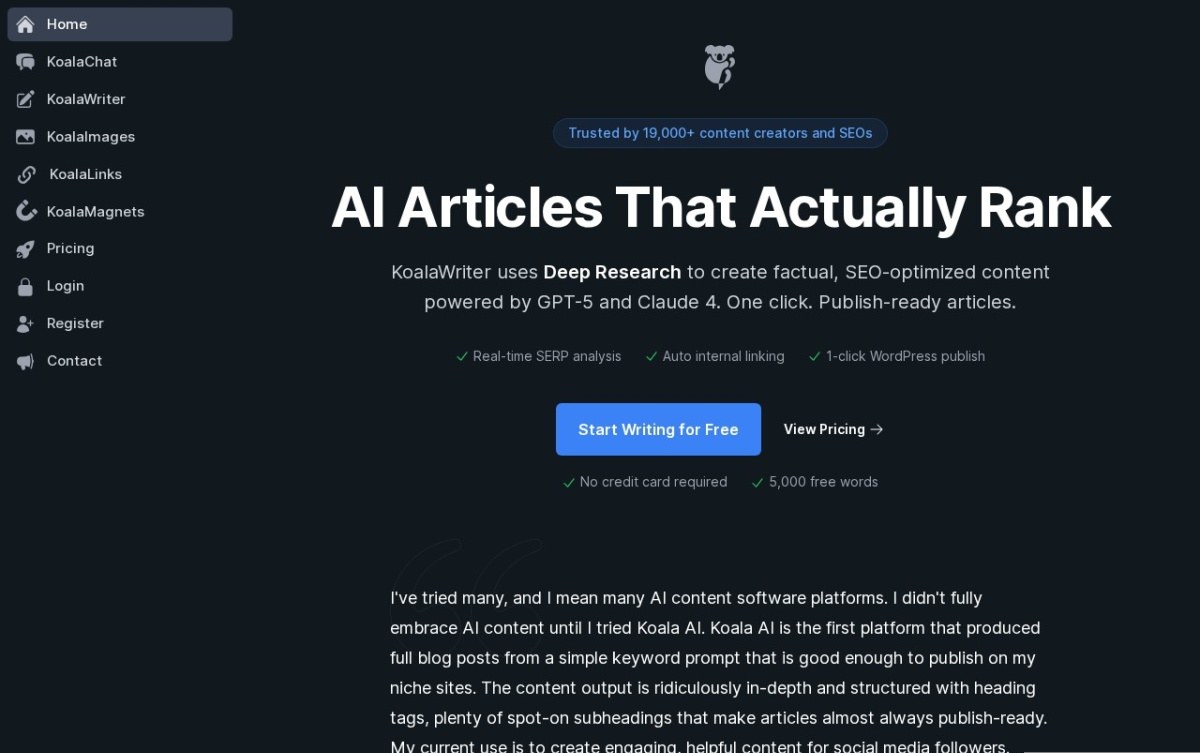
Koala AI writes long-form articles through KoalaWriter, and its Deep Research Mode pulls from current sources rather than the model’s training data alone. Live search analysis feeds the semantic terms in.
Its internal linking runs at a scale few competitors match, with more than 10 million links created across customer sites by the company’s own count. There’s also a dedicated generator for Amazon affiliate articles.
The free tier covers 5,000 words with no card, and paid plans start near $9 a month. Grounded generation takes longer than template-based writing, and the affiliate specialism is wasted if you don’t publish that kind of page.
5. ZimmWriter
ZimmWriter is Windows desktop software, not a browser dashboard, and it generates up to 1,000 articles in a single batch. Revindir LLC has run it since 2022.
Its billing is the real difference. You connect your own provider keys and pay those providers directly, so there’s no subscription markup on usage. A quiet month costs you the licence and nothing else.
That licence runs about $24.97 a month or $247 a year. Two costs come with it: Windows only, and you manage provider keys and their billing yourself instead of seeing one invoice.

6. PageOptimizer Pro
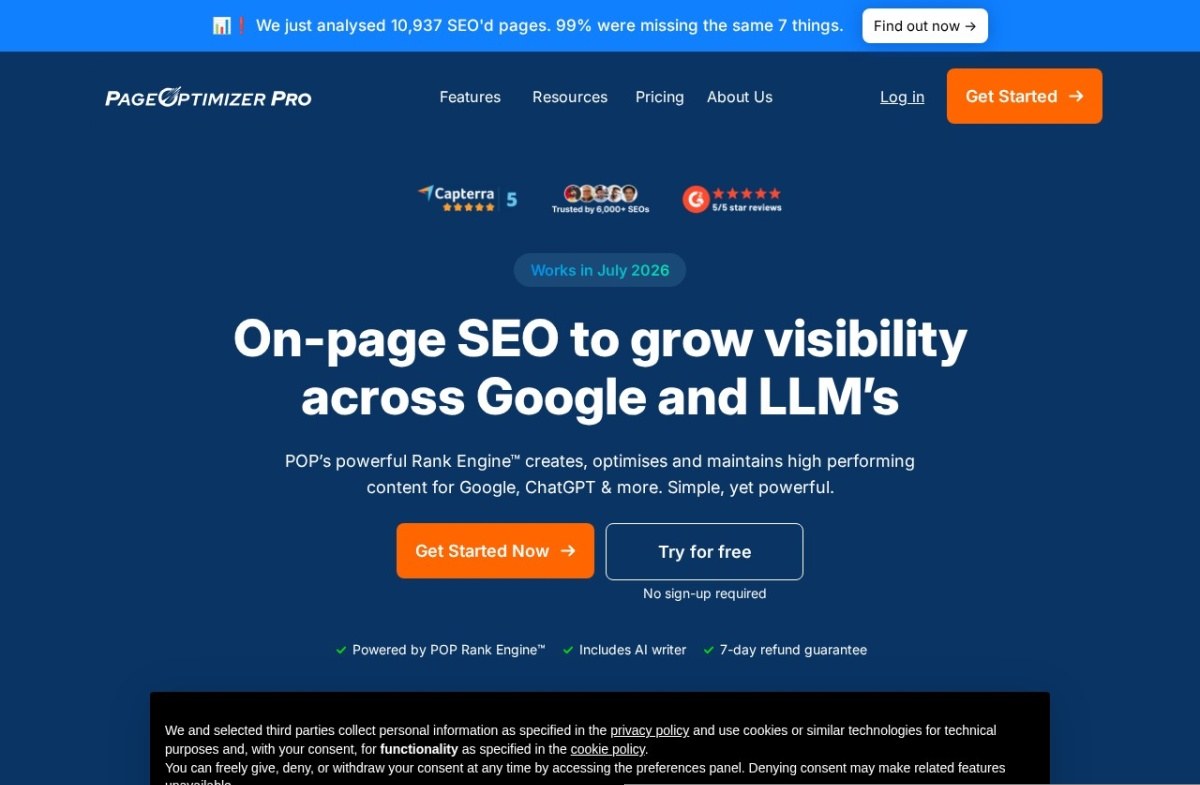
PageOptimizer Pro scores pages from a Rank Engine built on more than 400 peer-reviewed experiments across 300-plus on-page parameters. Most rivals score by matching terms against whatever ranks today.
It also audits more than 100 trust and authority signals, which competing scoring tools mostly skip. Support runs to 61 languages, and it’s been going since 2016.
Our listing records $34 a month, and pairing it with your own model key costs roughly $1 per optimised article. Two catches: the main site doesn’t publish its prices, and the research-led method takes longer to learn than a simple score.
7. GrowthBar
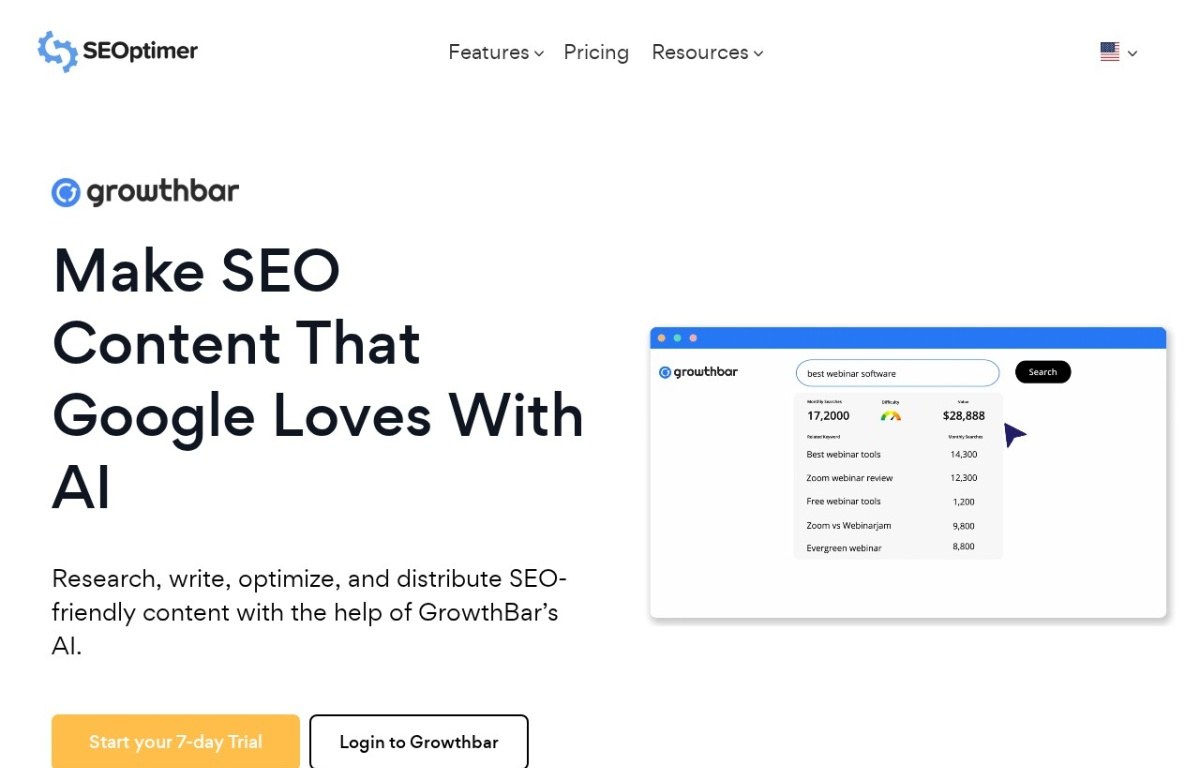
GrowthBar puts keyword data, competitor data and AI writing behind a Chrome extension that draws on top of the results page you’re already looking at. It started in 2020.
One thing our listing hasn’t caught up with: growthbarseo.com now redirects to seoptimer.com/growthbar, and the product sits inside SEOptimer’s site. It’s still sold as GrowthBar, so treat the ownership as changed rather than the tool as gone.
Pricing starts around $36 a month with no free plan. The extension-first design that makes it approachable also caps how far it goes on technical work, and it isn’t built for running dozens of client sites.
8. RankIQ
RankIQ aims at one reader the rest of this list mostly ignores: the individual blogger. Brandon Gaille built it around a curated keyword library instead of open-ended research.
Its report analyses what already ranks for a chosen keyword and produces a brief, which feeds its optimiser. A widely cited study of Mediavine blogs found those using it grew Google traffic 468% more over a year than comparable blogs that didn’t.
It costs about $49 a month with no free plan. The curated library is the trade: it removes the hard part of research, and it also limits you to keywords somebody else picked.

9. SEOwind
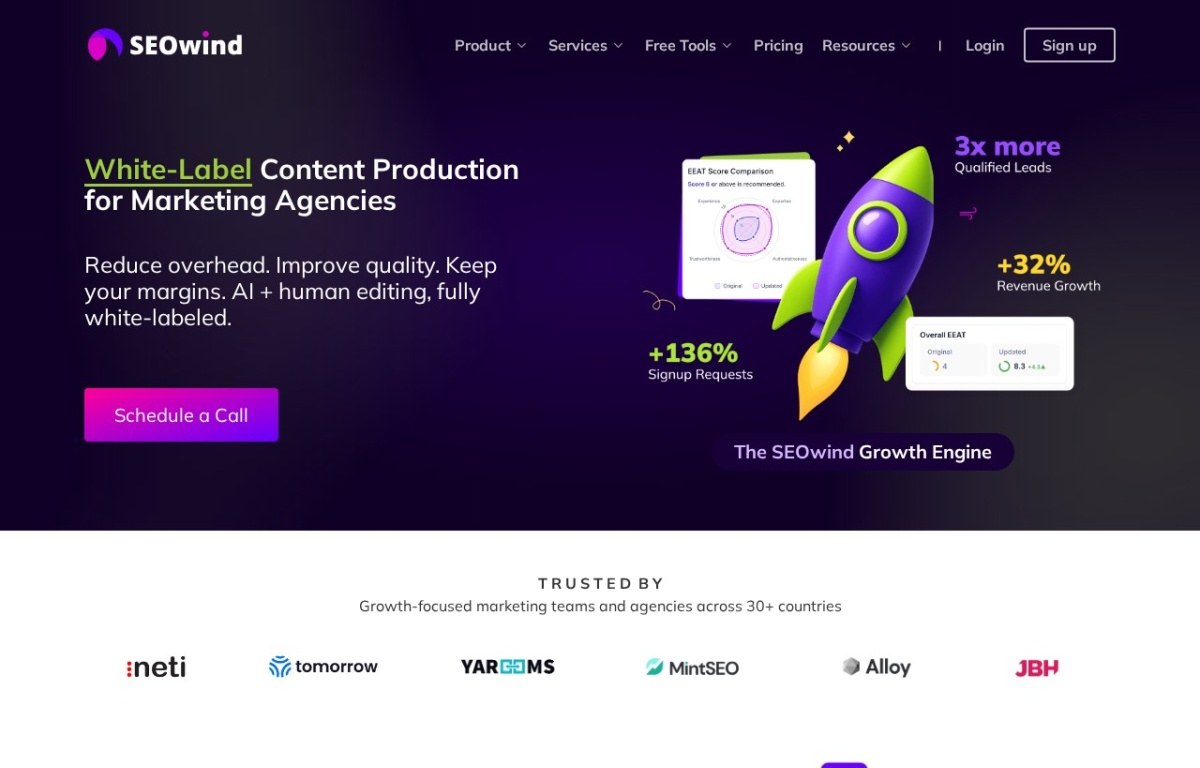
SEOwind writes long-form articles from search and competitor research, and packages the output white-label for agencies to resell under their own brand. Former agency operators founded it in 2021.
That assumption of a middleman shapes the whole product. Plans are built around content volume for client workloads, where RankIQ above assumes one person writing for one site.
Our listing records $49 a month as the entry point, though the pricing sits behind a separate page. If you’re a single site owner, you’re paying for packaging you’ll never use.
10. Clearscope
Clearscope popularised content grading: it reads the pages ranking for your keyword and scores your draft on the terms and depth they share. Mushi Labs launched it in 2016.
The grading runs inside Google Docs and WordPress rather than in a separate window, so a writer never leaves the document. That integration is why editorial teams keep choosing it.
It’s the most expensive entry here at about $189 a month, with no free plan. Its own success is the catch: newer tools copied the scoring model and charge a fraction of this.

11. Botify
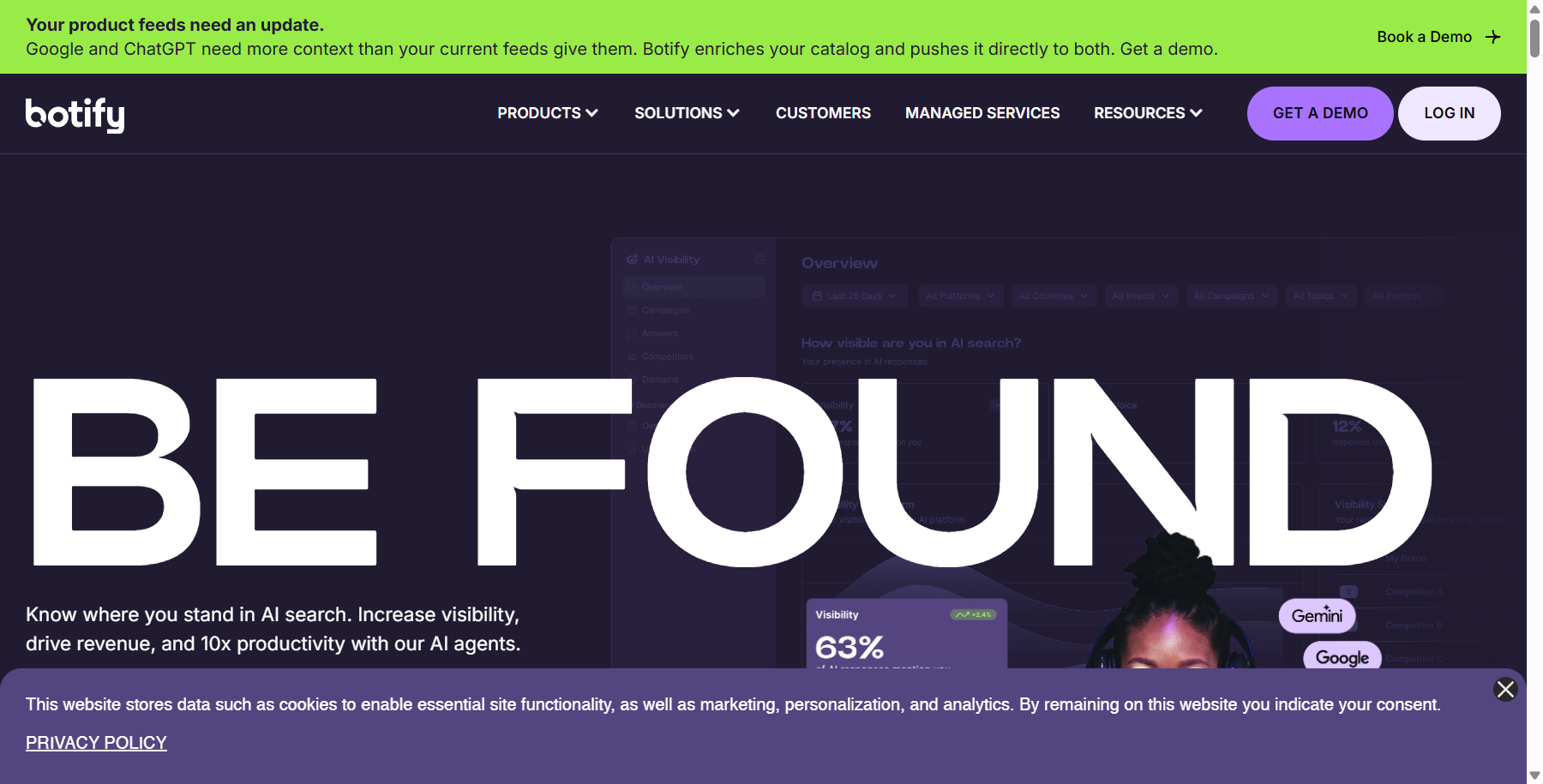
Botify has done enterprise technical SEO since 2012, founded in Paris by Adrien Menard, Thomas Grange and Stan Chauvin. Crawl analysis and indexation at large-site scale came long before the current wave.
It now pairs that with automation: deployment tools that apply changes, bot-rendering work, and catalogue enrichment aimed at AI shopping agents. It serves more than 500 enterprise customers as an official Google and Microsoft Bing partner.
Pricing goes through sales with nothing published and no trial. The depth that suits a retailer with a million pages is the same depth that makes it wrong for a blog.
12. Frase
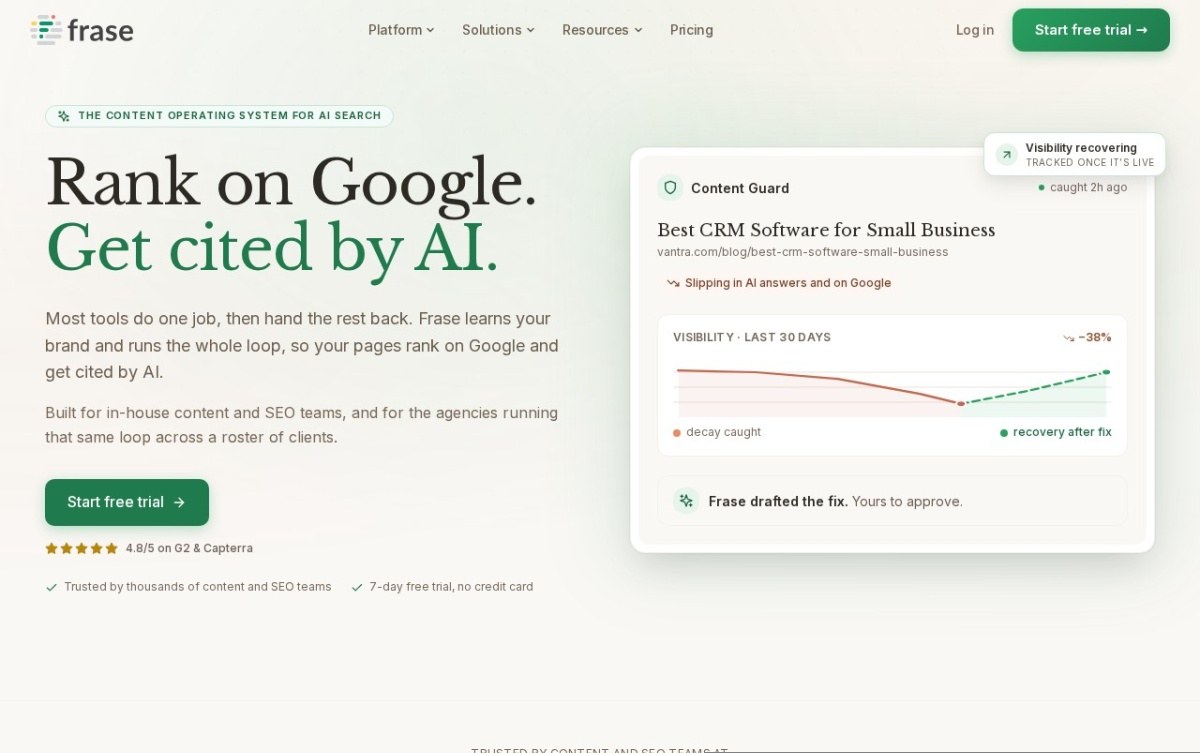
Frase reads the pages ranking for your keyword in real time, pulls out the questions and headings they cover, and builds a brief from them. Then you draft against that brief in the same window.
Keeping both steps together is the point. The research that built the brief stays visible while you write, instead of sitting in a document you closed an hour ago.
A free tier covers standard use and paid plans start near $15 a month, the cheapest paid entry on this list. Grading depth doesn’t reach Clearscope’s, and briefs need a settled topic with real competitors to work from.
13. InLinks
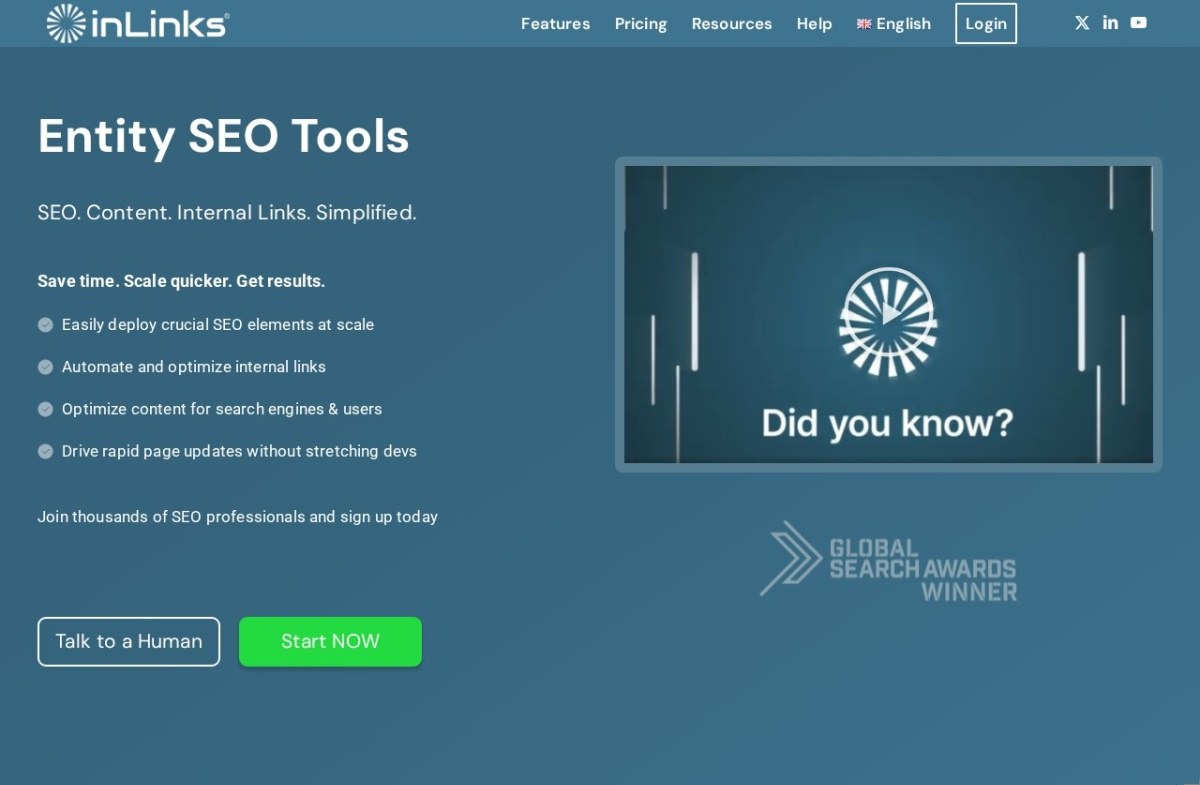
InLinks works from entities rather than term counts. A knowledge graph reads what your pages are about, then describes those people, places and concepts to search engines directly.
Two chores fall out of that. It suggests internal links from real topic relationships, and it writes your schema markup, which most content tools leave to a developer. Over 23,000 people use it.
A free plan covers light use and paid plans start around $49 a month. The entity model takes longer to learn than term matching, and link automation pays off on big sites more than small ones.
14. NeuronWriter
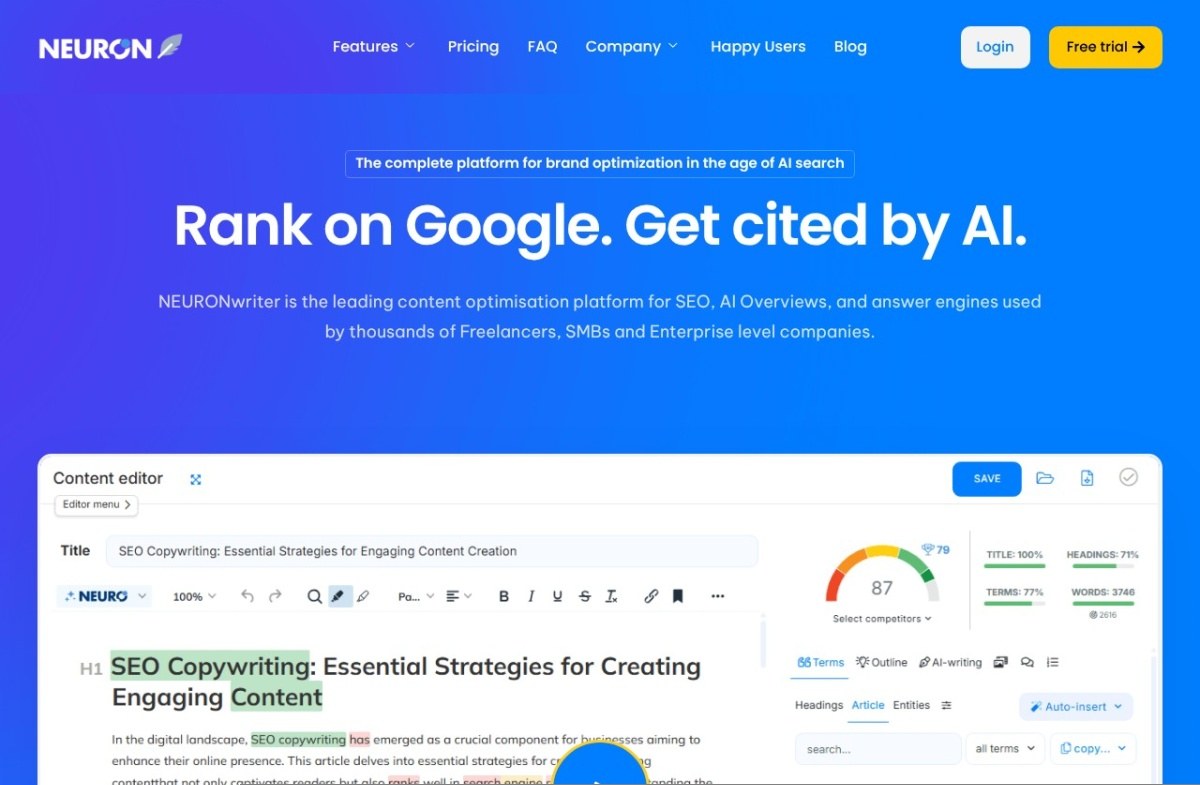
NeuronWriter builds content plans from live search analysis, surfacing the terms, questions and structure that ranking pages already share. Contadu has built it out of Poland since 2018.
The capability tracks Surfer and Clearscope closely. The price doesn’t: it starts around $19 a month where those two start at $79 and $189.
There’s no free plan to try first. It carries less tooling around the edges than the bigger suites, and a smaller name means fewer tutorials when you get stuck.
15. Outranking
Outranking runs clustering, briefs, drafting and scoring in one workflow. Its Concepts feature grounds a draft in the pages currently ranking, rather than whatever the model produces unprompted.
Its score is deliberately explainable. Hit terms, missed terms, word count and headings are all visible, which makes it defensible in a client report and easier to teach a new writer.
Plans start near $19 a month. Document and seat limits on that tier bind quickly for a growing agency, and going past them means a sales conversation rather than a published price.
How to choose between them
Start with the job, not the rating. If you don’t know what to publish next, clustering answers that and scoring can’t. If you know the topic and the draft reads thin, a grader fixes it faster.
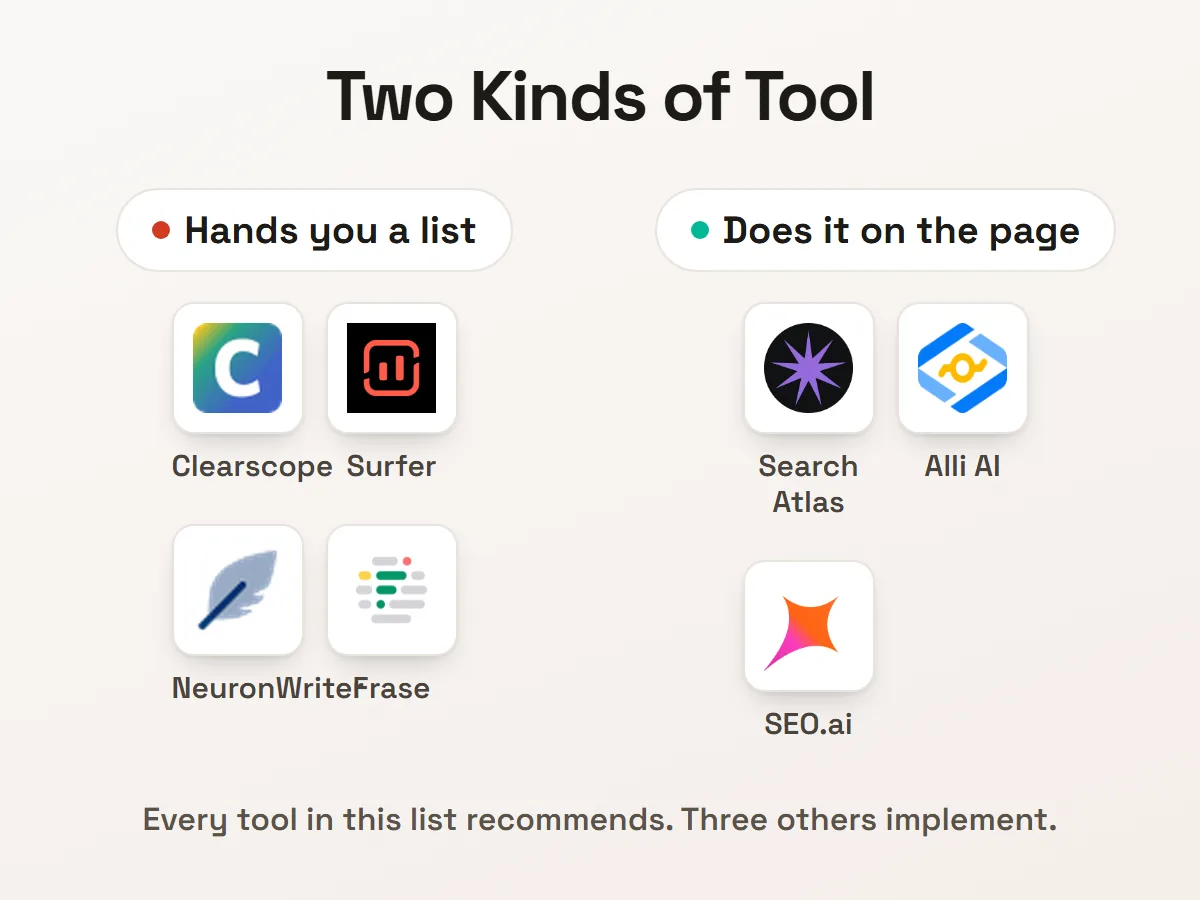
Then ask who implements. Every tool above hands you a recommendation, and three others in our catalogue apply the change for you: Search Atlas, Alli AI and SEO.ai.
All three rate 4.3, the same as this list’s last four, and they lost the tiebreak on price rather than on merit. Auto-applied fixes need review, because a change you didn’t approve still ships to a live page.
Then check the bill against your output. Four of the fifteen start above $49 a month, which is hard to justify at two posts a month.
For the groundwork under all of this, our guide to the importance of SEO covers what the scores are approximating. Our B2B SaaS SEO strategy piece works through the planning these tools speed up.
Questions buyers ask
What is a content score?
A content score is a number comparing your draft against the pages already ranking for your keyword, counting shared terms, depth and structure. It predicts nothing on its own. Eight tools here produce one, and they don’t agree with each other.
Which of these have a free plan?
Three: Koala AI, Frase and InLinks. Surfer SEO and PageOptimizer Pro run trials instead. The remaining ten want payment up front, and Botify quotes through sales.
Can one of these replace an SEO agency?
No, and the listings don’t claim it. They remove the manual work in research, grading and internal linking, which is what lets a small team compete at all. Deciding what deserves a page stays with a person.
Do these tools help with AI search as well as Google?
Some do. Surfer SEO alerts on chat citations, Botify tracks answers alongside classic search, and InLinks feeds structured data that assistants read. For tracking alone, the seven in our brand monitoring roundup fit better.