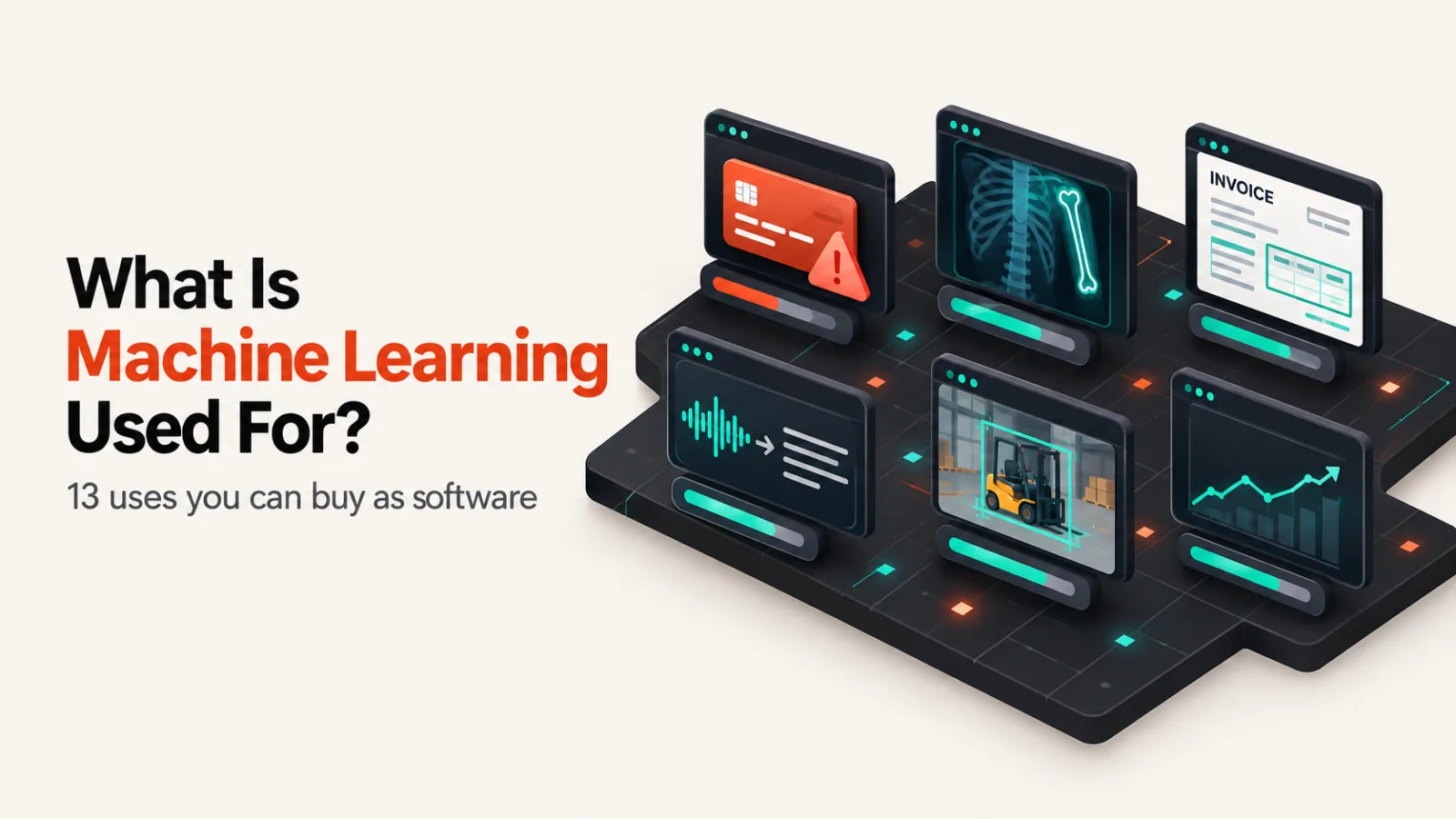
Machine learning is used for 13 jobs you can already buy as software. It spots fraud and cyber attacks, predicts credit risk, demand and prices, reads X-rays, invoices and speech, and ranks what a shopper sees.
You won’t often find it sold under its own name. Of the 4,361 listings in our catalogue, only 25 use the words machine learning in their one-line description, while 496 say agent or agents.
That’s because the technique is sold by the job it does, so this page is organised by job. Each one names the listings that do it, what they charge and where the model falls short.
Of the 25 products named below, 16 publish no price. The nine that do mostly meter it: by the minute, the device, the user or the search request. We read each vendor’s site from a US server on 7 October 2026.
How the 13 uses are grouped
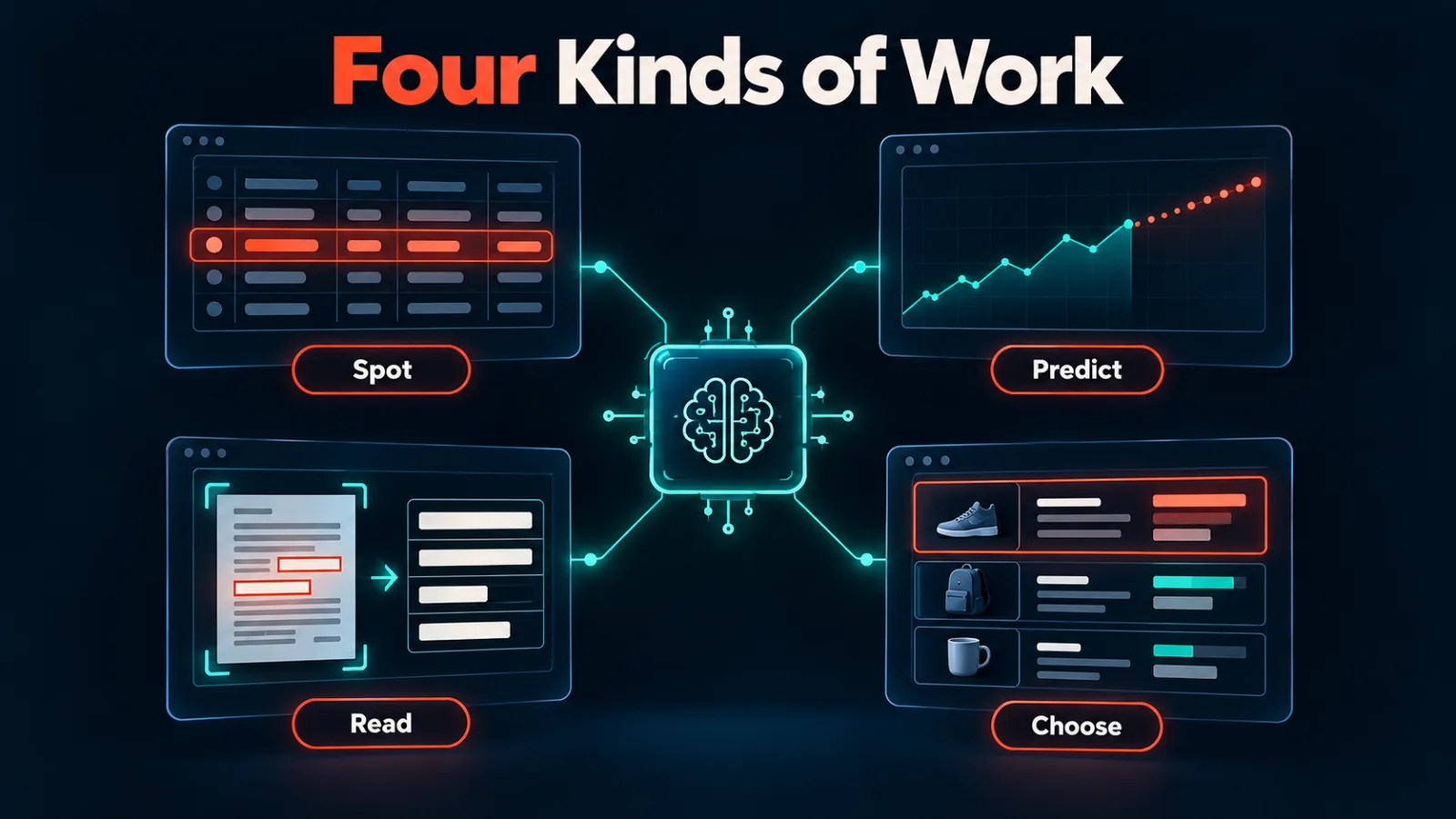
Every use below is one of four kinds of work: spotting what doesn’t belong, predicting a number, reading what people used to read, or choosing what to show. The uses are grouped that way, not ranked.
In every case the software learned its rule from examples instead of being handed one by a programmer. A fraud model learned from past payments, a speech model from recorded audio.
Inside a group, the listing with the higher editorial rating is named first. That rating is our editorial assessment of published feature, plan and pricing data, and it isn’t a lab score.
Spotting what doesn’t belong
Fraud and financial crime
A fraud model scores each payment as it happens, using patterns learned from past transactions. Anything unlike the customer’s normal behaviour is held or sent for review.
Feedzai sells what it calls an AI-native platform for fraud and financial crime prevention, aimed at banks and fintechs. Hawk AI covers money-laundering monitoring, payment screening and fraud, and says its explainable AI reduces false positives.
Neither publishes a price, and both sell through a demo. The limit is the false positive: every fraud model blocks some honest payments, and fraudsters change tactics, so it has to keep learning.
Our comparison of AI fraud detection tools for banking covers more of this market.
Cyber threat detection
Security software applies the same idea to computers and networks. It learns what normal activity looks like, then flags or blocks what isn’t.
CrowdStrike describes its Falcon platform as AI-native cybersecurity, and its 4.6 is the highest editorial rating on this page. Darktrace says its AI learns each organisation’s own patterns and interrupts attacks in progress within seconds.
CrowdStrike is one of the nine with a public price. Falcon Go costs $59.99 per device a year, or $7.99 a month. Darktrace publishes none and offers a free trial.
A model of normal needs time to learn your network. Until it has, it’ll flag unusual work that turns out to be innocent.
Anomalies in business numbers
The same watching works on revenue, costs and sign-ups. A model learns each metric’s usual rhythm and raises an alert when one breaks it, so nobody has to stare at dashboards.
Anodot does this for payments, subscriptions and ad campaigns, grouping related anomalies into a single incident. A banner on its site says it’s now a Glassbox company.
It publishes no price. The limit is noise: a model that alerts on every blip teaches people to ignore it, so check how alerts are grouped before you buy.
Predicting a number
Credit scoring and insurance underwriting
Lenders and insurers were buying machine learning long before chatbots arrived. The model takes an application and returns a risk score, learned from how past loans or policies turned out.
Gradient AI builds underwriting and claims models for insurers and cites more than 300 enterprise deployments. GiniMachine is no-code credit and collection scoring that promises a predictive model in a few clicks.
Neither publishes a price, though GiniMachine offers a free trial. The limit is explanation: a refused applicant will ask why, and so will a regulator, so a score nobody can explain is a liability.
Demand, weather and staffing forecasts
A forecasting model turns history into a number for tomorrow: megawatts, patients, orders.
Jua AI builds an AI weather model that it says is in production at utilities, energy traders and hedge funds. In-House Health predicts patient numbers for each hospital shift and schedules nurses around the forecast.
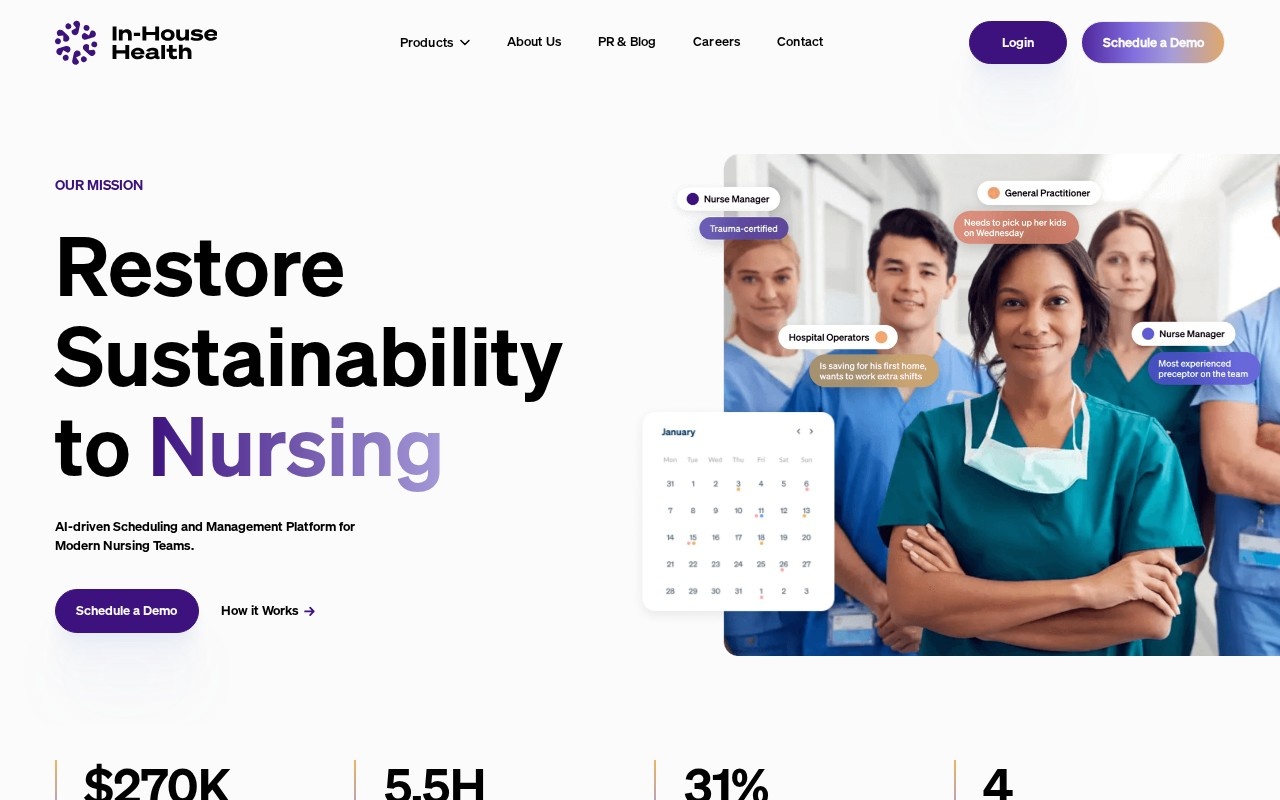
Neither publishes a price, and both start with a demo. A forecast is a probability, not a promise, and it’s least reliable for the rare event you most wanted warning of.
Pricing
Retailers use machine learning to set prices. The model estimates how demand moves when a price changes, then recommends a price for each product.
Competera sells this to enterprise retailers in two editions. One is a statistical engine built on price elasticity, and the other is a neural network that reads more than 20 demand factors.
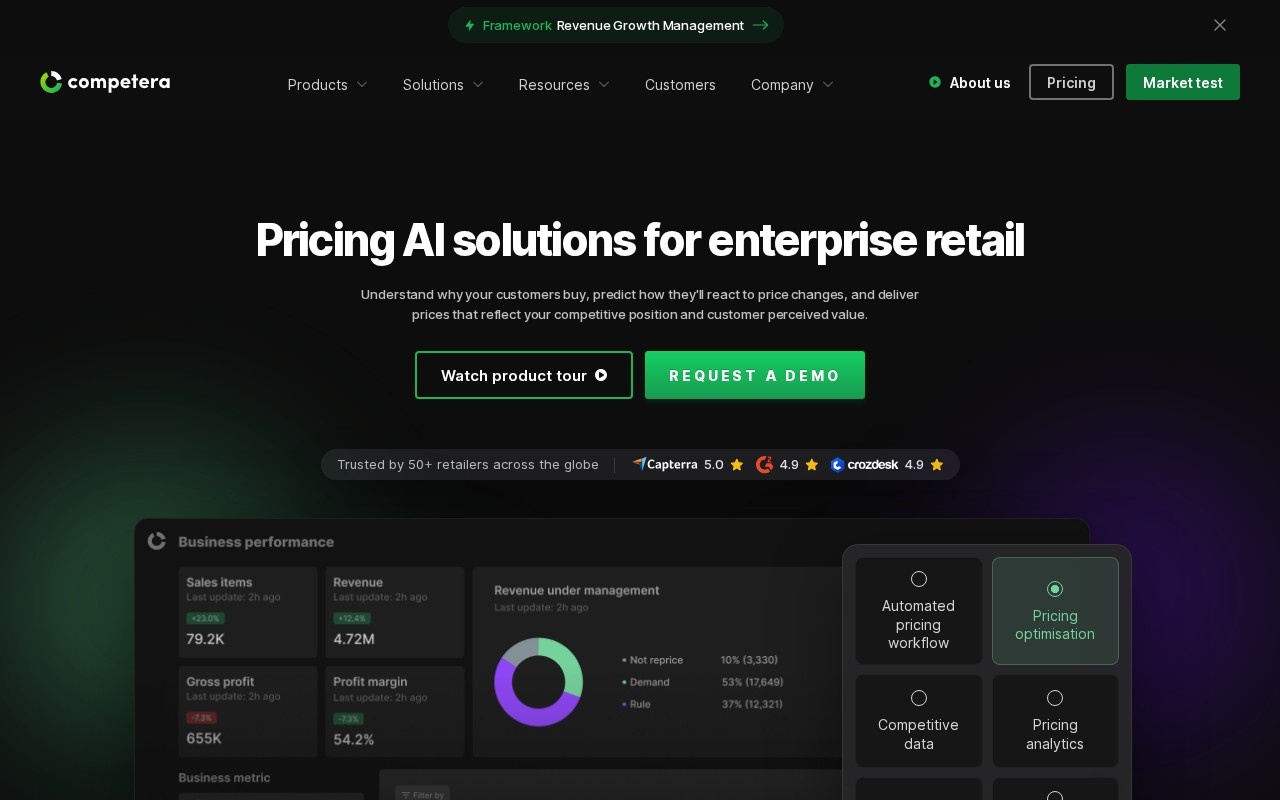
Both go through sales, with no published figure. The catch is history: Competera’s page asks for at least three months of data for the first edition and two years for the second.
Churn prediction
A churn model scores each subscriber on how likely they are to cancel, so a retention offer reaches the people it could keep.
Subsets does this for consumer subscription businesses, pairing the prediction with A/B tests and automated retention flows. It publishes no price.
Knowing who’s likely to leave isn’t knowing why. The score only pays for itself if you have something to offer the people it names.
Reading what people used to read
Medical imaging
Imaging models learn from scans that specialists have already labelled, then mark the same findings on new ones.
AZmed reads X-rays for fractures and chest abnormalities, and says its Rayvolve suite now covers eight FDA-cleared findings. PathAI sells a digital pathology platform with FDA 510(k) clearance.
A February 2026 press release on PathAI’s site says Labcorp is deploying that platform nationwide. Neither vendor publishes a price, and hospitals and labs buy through sales.
A clearance covers named findings, not radiology as a whole. The software supports the specialist, who still makes the diagnosis.
Pulling data out of documents
Document models read invoices, orders and forms, find the fields that matter and pass them to your other systems.
ABBYY sells FineReader for scanned and digital documents, plus a platform it calls purpose-built AI document processing. Rossum.ai handles transactional paperwork such as invoices, and its site announces that Coupa has acquired it.
Both publish a price. FineReader PDF Standard costs $16 a month or $99 a year. Rossum’s Starter plan begins at $18,000 a year, and a 14-day trial is available.
A person still checks the fields the model isn’t sure of. Rossum lists that step, human in the loop, as a feature of its entry plan.
Speech to text
Speech recognition is the machine learning most people have already met. The model learned from recorded audio paired with transcripts, and it turns new audio into text.
Otter.ai applies it to meetings, with live transcripts, summaries and action items. Google Cloud Speech-to-Text sells the same capability to developers, in more than 125 languages.
Otter’s free Basic plan includes 300 transcription minutes a month, and Pro lists at $16.99 per user a month. Google’s standard rate is $0.016 a minute.
Accuracy still drops with crosstalk, strong accents and poor microphones, so check a transcript before you quote from it.
Translation
Translation models learned from text that people had already translated, which is why they’re strongest in widely used language pairs.
SYSTRAN, which dates its translation work to 1968, covers 55 languages and can run on a customer’s own servers. Intento automates enterprise localisation with translation models and AI agents, and cites more than 650 languages.
SYSTRAN Translate Pro Plus costs $18.99 per user a month on an annual commitment, or $25.99 without one. Intento sells through a demo.
Fluent output can still be wrong, so contracts and medical text need a human reviewer. Our comparison of AI translation tools looks at ten of them.
Cameras that watch for hazards and stock
Computer vision models learn what a forklift, a hard hat or a pallet label looks like, then watch for them without a break.
Intenseye runs on a site’s existing cameras to detect more than 50 types of workplace hazard, and says it uses no facial recognition. Gather AI puts cameras on forklifts and drones to read warehouse inventory.
Intenseye’s pricing page says one subscription per camera and gives no figure, and Gather AI sells through a demo. A camera only sees what’s in front of it, so coverage decides the result.
Choosing what to show
Search ranking and recommendations
Every search box and every row of suggested products is a ranking problem. The model learns from clicks and purchases which results people wanted, then reorders the next page.
Algolia sells search and recommendations to developers and counts more than 18,000 customers. Bloomreach uses its Loomi AI to personalise email, web, mobile and search for each shopper.
Algolia’s free plan covers 10,000 search requests a month, and its Grow plan charges $0.50 per 1,000 after that. Bloomreach asks you to request pricing.
Ranking models need behaviour to learn from, so a new shop with little traffic gets less out of them.
What the prices tell you
Sixteen of the 25 products above publish no price. They’re sold to banks, insurers, hospitals, retailers and warehouses, where the model usually learns from one customer’s own data and a sales team runs the deal.
The nine with a public price sell something more standard, so they meter it. Speech, translation, search and device security work much the same for every customer, and they’re charged per minute, user, request or device.
Nine in 25 is a lower share than the catalogue as a whole. Our AI tool pricing study counted a starting price on 2,618 of 3,969 listings in September 2026, about two in three.
The 13 uses, side by side
| Use | Listings named | Published price, 7 October 2026 |
|---|---|---|
| Fraud and financial crime | Feedzai, Hawk AI | None |
| Cyber threat detection | CrowdStrike, Darktrace | CrowdStrike, $59.99 per device a year |
| Anomalies in business numbers | Anodot | None |
| Credit scoring and underwriting | Gradient AI, GiniMachine | None |
| Forecasting | Jua AI, In-House Health | None |
| Pricing | Competera | None |
| Churn prediction | Subsets | None |
| Medical imaging | AZmed, PathAI | None |
| Document data | ABBYY, Rossum.ai | ABBYY, $16 a month. Rossum.ai, from $18,000 a year |
| Speech to text | Otter.ai, Google Cloud Speech-to-Text | Otter.ai, free plan, then $16.99 per user a month. Google, $0.016 a minute |
| Translation | SYSTRAN, Intento | SYSTRAN, $18.99 per user a month on an annual commitment |
| Camera monitoring | Intenseye, Gather AI | None |
| Search and recommendations | Algolia, Bloomreach | Algolia, free plan, then $0.50 per 1,000 requests |
Build it or buy it
All 13 uses above are bought as finished software. If your problem isn’t on the list, the alternative is to train a model on your own data.
TensorFlow is a free, open-source platform for doing that. Hugging Face hosts models other people have already trained, with a free hub and a paid account at $9 a month.
Our guide to the best machine learning software compares eight such tools. The Data and Analytics category lists more of the catalogue’s prediction and analytics tools.
Common questions
What is machine learning, in one sentence?
Machine learning is software that learns a rule from examples instead of being given the rule by a programmer. Show it enough labelled X-rays or past payments and it finds the pattern itself.
Is machine learning the same as AI?
No. AI is the broad aim of software that does things we’d call intelligent, and machine learning is the main way it’s built today. Every product on this page is both.
What’s the difference between machine learning and generative AI?
Generative AI is machine learning pointed at a different job. Most uses on this page classify, predict or rank, while a generative model produces new text, images or audio. Translation sits between the two.
How much does machine learning software cost?
From nothing to five figures a year. TensorFlow is free, Google’s speech service charges $0.016 a minute, and Rossum’s entry plan starts at $18,000 a year. Sixteen of the 25 products here publish no price at all.
Can a small business use machine learning?
Yes, through the metered products. Otter.ai and Algolia have free plans, a paid Hugging Face account costs $9 a month, and CrowdStrike’s Falcon Go costs $59.99 per device a year. The products without a public price mostly sell to larger organisations.
Do I need a data scientist?
Not for the 13 uses above, which are sold as finished products. You’d want one when you train your own model with TensorFlow or adapt one from Hugging Face.
Where does machine learning go wrong?
You’ll see it fail when the real world stops looking like the data it learned from. A fraud model meets a new scam, a speech model meets a new accent, and a forecast meets a year unlike the last five.