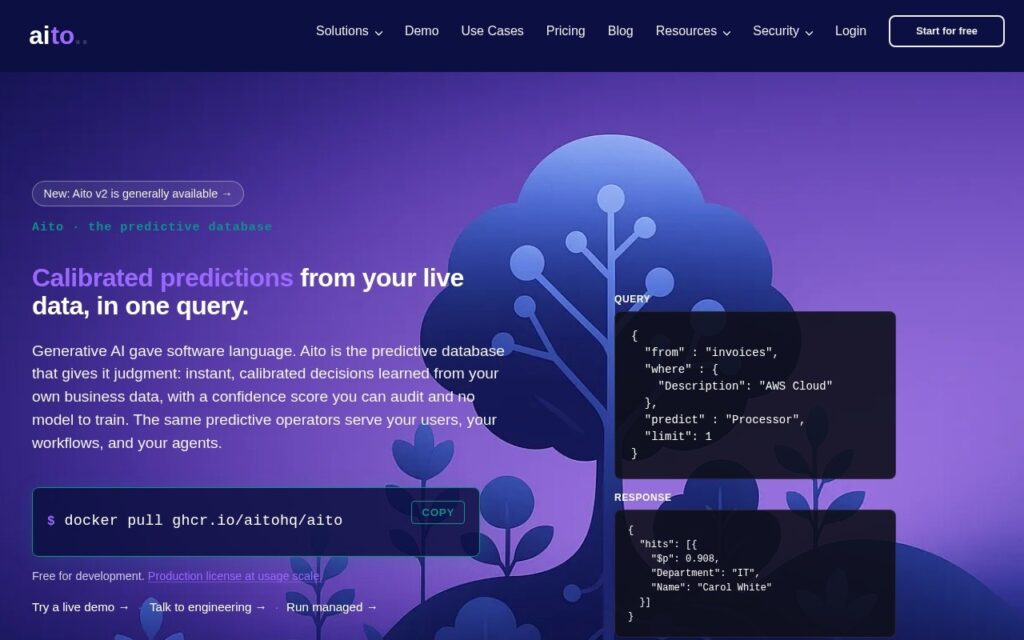
Aito describes itself as the predictive database. A developer loads business data such as invoices, tickets, purchase orders or product catalogs, then sends a query that names a table, a condition and the field to predict. The response comes back with the most likely values and a calibrated probability, so an application can decide what to process automatically and what to send for review. The company says there is no model to train and that every prediction carries a confidence score and an explanation that can be audited.
The use cases listed on the site include invoice general-ledger coding, purchase order routing, tag and category prediction, smart search with persona-conditioned re-ranking, recommendations, smart forms that predict the remaining fields once one is chosen, catalog gap-filling, pattern discovery and anomaly detection, where low confidence on a normal field is the signal. Aito also positions itself as a tool that LLM agents can call for fast, calibrated judgments, and the v2 release is announced as available to all. Aito can run self-hosted from a Docker image or as a managed instance on AWS in Ireland, which the site says is GDPR-ready with AES-256 and TLS 1.3.
The self-hosted Docker image is free for development with 10,000 rows per table and 50,000 rows in total, and a production license key lifts the caps at a custom price. Managed cloud tiers are priced in euros: Sandbox is free with 5,000 API calls a month, Dev is 75 euros a month with 500,000 calls and 500MB of storage, and Prod is 350 euros a month with unlimited calls and 1GB of storage. Enterprise deployments are by quote. Paid plans are not refunded for the current billing period when cancelled.