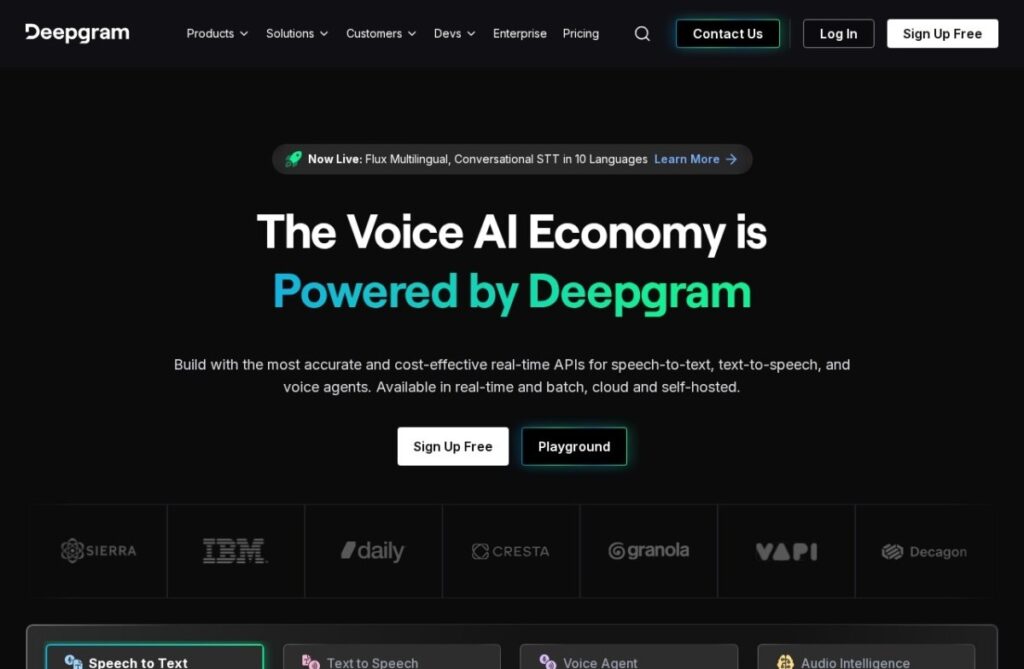
Deepgram has operated since 2015, among the older speech-to-text companies still active, and it trains its own speech recognition models from the ground up rather than fine-tuning an existing open model like Whisper. That from-scratch approach is the company's core technical claim: models built specifically for accuracy and speed at production scale rather than adapted from a general-purpose base.
Real-time streaming transcription is where Deepgram is used most: call centers, voice agent platforms, and live captioning systems rely on its API to transcribe speech as it happens rather than after a recording finishes, a harder technical problem than batch transcription of a finished file. Enterprise customers in telecom and customer support make up a meaningful part of its business.
Pricing runs on usage-based API rates with free credits for testing before production deployment. For an engineering team building a voice agent or call-analytics product that needs fast, accurate real-time transcription at scale, Deepgram's from-scratch models and streaming focus target that specific technical requirement more directly than general-purpose transcription APIs.