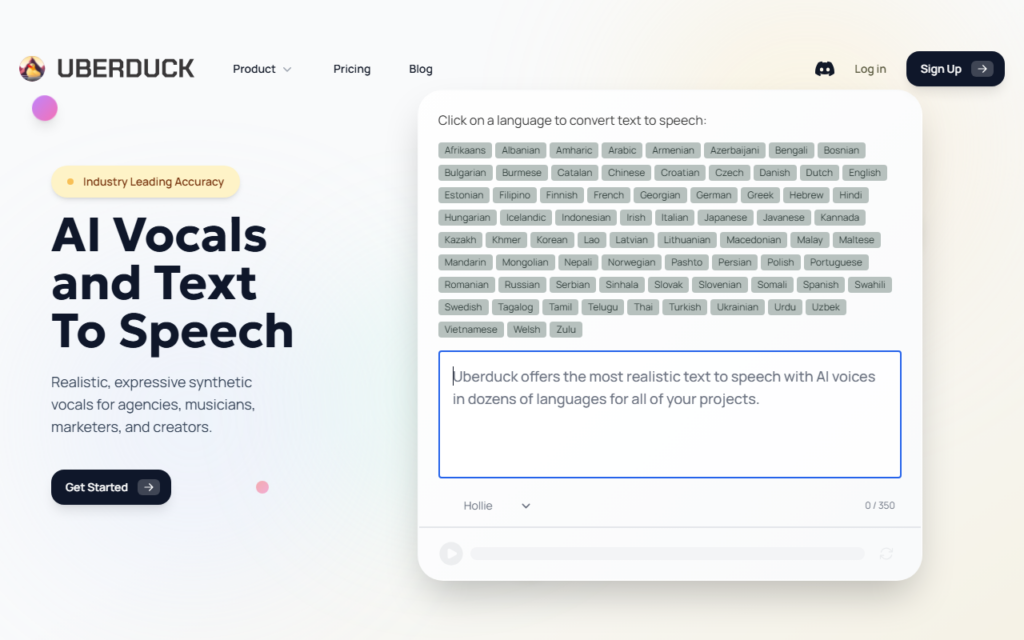
Uberduck covers synthetic vocals across text to speech, voice cloning and speech-to-speech conversion, with API access for programmatic use. Its distinguishing angle is musical rather than corporate: it is built for making vocals for tracks, supporting more than 70 languages and a wide range of musical styles.
Speech-to-speech conversion is the more interesting capability. Recording a performance and converting the voice keeps the human phrasing and timing that pure text to speech flattens, which is exactly what matters when the output is music rather than narration.
Voice cloning carries obvious ethical and legal weight, and consent for any cloned voice is the user’s responsibility rather than the platform’s. For music production and creative work the toolset is strong; for straightforward narration there are more focused options.
Pricing is provided as a guide. Check the official site for the latest plans.
Is Uberduck expensive?
Uberduck has no advertised paid tier. Among the 83 priced tools we list in Audio, the median entry price is $10 a month.
67% of Audio tools in the directory offer a free tier, and this is one of them.
Compared against every priced listing in Audio, recalculated as the catalogue changes. Method and the full market breakdown are in our AI tool pricing study.
Pros & cons
Pros
Music-oriented vocals rather than only corporate narration
Speech-to-speech keeps human phrasing that TTS flattens
Cons
Voice cloning places consent and rights entirely on the user
Trains custom AI singing and speaking voices for music production, with an audio plugin for the DAW, an API, and a free tier of 5 conversion minutes a month.