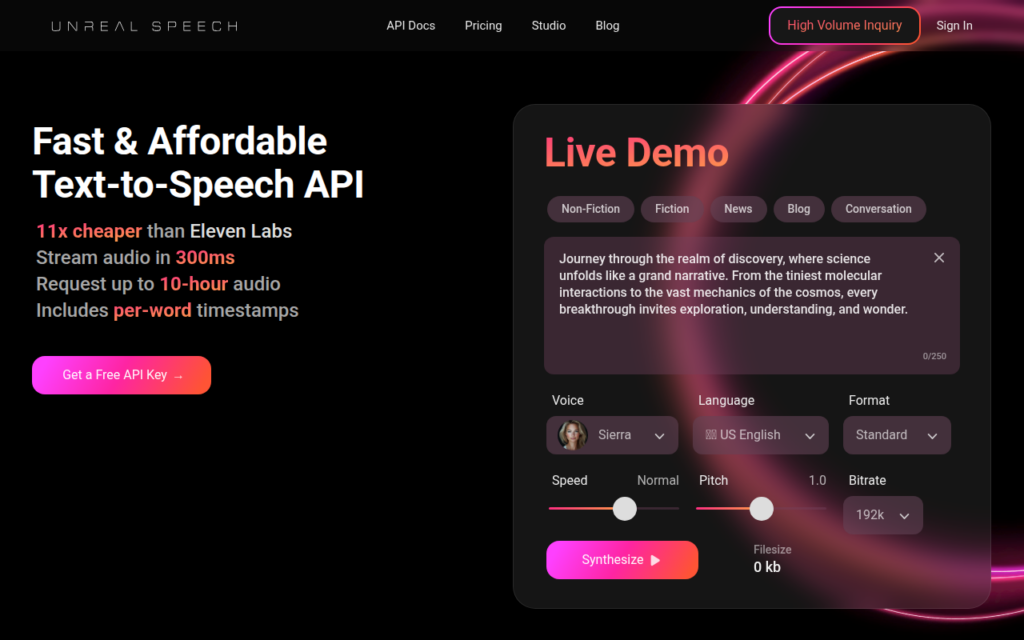
Unreal Speech competes on the two variables that decide whether text-to-speech is viable at scale: cost per character and time to first byte. It positions itself as substantially cheaper than the premium incumbents and streams audio in roughly 300 milliseconds, which is the threshold where a synthesised voice starts to feel conversational rather than delayed.
The feature set reflects a production rather than demo focus. It can generate very long audio in a single request, which matters for audiobook and long-form narration pipelines, and returns per-word timestamps, which is what makes caption alignment, karaoke-style highlighting and precise editing possible downstream.
The trade is breadth. With dozens of voices across a modest number of languages, it covers fewer options than the largest providers. For applications that need one good English voice at high volume and low latency, that is the right trade; for wide multilingual coverage it is not.