When was the last time you leisurely searched the Yellow Pages for a service provider? About 20 years ago, if that, right? Thanks to web search engines like Google, an infinite amount of information, shops and services are just a search query away.
And that’s exactly why you need search engine optimization if you want to get more visitors to your website and increase sales . But wait a minute: what is SEO? How does professional search engine optimization work and how long does SEO take? Get ready for a whole load of answers – here we go!
First of all : You don’t learn how to optimize for search engines in five minutes, and our guide is correspondingly extensive. Don’t have much time? Then you can easily jump to individual chapters with the table of contents on the left!
You will see that search engine optimization has nothing to do with magic. It’s about analyzing data, deriving an SEO strategy and implementing this strategy in the form of different SEO measures, divided into on – page and off-page optimization.
[toc]
No, I’m not saying that optimizing for search engines is trivial. Google makes the game more complex and elaborate every year. Rather, I want to make it clear that good results are no coincidence and investing in search engine optimization is not speculation.
What is SEO?
SEO ( Search Engine Optimization ) is nothing more than search engine optimization. Strictly speaking, it should be “optimization for search engines”, because that is the purpose behind the work. If you do it right, SEO measures will result in your page appearing in organic search results. Search Engine Results Pages (SERP), is displayed as close to the front as possible.
SEO is a subfield of Search engine marketing. Optimization can target different types of search engines, including image search (e.g. Google Images), video search (e.g. Google Video), news search (e.g. Google News) or vertical search engines (e.g. Booking.com).
And yes, theoretically you can also use this optimization for other search engines, such as Bing, Yahoo! And DuckDuckGo, operate – we are only talking about Google here, since this search engine is by far the most important with a market share of 75 percent worldwide and over 90 percent in the USA.
By the way, Google is not the top dog everywhere:
- China (Baidu)
- Japan (Yahoo! Japan)
- South Korea (Naver)
- Russland (Yandex)
- Czech Republic (Seznam)
You can find out the most important things about SEO in our 7-minute video!
How does search engine optimization work?
So-called keywords, which users search for via search engines, are central to optimization for search engines. As a company, it is essential that your website is found on the first page of search results for the keywords that match your offer.
Search engine optimization consists of a series of measures on and off the website so that it is listed as high as possible in the organic Google search results for a specific search term. And here’s some jargon:
- OnPage Optimization : Measures on your website, e.g. improving your meta elements, keyword or entity optimization of content on a landing page, responsive design, etc.
- OffPage Optimization : Actions outside of your site, such as collecting backlinks and mentions
- Keywords : Search terms
- Backlinks : A backlink is a link that leads from one website to another website.
- Organic Search Results (Natural Listings) : natural and non-paid organic search results
- Search engine ranking: ranking of search results
One note: don’t expect this to jump your page to #1 right away. It takes a lot of work, know-how and patience to make it there . With search engines, you have to earn visibility, so to speak.
At the same time, I have to note that SEO optimization is not actually about earned media . SEO is a process designed to help your media perform better. However, you can “earn” organic traffic through the optimization that you or your SEO agency has carried out. This makes organic traffic a form of earned media, even if the content on your site is owned media itself .
How is search engine ranking determined by Google?
The bottom line is that Google wants one thing above all: to offer users the searched result as quickly as possible and thus to satisfy them. Because then they keep coming back to that search engine, so Google can keep making money from ad sales. So much for the greatly simplified explanation.
Basically, the Internet is nothing more than a huge, huge library. So how does Google decide which works to show in the top 10? Very simple (at least on the surface): The factors relevance and authority are particularly heavily weighted. The Google algorithm therefore uses these factors, among others, when it evaluates a page:
- Content, english Content, on the page (relevance to search query, quality and expertise)
- Backlinks Backlinks, from other websites to the page ( domain popularity and link popularity are important SEO ranking factors as they reflect authority; Google uses PageRank as a metric )
- User signals, such as length of stay, engl. Dwell Time or quick return to Google search results. Shortclick, also called pogo sticking (user satisfaction)
- HTTPS, Mobile Friendly, Safe Browsing, Core Web Vitals (Page Experience)
In other words, if you want a page to rank for a specific keyword, that page needs to deliver what’s being searched for (also called search intent or search intent ). Can you still manage to build up a certain level of authority through backlinks and a satisfactory user experience? User experience, you have very good ranking chances.
And which SEO areas should you keep an eye on in 2025 to meet these Google requirements and increase your ranking chances? You will find out in this 3-part video series on current SEO trends!
Search Engine Submission
In the past, the inclusion in the index of various search engines was done by submitting the URL of the relevant page. A web crawler was then sent by the respective search engines to analyze the page and, if necessary, to index it.
Nowadays, a search engine registration is no longer necessary.
Search engines like Google, Bing and Yahoo! Also find new websites within a very short time. It is advisable to register a new website with tools such as Google Search Console or Bing Webmaster Tools . They provide reports and features to improve your visibility, notify you of issues, and allow you to see your site from a search engine’s perspective.
Google’s quality guidelines and rules for SEO
Google has general guidelines for webmasters that (if you follow them) will make your website easier to find (crawl), index (index) and rank (rank). In addition, the so-called quality guidelines describe illegal SEO measures, also known as search engine spamming.
Search engine spamming describes all methods to manipulate search engine rankings. If you use this kind of SEO measures, there is a risk that…
- Your visibility in the search results is permanently reduced or…
- In the worst case, your website will be completely banned from the Google index.
In principle, it is (almost) always possible to reverse Google penalties by removing the reason for the penalty and submitting a reconsideration request. Reconsideration Request made in the Google Search Console .
Colloquially, the optimization using unwanted methods on the part of the search engines is often referred to as Black Hat SEO (Black Hat Search Engine Optimization). The opposite is White Hat SEO (White Hat Search Engine Optimization).
Examples of illegal link building practices, also known as link spamming:
- Link farms eg building a private blog network, engl. Private Blog Network (PBN) using Expired Domains
- Link purchase, also in the form of sponsorship and remuneration with products
- Automated link building via blog comments, forum profiles, etc.
- Participation in link exchange programs (individual link exchanges are usually not a problem)
- Participation in guest article networks (individual requests are certainly allowed)
Examples of illicit on-page SEO practices:
- Hidden text
- Hidden Links
- Keyword Stuffing
- Bridge sides
- Automatically generated content
- Creating a large number of pages with thin content
- Copied Content ( Duplicate Content )
- Rich snippet markup abuse
Examples of other prohibited practices:
- Participation in affiliate programs without sufficient added value
- Misleading Redirects
- Cloaking
What is a search engine optimizer or SEO manager?
Good search engine optimization can do a lot – but it also requires a lot of commitment and expertise. That’s what SEO managers are for. Anyone who works in this branch of online marketing has all aspects of SEO in view and does the “background work”, so to speak, that is necessary for good rankings, including:
- Keyword research keyword research
- SEO strategy development
- Competitor analysis and reverse engineering of top competitors
- Technical Optimization Technical SEO, also known as on-site optimization
- OnPage Optimization On Page Optimization
- Linkaufbau, engl. Link Building
- Creation of a content marketing strategy and management of content marketing
What does SEO optimization bring?
You probably already guessed it: SEO doesn’t just happen on the side. Of course, the question arises as to whether the effort is really worth it. Well, see for yourself – here are 5 good reasons that speak for SEO:
1. Organic search is the most powerful and lucrative online marketing channel.
Organic search (Google) has become significantly better in recent years at delivering results that match the search intent of users. According to a study by BrightEdge , organic search accounts for 53.3{b2e062dacaa682ac06b65f50eda167b816e329330e76ab97664011f321ee08e4} of all web traffic . This makes organic search the most important source of visitors and the strongest online marketing channel.
Other interesting facts and figures from the study:
- In B2B, search (organic and paid search) delivers 76{b2e062dacaa682ac06b65f50eda167b816e329330e76ab97664011f321ee08e4} of visitors.
- B2B companies generate twice as much revenue from organic search than from other channels such as social.
- Google’s RankBrain has meant that the search engine has become even better at delivering the perfectly matching website content to a search query .
So what should companies think about?
- Content Marketing: Target group-oriented content increases visitor numbers and converts prospects into customers.
- Data – driven content strategies: To remain competitive, companies need to invest in search engine optimized content. This means content that is findable, optimized for intent, measurable and lucrative.
- Data analysis: To successfully optimize for search engines, a large amount of relevant and up-to-date data is required. This is the only way companies can really understand their target group and their tastes and deliver the ideal products and services.
2. Optimization for search engines is still in its infancy in German-speaking countries.
There’s a good chance your competition is in the back room discussing whether to try it yourself. If you get in now, you’re one step ahead – if not, you might be left behind. And no, this not only applies to small no-name companies, but also if you have already established your brand! “We’re known anyway” isn’t an argument you should rely on.
3. Results on page 1 of the SERPs are highly trusted.
True to the motto “There must be a reason why this is listed there”, we all tend to trust the top ranks the fastest. And finally, it is customer trust that you want to win – only satisfied customers will come back or recommend you to others!
4. With SEO content, you can pick up your target group in a wide variety of phases.
No one makes a purchase decision without first doing some research. So instead of just focusing on “Sales-Sales-Sales!”, you can use Google Optimization to get your attention early in the decision-making process . This way you can reach a much larger audience. In our graphic you can see which methods and content you can work with:
5. Search engine optimization delivers sustainable results.
Yes, it takes a while for a page to be fully SEO optimized and yes, you need a bit of patience to see the first results. In the long term, however, high-quality content and carefully maintained pages will become a sure -fire success and make themselves comfortable in the top rankings. From experience we can say: Google rewards thorough work – not only today and tomorrow, but even years later.
SEO and content marketing can deliver massive amounts of quality traffic that converts far better than “cold” marketing. Yes, it can be a significant investment, but that investment will yield a great return on investment (ROI) over the long term.
Successful SEO and content marketing revolves around creating content for the entire user journey, understanding search intent, promoting content to relevant influencers, improving website user experience, end-to-end user centricity, and data-driven decision-making.
If a company really consistently implements these steps over a year without giving up, whining, fighting back, “optimizing” costs or panicking – then sustainable organic traffic growth will develop, which the company will enjoy for years to come and can support and establish the brand with the target group online.
The most helpful brand wins. That much is clear.
Who is Search Engine Optimization (SEO) good for?
If you just got the impression that search engine optimization is the ultimate panacea, we have to be honest and say that this does not apply to every business without exception .
SEO is worthwhile in these areas
- Most online shops
- Price-intensive services (e.g. consulting services, brokerage offices, agencies…)
- Modern B2B area (e.g. software as a service, service provider…)
- Local providers who want to dominate the local market (one-off packages are usually sufficient)
In these areas you should check whether search engine optimization is the right channel
Traditional B2B area
Orders are traditionally placed here through personal contacts. In our experience, for example, optimization for Google does not pay off for a print shop that only accepts large B2B orders.
Shops with a very small range compared to the competition
If the competition offers 100 products and your own shop just 10, even the best SEO can do little. The search intention is then very clear: browse and compare a large selection.
Very low search volume in a highly competitive niche
So if you’re in an area where even your most important keyword has very few searches per month and the competition is still tough, you might be investing your budget in vain.
And how do you find out whether optimization for search engines is worthwhile in your specific case?
The most important step is clearly to check the search volume and the price per click for your main keywords (and in the course of this the keyword difficulty ). This is the only way you can see whether there is enough demand and which search terms your SEO strategy should be based on. Higher click prices show you which keywords really lead to leads and sales. Be sure to look at the competition as well. What works for others may help you too!
Search engine optimization (SEO) in 2025
Now that you know how Google ranks websites and what SEO actually brings, let ‘s take a closer look – which factors does the Google algorithm value most? In other words: How can you set the levers in motion and really push your side?
Please note that we only provide an initial overview here . But don’t worry – you can find all the details, examples and step-by-step instructions in our respective guides!
If you prefer to watch a video, here are the 5 fundamental SEO essentials for beginners:
1. Quality content
“It’s enough if I just clap out a few hundred words”: If that’s your content marketing strategy , you should reorient yourself as soon as possible! A good starting point is your own Google search behavior . Would you read a post that contained a lot of empty blah blah and maybe even outdated information? Either way, you have to do better on your side than the competition. What you want is evergreen content : content that is consistently well received and has been created with great attention to detail.
Content is only valuable if it…
- Provide correct information (don’t forget reputable sources!)
- Are complete or…
- Contain meaningful internal links to relevant contributions
- Are current
- Be of an appropriate length for the search query
- Completely cover the search intention, ie offer maximum benefit
2. Content-Design
The best content is only half as good if it is carelessly prepared. In practice, this means that you make sure a good flow of reading by…
- Write short, precise sentences and correct mistakes
- Pay more attention to understandability
- Paragraphs do not become too long
- Visually break up the text with graphics, tables, lists, videos, etc
Be really strict with your own work here! If it is already too tedious for you to proofread your text again or to optimize it visually – what reason should your readership have to deal with the article for a long time?
3. Authority
For good rankings, it is important that Google classifies your site as trustworthy and recommendable . Behind this is the update called Google EAT (Expertise. Authority, Trustworthiness). And what does authority mean for search engine optimization?
It means that you need to take care of your backlink profile. In a way, backlinks are recommendations that other sites give you. “Quality over quantity” is the motto, because even if you want to get as many links as possible – backlinks from untrustworthy sites will do you more harm than good!
And if you’re now wondering whether you can’t just buy these links or get them by other means: Of course you can . But it doesn’t make sense, because sooner or later Google will still find out about cheating. And penalties are the last thing you want to achieve!
In this guide you will learn everything about the concept of Google EAT from the Quality Rater Guidelines.
4. Basic technical requirements
Let’s not fool ourselves: if the technical foundation is not right, frustration is inevitable. But the good news is that you can change many small things with comparatively little effort. Examples of technical SEO include…
- Short loading times (e.g. through optimized image sizes) – you can check this using Google’s PageSpeed Insights.
- Optimization for mobile devices ( Mobile First )
- Increased security through the HTTPS certificate
- Die Core Web Vitals
- Meaningful URLs instead of automatically generated, meaningless addresses
You can find much more information in our guide to on-page optimization.
Search engine optimization (SEO) in practice
So there it is, the theoretical foundation (aka your SEO basics), but now how do you put it all into practice? As a new SEO, what do you need to do to optimize your website for Google? Here you will find an overview of the most important steps and links to the appropriate guides for more details!
Step 1: Keyword-Recherche
Without search terms, nothing works in search engine optimization or Google in general. Accordingly, detailed keyword research is the most important basis of your SEO campaign. Here you divide which keywords should rank for which page and distinguish between commercial and informative keywords (and other types). More on that in the next point.
If you want to start right away, you will find 7 free keyword tools in the video!
And here’s our comprehensive guide to keyword research!
Step 2: Analysis of the search intention
It’s actually quite simple: You want to give people exactly what they are looking for. So you have to be able to correctly assess the keywords from your research. Commercial keywords such as “buy wooden bed” have an obvious purchase intention, which means that you tend to be well advised with a shop category page.
And the so-called informational keywords? You should definitely not give it away! For example, if you search for “care for wooden furniture”, you don’t primarily want to buy something. But if you now create a guide page for just such keywords, you will also gain attention for non-commercial topics. And if the person is then ready to buy, they ideally have your shop in mind…
This is a very banal example, but what we want to say with that: For each keyword, think twice and three times what users expect from the search query. The easiest way to do this is to create buyer personas. With Hubspot’s Make My Persona tool, it’s quick and easy, and you’ll have an idea of who the specific individuals in your target audience are.
There is even more information about the search intention in the video!
Step 3: Plan website structure
In theory, it’s (once again) very simple: Users and Googlebot, Google’s web crawler, find their way around most easily if you manage to create a clear, tidy website structure . Ideally, of course, this should happen right from the start so that you don’t have to set up redirects afterwards and laboriously rebuild everything.
As soon as you have your keyword lists ready and the search intent firmly in view, it is time to plan the website structure. (You can visualize your structure with tools like Flowmapp or Bubbl.us.)
Step 4: Write and optimize SEO texts
Not every subpage needs a lot of text – but most of them do! Accordingly , you should plan a lot of time for the text work. Simply stuffing a few lines with the keyword will do you more harm than good. Or would you want to read such texts yourself?
Your content should be keyword-optimized and at the same time offer informative added value. If you want to write a good SEO text , you have to consider the search intent down to the smallest detail. In reality, this means: No matter how enthusiastic you are about your offer. “reading dull advertising language” is never a search intention. So be sure to use keyword tools like Ahrefs or SEMrush to see what people are really searching for.
In this guide you will learn how to write user-centric and search engine-optimized texts !
Step 5: Optimize Google Snippet
It’s the showcase for your contribution: the Google Snippet! Consisting of Title Tag and Meta Description, it conveys at a glance what the page is about. The snippet is your great opportunity to gain clicks and, last but not least, to provide orientation to Google. Because we can reveal this much right away: The automatically generated snippets are anything but exciting.
In this case, DIY is clearly the better solution. For example, make sure that the title always contains your main keyword in addition to the meta description, and think about short, crisp formulations. These should be formulated as appealingly as possible – only then will you arouse interest!
Search results for the keyword “Google snippet”
Yes, snippets are handiwork and there is no guarantee that Google will actually display your title or meta description in this way. But one thing is certain: snippet optimization pays off – see for yourself with our video about title tag optimization!
Step 6: Publish content
Happy with your content? Then get it out there with the right planning! In any case, create an editorial plan in which you determine when which article should go online. Believe us: the older your website is and the more content it gets, the more important this overview becomes.
With your editorial plan, on the one hand, you avoid having duplicate topics and, on the other hand, you keep track of which keywords you have already covered. Also take a look at the old posts from time to time. Maybe some of the content pieces that have already been published could use an update!
Try to publish new content regularly . However, quality comes before quantity! Over time, you should then monitor which content is performing best. In technical jargon, this is referred to as a content audit . you can see how it’s done in the guide!
How long does Google Search Engine Optimization (SEO) take?
Jumped right to the top from now on? Unfortunately, the optimization for the Google search does not work that way. Be aware that with good SEO, it takes time before you see real results. Here is an overview of the periods of time you should expect:
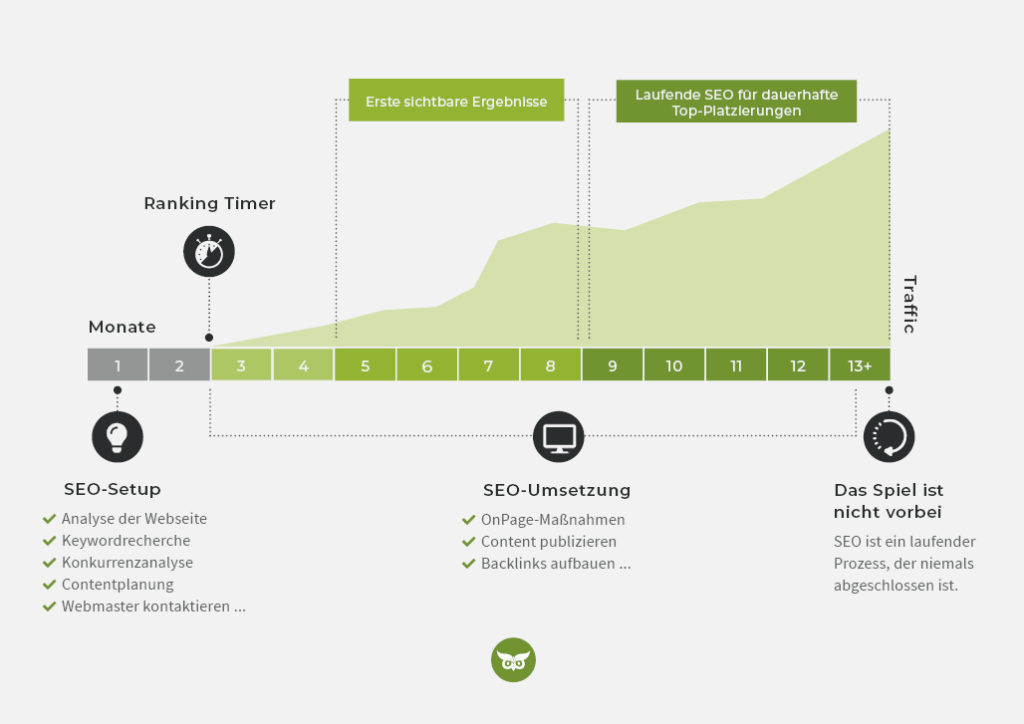
You should also know that the size of the project matters. In the case of already established sites that have already built up a backlink profile, it usually takes around 3-6 months to see the first results. A completely new page, on the other hand , has to prove itself first because it has no “history” that Google could draw on. In such a case you have to be patient for around 9-12 months.
And don’t forget: search engine optimization is not a one-off job, but an ongoing process. The motto is to keep at it – otherwise you will slip back to the lower ranks. How so? The competition never sleeps.
So if SEO takes so long, why go this route at all? Why not just take the shortcut and buy top placements through Google Ads? Below is the answer!
SEO vs. SEA
We have now explained at length what SEO is. But what about SEA? The abbreviation stands for Search Engine Advertising. Well, and which is better, SEO or SEA? That entirely depends on what your main goal is.
| INFO / CHANNEL | SEO = search engine optimization | SEA = search engine advertising |
| Benefits | Sustainable results / snowball principlev. A. initially very labour-intensivevery precise knowledge of the target group, since the analysis of the search intention requires a lot of empathy | Fast resultsTarget group can be defined very preciselyHigh measurabilityGood opportunity to test strategies |
| Disadvantage | Time-consumingrequires (especially initially) patiencerequires a lot of know-how | Depending on the niche, high prices per clickdo not result in results as soon as you stop paying |
Google Ads can give you visibility in no time, but only for as long as you pay for it. As soon as the ad budget is used up, your page disappears again into the proverbial sinking.
Not so with search engine optimization : you cannot buy good placements in the organic search results. If you make it into the top 10 (or even top 3), you do it on your own and therefore all the more sustainably. A professionally optimized page ranks “almost by itself” over time and for more and more keywords.
And yes, search engine optimization requires some effort, especially in the beginning. But once you’ve done the keyword research, structure planning, etc., written your most important content pieces and built a competitive link profile, the workload will decrease (depending on your competition).
For the question “SEO or SEA”, the answer is: definitely both!
The trick is to use both strategies hand in hand . SEA provides you with valuable data at the beginning of your search engine campaign and quickly gives you visibility. After this kickstart, however, a sustainable solution must come – time to shine for search engine optimization!
Implement SEO optimization yourself or with an SEO agency?
Do it yourself or let someone from the field do it: The tiresome question also arises for search engine optimization. Only you can answer them yourself, but we can at least give you a decision-making aid in the form of a cost analysis . If you decide to work with professionals, we have also put together a few tips on how to distinguish serious agencies from charlatans !
How much does SEO cost and is SEO optimization free?
Well-done, efficient Google optimization necessarily involves many hours of work. So it is only logical that the work of a good SEO agency cannot be dirt cheap. So if your budget is around 200-300 euros, we unfortunately have to say: That’s never enough in life – think in thousands. What the…, are you thinking now? Well, just look at the average hourly effort for common SEO measures:
| TASK | HOURS |
| Research and write text for a detailed landing page | 6-8 h |
| Enter text on the website, link internally, research images, content design… | 1-2 h |
| Research 30 contacts for guest article requests, find topics, write to webmasters… | 10-14 h |
| Write 2 guest articles to build backlinks | 8-10 h |
Let’s assume that all these tasks are actually completed as quickly as possible. Then we are already at 25 hours of work. If a really cheap, fictitious service provider calculates an hourly rate of 60-100 euros, this results in net costs of just under 1,500-2,500 euros per month for the tasks mentioned above.
Attention: This price does not include keyword research or ongoing monitoring of progress , nor technical measures , etc. The costs that the agency incurs for the necessary tools are also not taken into account – and without tools you are flying blind.
So if someone is offering you a cheap “complete package” or infinitesimal monthly cost , they are either pretty bad business people or the agency is not doing their job properly. Either way, you will waste your budget this way and, in the worst case, end up with Google penalties . (Believe us: we’ve seen quite a bit there!)
Because we know that clean work is the be-all and end-all, our monthly SEO support starts at 3,000 euros. Individual packages such as keyword analysis including page structure planning start at 1,800 euros. Our costs result from the following factors, among others :
- Competition , How competitive are the keywords?
- Goals . How quickly should certain goals be achieved?
- Niche . Will it be difficult to build backlinks in this niche?
On this basis, we calculate our estimated hourly effort and create a concrete offer. If it is a simple niche or even local SEO , we offer unique SEO packages , for example:
- Linkaufbau Paket
- Creation of a concept or strategy for the restart
- Keyword research including page structure planning
- Local SEO complete package
- SEO check so you know what needs to be done on your website
- Customized SEO texts
It almost goes without saying, but to answer the initial question: there is no such thing as “free” SEO optimization. Optimization for search engines is free at most if you lend a hand in all areas yourself and do not count the time you need for further training and implementation as working time. And that makes little business sense…
How can I learn search engine optimization?
You don’t have a budget for monthly support, but you have plenty of motivation for SEO on your own? Then get involved, watch videos, familiarize yourself with the tools. Dare! You can familiarize yourself with this selection of information sources :
- Google | starting guide
- HTML-Seminar.de | HTML basics
- LearningSEO.io | complete training
- Moz | Beginner’s Guide
- Backlinko | Resources
- Matt McGee | The building blocks of the pyramid
- Evergreen Media® Free SEO Course
- Evergreen Media® YouTube-Kanal
Don’t just focus on (reputable!) blog posts, but definitely look at additional application examples . For example, you can find lots of tutorials and regular SEO checks on our YouTube channel!
You can also find exciting new topics from the scene on our blog, and if you are an absolute newbie, we can only recommend our video series for beginners!
But no matter where and how you get your information, here are two more important tips :
- Always remember that you don’t want to just rank #1 for any search term, because that alone won’t make you any sales. You need to choose the right keywords, and your content needs to be designed in a way that actually drives paying customers!
- Analyze all measures that you have implemented, because this is the only way to see where there is room for improvement. Take your time to get to know the Google Search Console.
Latest news on SEO and education
The Google Webmaster Central Blog is recommended for the latest news, as is the SEO Roundtable.
For classic basic knowledge, Moz and Orbit Media can be classified as serious. You can find an overview of all Google ranking factors at Northcutt.
If you are already advanced, the articles from Advanced Web Ranking, Ahrefs, SEMrush And Webris Are extremely valuable, as the SEO tips presented are usually based on data and personal experience.
- Step-by-Step Guides to Search Engine Optimization and Content Marketing.
- One-hour seminars to take your online marketing knowledge to the next level
- Detailed theory videos so that you are always up to date
Your advantages:
- You will learn how to implement specific measures and what is currently working well above average
- You get tons of examples so you can derive an online marketing strategy for your business yourself
- You learn which developments you have to react to and what are just short-lived hypes
4 tips on how to recognize reputable SEO agencies
Anyone can promise the moon, true to the motto: “Once the contract is signed…” Well: Fairy tales are great – but they bring absolutely nothing to your website. So if you are currently looking for an SEO agency , we would like to give you a few tips to help you along the way. Your new partner agency should be able to offer this :
- Transparent cost model suitable for the project instead of utopian low all-inclusive prices or even a “best price guarantee”
- Concrete references and examples of successful projects
- Detailed information on the approach and progress of your project, if it comes to collaboration
- Specialization purely on search, not a full-service agency with a hundred different job sites
- Ruthless honesty
Don’t underestimate that last point. Because if there’s one thing you don’t need, it’s false promises that end up leaving you out in the cold. That also means: An honest SEO agency will reject your request if your project does not seem sensible and you would spend your money unnecessarily.
SEO optimization summarized
To everyone who has read through this far: Great, you need exactly this ambition for search engine optimization! If you just skimmed our 1×1: No problem, the only important thing is that you approach the matter with a realistic assessment.
SEO is the optimization of websites so that they appear as high as possible in the organic results of search engines.
Working towards these rankings pays off. If not immediately. For well-done SEO you need a lot of patience and enough time to implement all measures correctly. You have to be able to assess what someone expects when Googling a search query and deliver exactly that content. The high art of search engine optimization requires no more and no less. You can either dare to take these measures yourself or hire an SEO agency.
Don’t forget that search engine optimization is an ongoing process that never stops. It’s an endless competition for the valuable top spots for lucrative keywords.
Do you already have experience with one way or the other? Then share them with us. We look forward to your comments, and we look forward even more to hearing about your project!