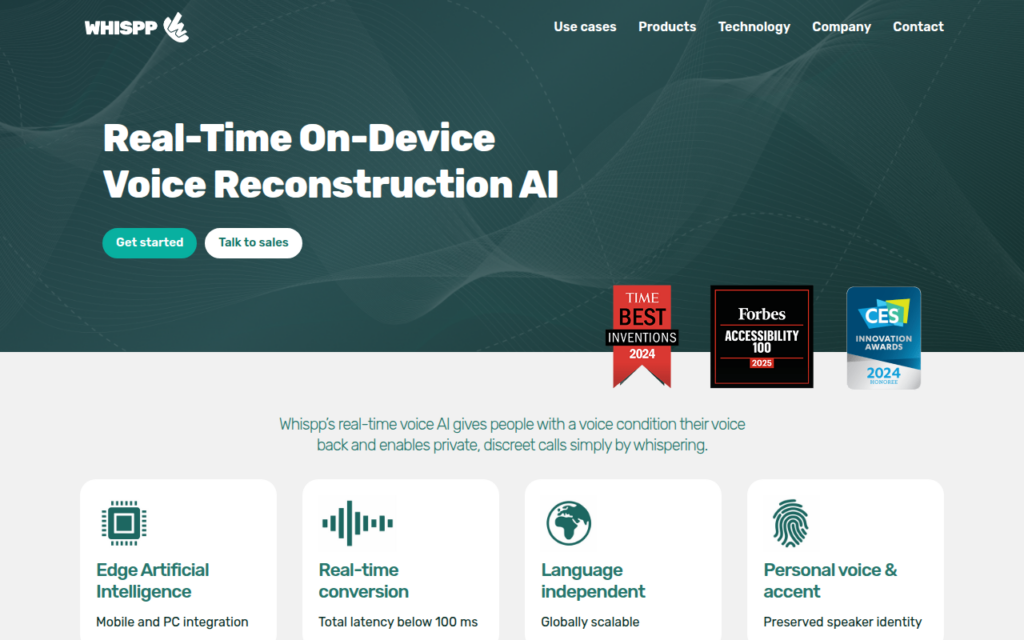
Whispp converts whispered or impaired speech into a clear, natural-sounding voice as the person speaks. It is assistive technology rather than a content tool, built for people whose voice has been affected by conditions such as vocal cord damage, laryngectomy, stuttering or ALS.
The engineering choice is what makes it work: rather than transcribing to text and re-synthesising, it converts whispered speech directly to voiced speech, which preserves the speaker's own intonation and timing. That distinction matters enormously to the user, because it is their expression coming through rather than a machine reading their words back.
Real-time operation is what makes it usable in conversation rather than only for recorded messages, a delay of even a second or two breaks natural turn-taking. It runs on mobile, which is where it needs to be for calls and daily use. This is a genuinely valuable application of the technology, and one where the accessibility case is the whole point rather than a secondary benefit.