Don’t neglect risk management: you need to control potential hazards to achieve your project objectives.
By definition, a risk is a possible danger, more or less foreseeable, inherent in a situation or an activity.
In Project management, zero risk does not exist. It is very likely that your project will not go according to plan. The idea is therefore to anticipate and limit as much as possible the risks that could arise in an attempt to reduce their impact on the smooth running of the project.
From the start of the Project, you must set up risk management: look for the weak points of your project, think about actions to prevent risks and consider the solutions to be provided if they occur. Thus prepared, you will avoid being destabilized when unforeseen events occur.
It is impossible to foresee all the risks, this is what gives a little adventurous side to project management. However, a rigorous risk analysis is a good way to guarantee the success of your project.
The Risk Management of a Project Takes Place in Five Stages.
Identify the Risks
Risks are part of the essential information that a Project manager Must know about his project. From the start of the project, you must draw up the most exhaustive list possible of all the events that generate risks. To do this, gather your team and brainstorm to list all the possible dangers.
There are different types of risk:
- Financial: cost higher than the estimate, lack of budget, etc.
- Human: lack of skills, absenteeism, resignation during the project, conflicts within the team, etc.
- Time: delays by subcontractors or suppliers, poor estimate of deadlines, etc.
- Technical: unsuitable software, breakdowns, obsolete hardware, etc.
- Legal: regulations and laws to be observed, bankruptcy of a supplier, etc.
- Environmental: negative impacts of the project on the environment, or environment having an impact on the project (flood, drought, storm, etc.).
- Organizational: change in company policy, economic changes, etc.
Consulting the archives of similar projects, whether they succeeded or failed, can be a valuable source of information on the risks usually encountered. You can also seek expert advice.
Assess and Prioritize Risks
Once your list of potential threats has been established, analyze each of them to estimate their impact on the project’s deadlines, costs and technical specifications. You will thus be able to separate the unfounded risks from the real risks likely to affect the progress of the project.
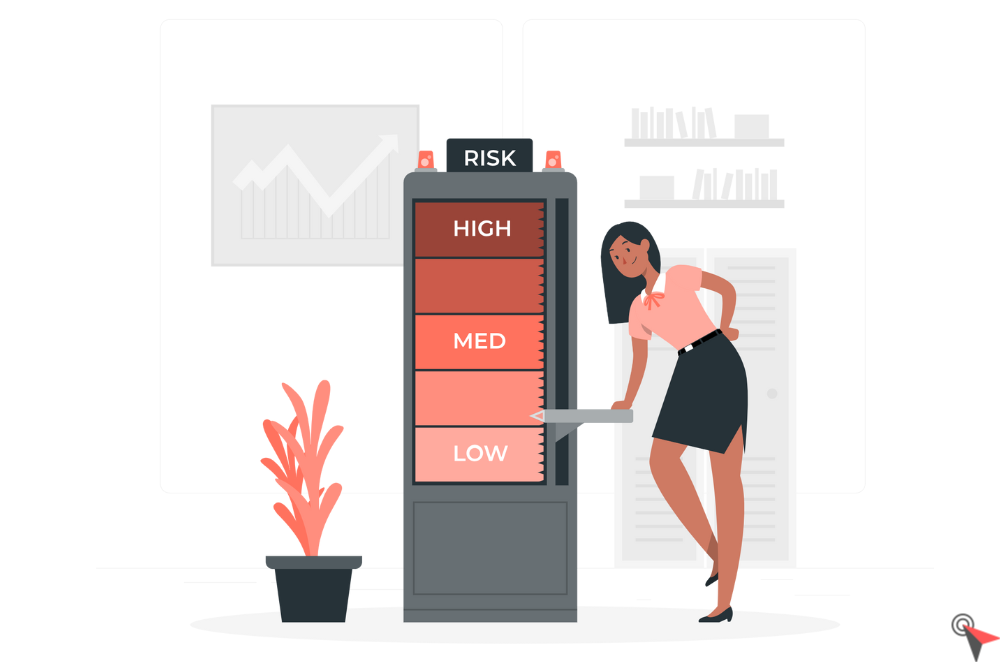
Next, you need to assess the likelihood of occurrence of each of the listed risks and their severity in terms of impacts, damages, and consequences on project objectives. This assessment results in a hierarchy of risks.
The goal is to focus on the biggest and most likely risks, act effectively to prevent them from happening, and determine the priority actions to take to control them.
Dealing with Risks
Risk treatment can be done in three ways:
- Eliminate the risk: You can repel the threat by implementing actions to remove the causes of the risk, such as increasing your resources or recruiting competent personnel. The cost will then be a determining factor in the decision-making process.
- Limit the effects of the risk: you cannot prevent the risk from occurring, but you can limit its negative impact on the project and make it more bearable.
- Revise the project: to avoid risk, the only option is to reorient your project, simplify it or find less risky alternatives.
Define responses for each risk, on a case-by-case basis. Identify the critical points, that is to say the periods when you will have to be extra vigilant, because the risks are the greatest.
You can also accept the risk and monitor it carefully to try to control its effects.
Monitor and Control Risks
Risk monitoring must be done throughout the project. As your project progresses, the potential risks evolve. Some can disappear, others appear, those considered weak can become real threats and vice versa.
Regularly review the risks by updating your list of potential threats, reassessing them and making sure that preventive actions are still appropriate. It is important to assign one or more people to this mission to be sure that it will be carried out rigorously.
Capitalize and Document the Risks
Your project is now complete. Congratulations, you have succeeded despite the risks. Now, it is necessary to Capitalize on the know-how And experience acquired during the risk management of your project.
Several reasons for this:
- Enrich knowledge of potential risks on similar projects;
- Increase response responsiveness;
- Facilitate decision-making;
- Improve the effectiveness of actions aimed at eliminating the risk.
As you have drawn on the experiences of other project managers, return the favor by sharing your knowledge of risk management. It is up to you to make sure the traceability of the risks encountered, the actions taken and the results thus obtained on your project.
Risk is an integral part of project management. It is therefore necessary to put in place a risk management plan, from the first stages of the launch of the project. This makes it possible to identify, prevent and limit these risks by anticipating their treatment through the implementation of preventive and corrective actions.
This is a necessary phase that will allow you to minimize the loss of time and money, and will prepare you to manage risk well when it arises.