We Built a Complete Podcast Audio Kit with the Suno V6 API, and Measured Everything
AI music has moved quickly from novelty to something teams actually use. Podcasters need theme songs and background beds, app developers need notification sounds and loops, video teams need music they can edit without licence negotiations, and product teams want all of it to arrive through an API so it can be automated. Most reviews of AI music still judge the output by ear and stop at “it sounds good”. That is not enough if you have to decide whether a model belongs in a production pipeline.
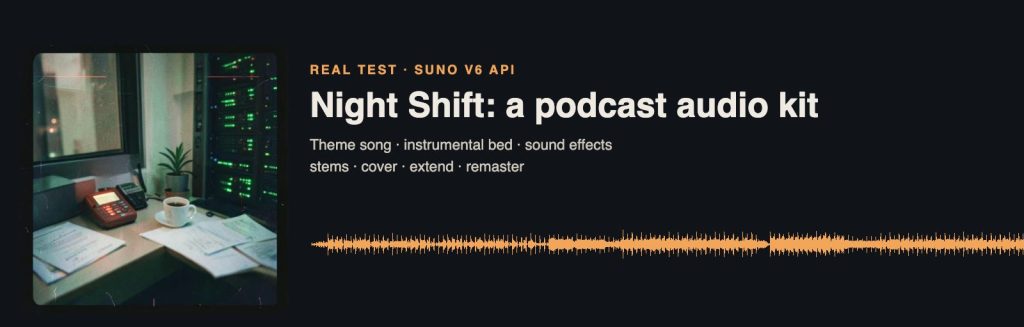
So we set a concrete brief and measured the results. The brief: produce a complete audio kit for a fictional developer podcast called Night Shift, using only the Suno V6 API. The kit needed a theme song with our own lyrics, an instrumental bed to sit under speech, a transition sound effect, an ambient loop, separated stems for the editor, an acoustic version for the outro, a longer version of the bed, and a mastered final mix. We made 13 requests in total. For every result we recorded the generation time and the cost returned by the API, and we used objective measurements where we could: a speech-recognition test for lyric accuracy, a loudness analysis to the EBU R128 standard, a tempo estimate and a null test on the stems.
You can listen to the main results directly in this article, and a three-minute walkthrough video at the end puts everything together.
How the Suno V6 API works
Suno V6 is exposed as a set of asynchronous endpoints. You send a POST request, receive a task ID, poll that task until its status is completed or failed, and then download the audio. A standard generation request returns two different tracks for the same input, so you always get a choice. Follow-up operations, such as cover, extend, remaster or stem separation, reference an earlier result by its task ID plus an audio index (1 or 2), which means you never need to store intermediate audio IDs yourself.
import time, requests

BASE = "https://api.apimart.ai/v1/music"
H = {"Authorization": "Bearer YOUR_KEY"}

def submit(action, body):
    url = f"{BASE}/generations/{action}" if action else f"{BASE}/generations"
    return requests.post(url, headers=H, json=body).json()["data"][0]["task_id"]

def wait(task_id):
    while True:
        d = requests.get(f"{BASE}/tasks/{task_id}", headers=H).json()["data"]
        if d["status"] in ("completed", "failed"):
            return d       # d["cost"], d["result"]["music"][i]["audio_url"], ...
        time.sleep(6)

song = wait(submit("", {"custom": True, "version": "v6", "title": "Night Shift",
                        "prompt": LYRICS, "style": STYLE, "vocal_gender": "female"}))
stems = wait(submit("stemsAll", {"task_id": song["id"], "audio_index": 1}))
Two details are worth knowing before you start. First, custom: true means “use my prompt as lyrics”, while custom: false means “treat my prompt as a description and write the lyrics yourself”. Second, the task response includes the actual cost of the job in US dollars, so you can log spending per asset without calculating it from a price list. Every cost in this article comes from that field.
Speed was the biggest surprise. Most generation requests finished in 23 to 43 seconds, including two full-length songs each. The slowest regular request, an inspiration-mode song where Suno also wrote the lyrics, took 70 seconds. Full stem separation took 91 seconds.
Test 1: the theme song, on three V6 versions
We wrote short original lyrics about late-night deployments and a style description that a producer might give a session band:
Style: upbeat indie pop, synth bass, bright electric guitar, driving drums, catchy female vocal, 118 bpm, podcast theme
Negative tags: heavy metal, screaming

[Verse 1]
Coffee's cold and the build is red
Forty tabs and a thousand threads
Somebody's pager lights the room
We ship at dawn, we ship it soon

[Pre-Chorus]
Line by line, we find the light

[Chorus]
This is the night shift, keep the servers humming
Night shift, hear the deadline coming
Every bug's a story we can tell
Night shift, night shift, we're doing well
(second verse, chorus and outro omitted here)
Suno V6 currently offers three public versions: v6, v6-wild and v6-mini. We sent the identical request to all three. Each request cost $0.05 and returned two tracks.
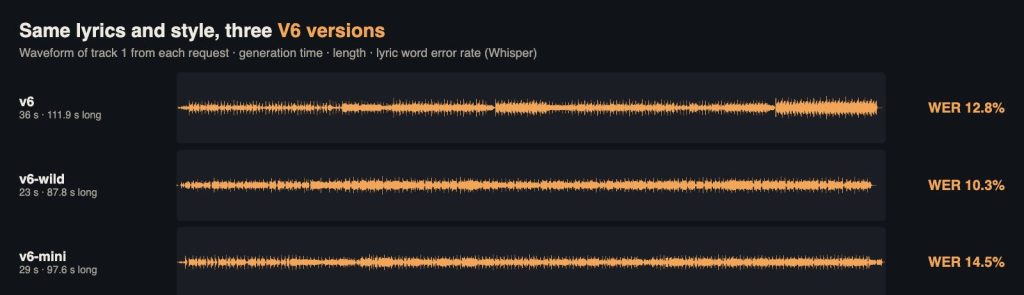
The structural differences are visible even in the waveforms. The v6 track is the longest at 111.9 seconds and has the clearest dynamic shape, with a quieter verse and a louder final chorus. The v6-wild track is the shortest at 87.8 seconds and stays at a more constant level throughout. The v6-mini track sits between the two at 97.6 seconds. We asked for 118 beats per minute, and a simple onset analysis of all three tracks estimated 117.5, which is within the resolution of our method, so Suno respected the tempo in the style prompt.
Night Shift, v6, track 1 (111.9 seconds).
Night Shift, v6-wild, track 1 (87.8 seconds).
Test 2: did it sing the words we wrote?
For a theme song, getting the lyrics right is not optional. Listening carefully to every take is slow and subjective, so we used a measurable proxy instead. We transcribed each track with Whisper and compared the transcript with our 117-word lyric sheet, using the standard word error rate (WER): the share of words that are wrong, missing or inserted. This measures Suno’s pronunciation and Whisper’s recognition together, so it is an upper bound on Suno’s own errors, but it is consistent across tracks and easy to repeat.
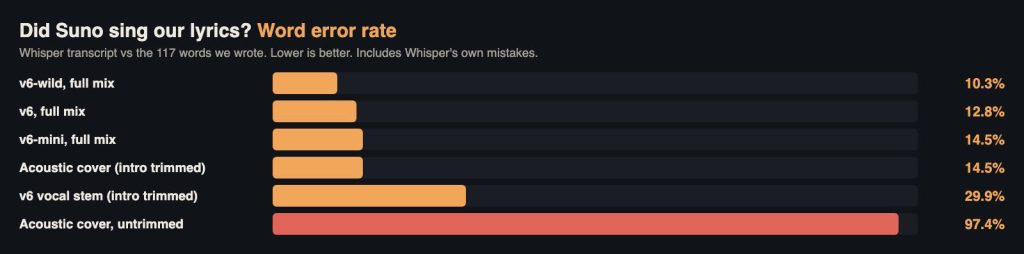
All three full mixes landed between 10 and 15 percent. Most of the “errors” were small and plausible: “we ship at dawn” heard as “we ship it done”, “servers” heard as “service”, and a few words added or dropped in the repeated choruses. In other words, Suno sang the lyrics as written, with clear enough diction for a speech model to follow. That is an important result for anyone generating songs with brand names, product names or specific messages.
Two measurements taught us more about testing than about Suno. When we first transcribed the acoustic cover (Test 5), Whisper returned complete nonsense about driving down a road, giving a 97 percent error rate. The cover has a long, quiet guitar introduction, and Whisper is known to invent text when it hears no speech. After trimming the first 12 seconds, the same file scored 14.5 percent, in line with the others. The isolated vocal stem scored worse than the full mix, at about 30 percent, even after trimming. Separated vocals carry small artifacts, and without the music Whisper repeated some phrases. The lesson: if you automate lyric checks, trim instrumental intros and test the full mix rather than the stem.
Test 3: letting Suno write the lyrics
For comparison, we also used inspiration mode, where the prompt is a description rather than lyrics:
an upbeat indie pop theme song for a podcast about software developers working late at night, catchy chorus, female vocal
(custom false, version v6)
Suno titled the song “Ship It” and wrote its own lyrics, which opened with “You push one more fix, the clock rolls past ten / Cold coffee, warm screen”. The two tracks were 142.7 and 162.8 seconds long, noticeably longer than our custom songs, and the request took 70 seconds. The lyrics were on topic and singable, and the idea of cold coffee appeared again, which suggests how common that image is in songs about developers. For a quick placeholder this mode is excellent. For a brand theme, writing your own lyrics gives you control over every word and, as Test 2 showed, Suno will sing them accurately.
Test 4: an instrumental bed that stays out of the way
Podcast music beds need to sit under speech without fighting it. We used custom mode with instrumental: true and asked for 90 seconds:
Style: lo-fi chillhop, mellow electric piano, soft vinyl crackle, laid-back drums, 85 bpm, unobtrusive background music for spoken word
(custom true, instrumental true, duration 90, version v6)
The first track came back at 92.2 seconds, close to the requested duration. The second ran to 139.6 seconds, so the duration field is a target rather than a hard limit, and you should check the length of every result. Our tempo estimate was 86 and 83 beats per minute for the two tracks, close to the requested 85. Neither track had vocals, which is not always guaranteed with generative music models.
Test 5: an acoustic version for the outro
Many podcasts close with a softer version of their theme. Suno’s cover operation takes an existing track and performs it in a new style. We referenced the v6 theme song and asked for this:
Tags: acoustic folk, fingerpicked guitar, soft female vocal, warm and intimate, 90 bpm, podcast outro
(cover of theme-v6, audio_index 1, custom true, same lyrics)
The request took 43 seconds and cost $0.05. Both versions kept the same lyrics and the same melody shape, but turned the band arrangement into guitar and voice. Suno’s own description of the result was “acoustic folk, steady 90 BPM; soft female vocal with a wide range”. The full cover is 131.7 seconds long, about 20 seconds longer than the original, because of the extended guitar introduction we mentioned in Test 2.
Night Shift (Acoustic), created with the cover operation from the v6 track.
One practical note from our integration: the cover endpoint path is /generations/coverSong. We first guessed /generations/cover and received a 404, so copy endpoint paths from the documentation rather than inferring them.
All of the operations in this article, from generation and lyrics to covers, stems and mastering, are available through one Suno API with a single key, which made it easy to script the whole kit and log the cost of each step.
Test 6: stems for the editor
An editor often needs to lower the vocals under a guest’s voice or keep only the drums for a transition. The stemsAll operation separates a finished song into individual instruments. It took 91 seconds and cost $0.24, the most expensive single step in our test.
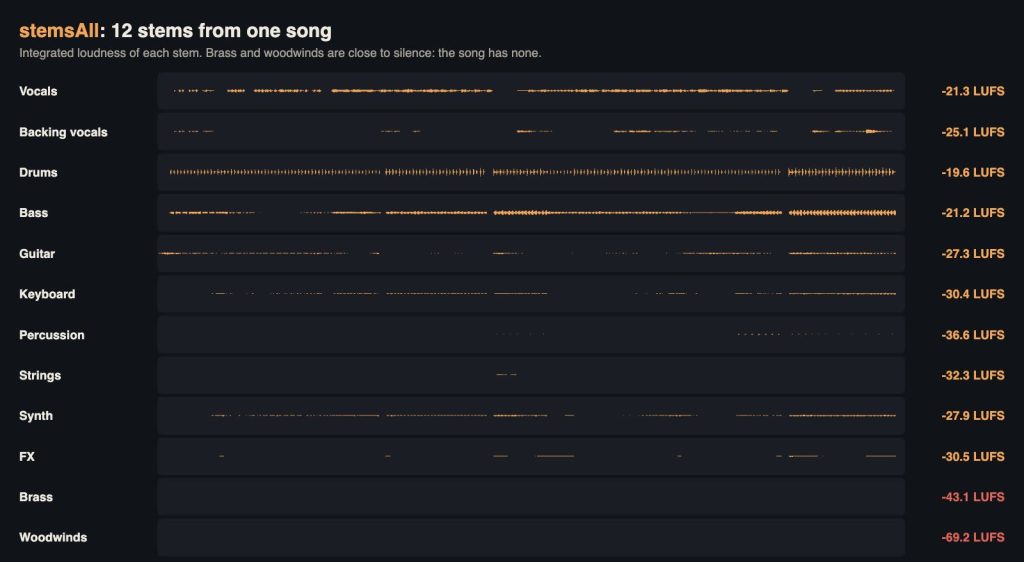
We received twelve stems: vocals, backing vocals, drums, bass, guitar, keyboard, percussion, strings, synth, FX, brass and woodwinds. The response actually contained 24 files, because each stem appeared twice. Both copies had identical loudness, so in practice you get twelve stems. Our song had no brass or woodwind parts, and those two stems were close to silence at −43 and −69 LUFS. You can safely skip near-silent stems in an automated pipeline by checking loudness before you import them.
We then ran two checks. When we mixed all twelve stems back together, the result had exactly the same integrated loudness as the original song, −14.2 LUFS. But when we inverted the original and summed it with the rebuilt mix, which is the classic null test, the residual was still −21.1 LUFS rather than near silence. That tells us the stems are high-quality separations of the finished mix rather than the original multitrack recordings. For editing, rebalancing and remixing that is perfectly fine. Just do not expect a perfect null if you rebuild the song from stems.
The isolated lead vocal stem.
Test 7: making the bed longer with extend and concat
A 90-second bed is too short for a long interview segment. The extend operation continues a track from a chosen point. We asked it to continue our bed from 80 seconds.
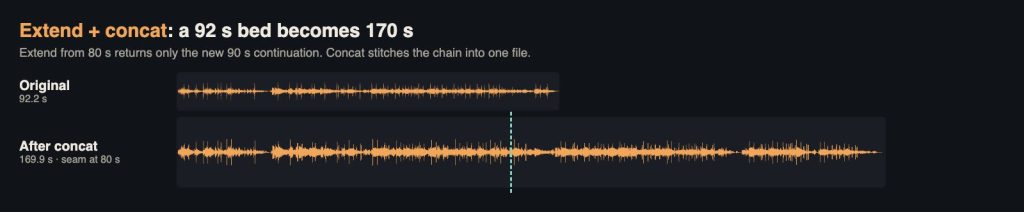
This is where we would have made a mistake without measuring. The extend task returned two tracks of about 90 seconds each. We expected a 170-second song, but extend returns only the new continuation, not the original plus the continuation. To get one file, you call a second operation, concat, on the extend result. It took 29 seconds, cost $0.004, and produced a single 169.9-second track: the first 80 seconds of the original followed by the 90-second continuation. In the waveform, the seam at 80 seconds is hard to spot, and the energy continues smoothly. If you build automatic length extension, remember that it is a two-step process.
The 170-second bed after extend and concat.
Test 8: sound effects and loops
Suno V6 also has a separate sound effects endpoint. It supports one-shot sounds and loops, with optional tempo and key. We made two:
short cinematic whoosh transition with a soft digital glitch at the end  (type one-shot)
gentle keyboard typing and soft server room hum, ambient texture  (type loop, bpm 85, key Am)
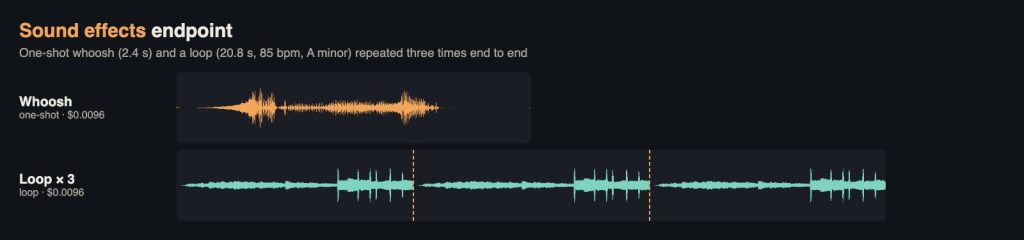
Each request took 22 seconds and cost $0.0096, under one cent, for two variations. The whoosh was 2.4 seconds long, with a rising swell and a short tail, exactly the shape of a transition effect. The loop was 20.8 seconds. We repeated it three times to check the loop points. The waveform shows a clear step at each join: the loop ends on its louder typing section and restarts on the quiet hum. In our test it worked as a loop rhythmically, but for a smooth ambient bed we would add a short crossfade at the join.
One-shot whoosh transition.
Test 9: remastering
The last step was the remaster operation, which reprocesses a finished song to improve clarity and texture. We used the normal intensity on the v6 theme song and measured both versions with ffmpeg’s EBU R128 analysis.
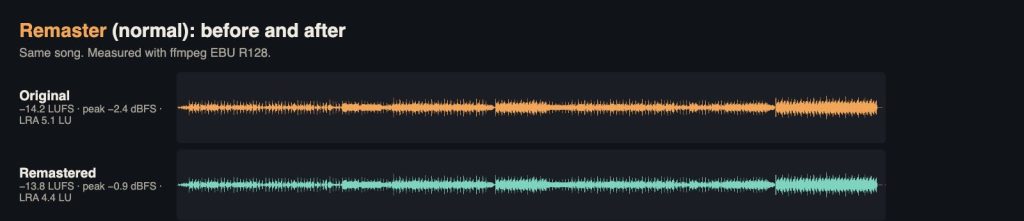
The remastered version was slightly louder (−13.8 LUFS instead of −14.2), its peak level rose from −2.4 to −0.9 dBFS, and the loudness range narrowed from 5.1 to 4.4 LU. In plain terms, the remaster made the song a little louder and more compressed. That suits a theme song that has to sound confident on phone speakers, but it leaves less headroom. If your podcast is normalised to −16 LUFS, which many platforms use for spoken word, the difference will mostly disappear after normalisation. The remaster also cost $0.05 and returned two versions in 36 seconds.
A bonus we did not ask for: cover art
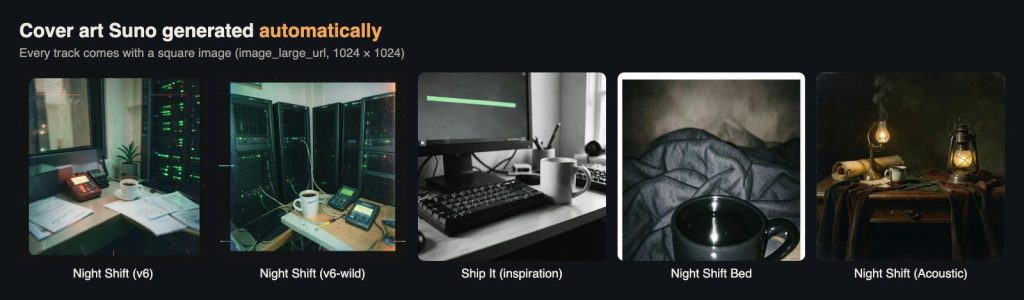
Every track in the response came with a square cover image. They were surprisingly relevant: server racks and a coffee cup for Night Shift, a mug beside a rumpled blanket for the instrumental bed, and an oil lamp for the acoustic version. They are not brand-ready, but they are useful as placeholders in a music library or a content management system, and they cost nothing extra.
The walkthrough video
We edited the main results, the charts and short excerpts of each track into the video below.
Walkthrough: building the Night Shift audio kit with the Suno V6 API (about 3 minutes).
What the whole kit cost
| Step | Requests | Time per request | Cost |
|---|---|---|---|
| Theme song on v6, v6-wild and v6-mini (6 tracks) | 3 | 23 to 36 s | $0.15 |
| Inspiration-mode song (2 tracks) | 1 | 70 s | $0.05 |
| Instrumental bed (2 tracks) | 1 | 36 s | $0.05 |
| Acoustic cover (2 tracks) | 1 | 43 s | $0.05 |
| Full stem separation (12 stems) | 1 | 91 s | $0.24 |
| Extend + concat | 2 | 29 to 36 s | $0.054 |
| Remaster (2 versions) | 1 | 36 s | $0.05 |
| Sound effects (2 × 2 variations) | 2 | 22 s | $0.019 |
| Total | 12 billed + 1 failed | $0.66 |
The complete kit cost 66 cents. The request that failed was our wrongly guessed cover endpoint, which returned a 404 immediately and was not billed. Stem separation was more than a third of the total, so if you only need vocals, the single-stem operation is the cheaper choice. The Whisper transcriptions we used for testing are not included, because they are part of our measurement, not of the kit.
Lessons for teams putting Suno into production
- Write your own lyrics for anything branded. Suno sang our words accurately, with a 10 to 15 percent word error rate that was mostly due to the transcription itself.
- Compare versions on important requests. At $0.05 for two tracks, running v6, v6-wild and v6-mini costs 15 cents and gives you six options with different structures.
- Treat duration as a target. One of our 90-second requests returned almost 140 seconds. Check and trim lengths automatically.
- Extend is a two-step process. Extend returns only the continuation. Call concat to get the complete track.
- Filter stems by loudness. Instruments that are not in the song come back as near-silent stems, and every stem was returned twice.
- Test lyrics on the full mix, after trimming intros. Speech recognition invents text during long instrumental passages.
- Crossfade loops. The loop rhythm was correct, but the levels at the join were not.
- Log the cost field. The API returns the real cost of every task, which makes per-asset budgeting easy.
The bottom line
For 66 cents and well under an hour of generation time, the Suno V6 API produced everything a small podcast needs: a theme song with our own lyrics, an acoustic outro, a long instrumental bed, sound effects, editable stems and a mastered mix. Most requests finished in under 45 seconds, and the results held up under objective measurement as well as listening. It still needs a human in the loop for the final choice of take, the loop points and the length of each piece. But as a production tool that can be scripted, measured and repeated, it is ready. If you want to build a similar pipeline, or combine Suno with image and video models under one key, you can find them all on apimart.ai.