
Baidu Apollo is an open autonomous driving platform that provides autonomous vehicle software, reference hardware designs, and cloud testing infrastructure. Automakers, robotics researchers, and mobility startups use Baidu Apollo to build, test, and deploy self-driving vehicle systems without creating an autonomous mobility stack from scratch.
Do not confuse this engineering ecosystem with B2B sales automation platforms like Apollo.io, which share the Apollo name but serve sales intelligence teams. Baidu Apollo focuses strictly on transportation AI, vehicle control systems, and commercial fleet management.
What Is Baidu Apollo?
Baidu Apollo is a full-stack autonomous driving ecosystem launched by Baidu in 2017 to accelerate self-driving technology development through collaborative architecture. The platform combines open-source core modules, cloud-based simulation engines, and vehicle-to-everything connectivity into an integrated development environment.
Unlike closed self-driving initiatives that keep all vehicle code proprietary, Baidu Apollo makes its core algorithm pipeline accessible on GitHub under an Apache 2.0 license. Anyone building automated transport can inspect the planning modules, integrate standard sensor inputs, and test path generation logic against open virtual environments. For commercial operations, Baidu pairs this open code with its Apollo Go robotaxi division, operating commercial passenger routes across several Tier 1 metropolitan areas in China.
Who Builds on the Apollo Ecosystem?
Baidu Apollo serves automotive engineers, autonomous haulage providers, and university robotics laboratories seeking a mature vehicle control pipeline. Teams building low-speed delivery carts, highway freight prototypes, or smart municipal sweepers use the framework to bypass multi-year foundational development cycles.
Independent vehicle software developers often struggle with custom sensor integration and real-time path planning safety constraints. Apollo provides structured interfaces for standard sensor suites, including Hesai LiDAR units, industrial cameras, and NovAtel global positioning receivers. If you run a research lab or prototyping team with a drive-by-wire chassis, the platform gives you a functional baseline within days instead of quarters.
Enterprise automotive manufacturers look at Apollo differently. Tier 1 suppliers and carmakers leverage Apollo's commercial branch to license certified high-definition mapping data, automotive-grade cockpit integrations, and high-concurrency cloud simulation environments.
Core Architecture and Simulation Workflow
Baidu Apollo operates as a pipeline of decoupled software nodes communicating over an optimized real-time messaging layer named Cyber RT. Cyber RT replaces standard robotic operating frameworks with deterministic, low-latency scheduling tailored to safety-critical automotive compute requirements.
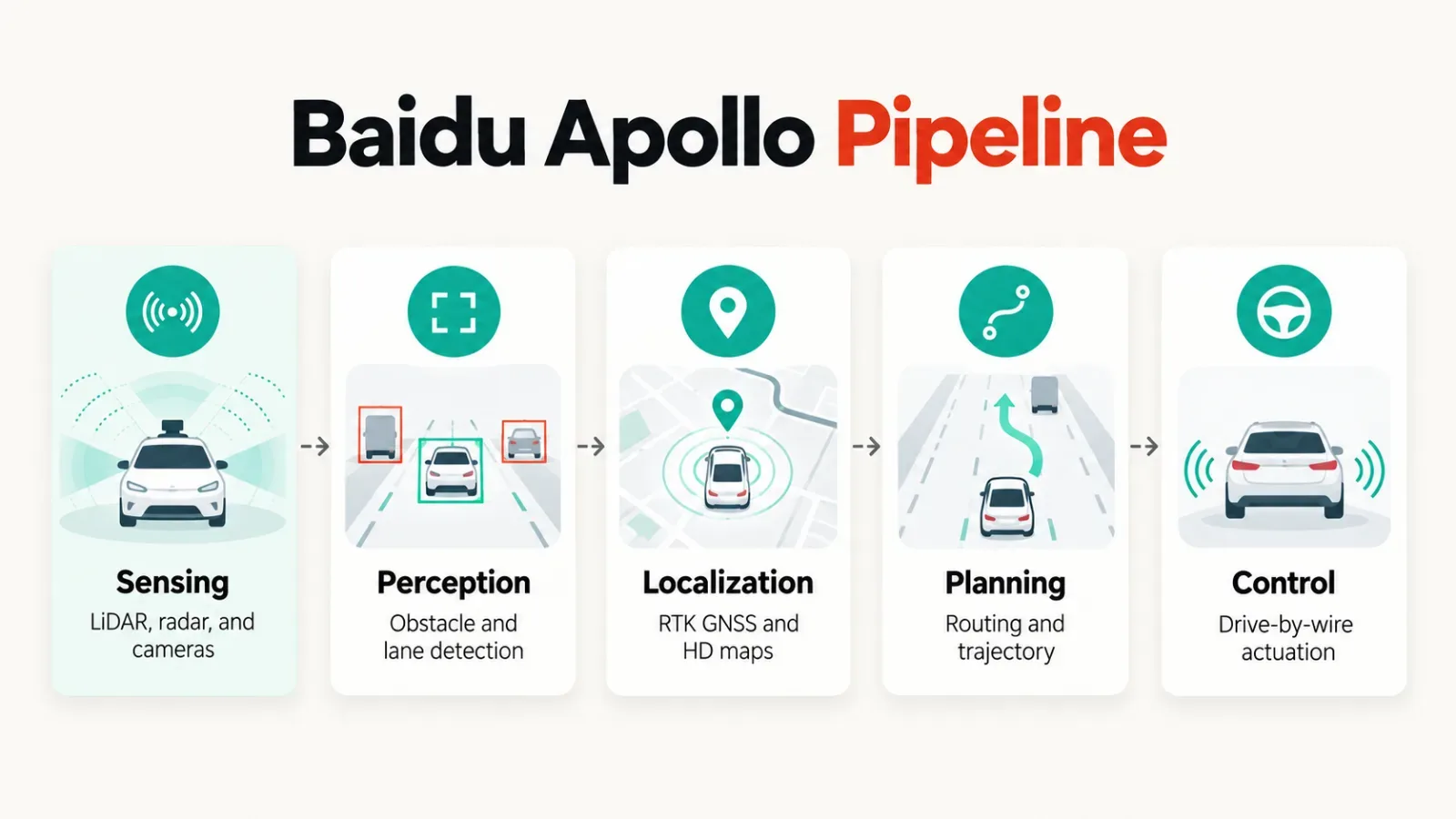
The software pipeline processes physical sensor data through distinct operational layers:
- Perception and Sensor Fusion: Deep neural networks process camera frames, point clouds, and radar signals to classify surrounding objects, track trajectories, and monitor traffic lights.
- Localization and HD Maps: High-definition maps combine with Real-Time Kinematic positioning and inertial measurement data to place the vehicle within centimetre-level accuracy.
- Prediction and Motion Planning: The system projects the future path of detected obstacles, calculates collision avoidance envelopes, and generates dynamic speed profiles.
- Vehicle Control: Control algorithms translate target paths into steering angles, throttle percentages, and braking pressures transmitted directly to the vehicle's drive-by-wire controller.
To ensure safety before real-world testing, engineers upload scenarios into Apollo's cloud simulation platform. The cloud tool runs virtual vehicles through millions of edge-case scenarios, validating software updates against sudden pedestrian incursions or harsh weather obstacles without physical collision risks.
Deployment Realities and Localization Requirements
Deploying Baidu Apollo in production requires substantial mechanical and regulatory preparation. The open-source code runs on Linux operating systems configured with real-time kernel patches, but it demands compatible vehicle platforms equipped with electronic throttle, brake, and steering actuators.
Geography matters heavily when considering Apollo for commercial production. While the open-source software stack operates globally on private test tracks, the platform's proprietary high-definition mapping services and cellular infrastructure support are optimized for mainland China. Teams launching commercial operations in Europe or North America must supply their own regional HD map providers and verify local wireless communications compliance. If your project demands localized, open autonomous driving code with global mapping integrations, you will need to evaluate regional infrastructure readiness before committing your fleet roadmap.