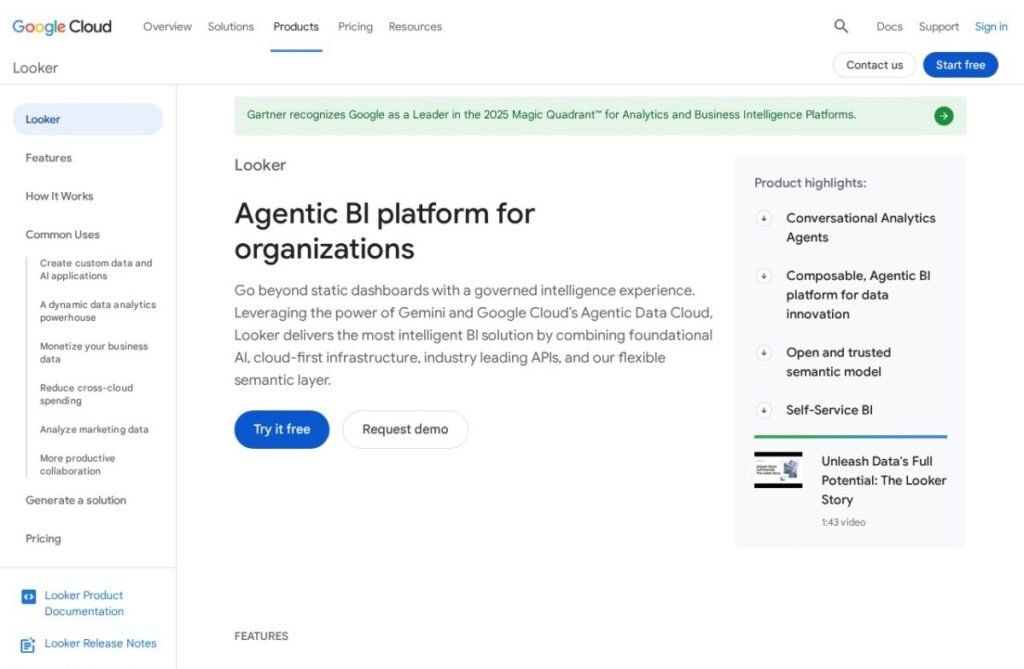
Looker, founded in 2012 and acquired by Google in 2019, built its reputation on a specific architectural choice most competitors don't share as strictly: LookML, a modeling layer where an organization defines its data relationships and metric calculations once, in code, so every report and dashboard across the company references the same governed definition of "revenue" or "active user" rather than each analyst calculating it slightly differently.
That semantic-layer-first design trades some of the drag-and-drop flexibility simpler BI tools offer for consistency at scale: a metric defined once in LookML stays consistent everywhere it's used, reducing the common problem of two dashboards showing different numbers for what should be the same figure. Now part of Google Cloud, it integrates natively with BigQuery and other Google data services.
There's no free tier; Looker sells through Google Cloud enterprise pricing. For a larger organization specifically concerned with metric consistency and governance across numerous dashboards and teams, Looker's code-first semantic layer addresses that problem more directly than tools prioritizing flexibility over strict consistency.