Intrascope swaps a pile of individual AI subscriptions for one shared company balance. Instead of each employee expensing ChatGPT Plus or a Claude plan, an admin funds one workspace, sets spending limits and watches usage in a single dashboard. It’s a cost-control tool for whoever owns the AI budget, not a new chatbot.
How Does Intrascope Replace Per-Seat AI Subscriptions?
Intrascope replaces per-seat AI subscriptions with a pooled balance that every team member draws from. Admins top up the workspace, then cap spend per user or per project, so one heavy experiment can’t drain the budget.
From one account, your team reaches models from OpenAI, Anthropic, Google, DeepSeek and Grok, xAI’s model. Real-time dashboards split token usage and spend by model, user and project, which is how admins find paid seats nobody’s touching.
Bring Your Own Key or Managed Access?
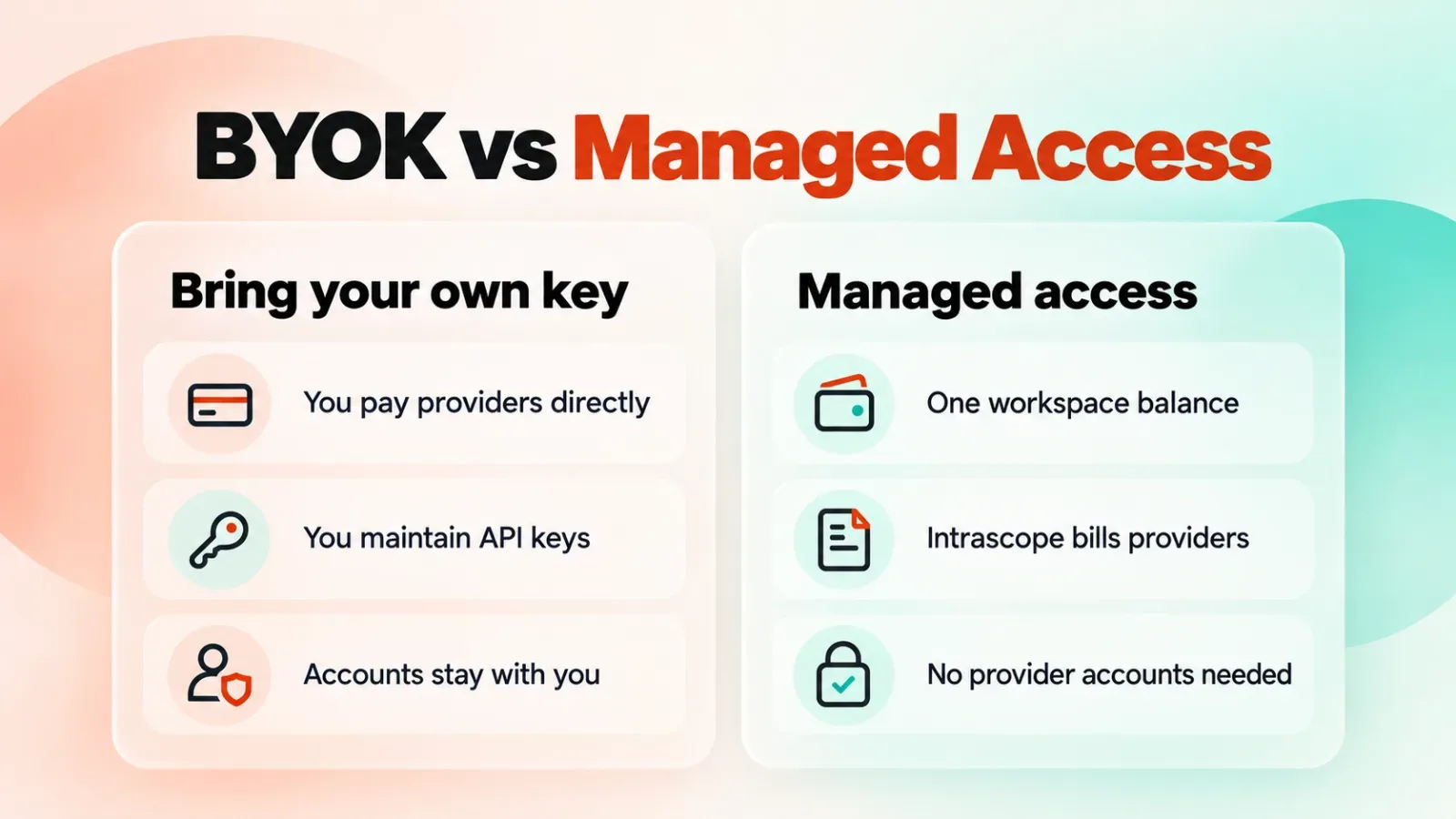
Intrascope offers two billing routes, and the choice decides who holds the provider relationships. Bring-your-own-key (BYOK) means you connect API keys from your own OpenAI, Anthropic or Google accounts. Managed access means Intrascope handles provider billing through your workspace balance.
| Question | Bring your own key | Managed access |
|---|---|---|
| Who pays the model providers | You, directly | Intrascope, from your workspace balance |
| Setup work | Create and maintain provider API accounts | Top up the balance and go |
| What happens if you leave | Your API accounts and keys stay with you | You set up provider access elsewhere |
| Best fit | Teams with an IT or engineering owner who already manages API keys | Teams that want one bill and no provider accounts |
Intrascope says the BYOK route cuts costs by roughly 85% versus bundled consumer subscriptions. Treat that as the vendor’s own claim, not a benchmark. Your saving depends on how many current seats sit idle, because API pricing charges per token used while a subscription charges whether anyone logs in or not.
Who Is Intrascope Built For?
Intrascope is built for operations, IT and internal enablement teams who’ve watched AI subscriptions sprawl across a company with nobody seeing the total. Solo users get little from it: if you’re the only person paying for ChatGPT, a team workspace adds admin work and saves nothing.
The fit is strongest when you can answer yes to two questions. Are people paying for overlapping tools, such as ChatGPT Plus and a Claude plan? And can you name seats that went unused last month?
When Does Pooled Usage Cost More Than Seats?
Pooled, usage-based spend isn’t automatically cheaper. A flat subscription caps what one person costs you. Metered API usage doesn’t, so a few daily power users running long documents through top-tier models can outspend their old seat price.
Use a simple rule. If most of your seats see light or occasional use, pooling wins. If nearly everyone is a heavy daily user, compare a month of real token usage against your seat bills before you switch, and set per-user caps from day one.
Intrascope’s 7-day trial needs no credit card, but seven days won’t show a full billing cycle. Run your heaviest users through it, not your lightest, or the trial will flatter the numbers.
Who’s Behind Intrascope?
Intrascope is an early-stage startup. It launched on Product Hunt, where it drew discussion from the community.
A young vendor sitting between your team and its model providers is a real dependency. If that worries you, pick the BYOK route. Your API accounts and usage history stay with the providers, so walking away doesn’t mean rebuilding access.
What to Gather Before Starting the Trial
Pull the last three months of AI subscription charges from expense reports and company cards, and list who holds each seat. Mark the seats with little or no use, since those are what Intrascope’s pooled balance replaces. Then start the trial, route one real team’s work through it, and compare the dashboard against those receipts.