Project Stakeholder Management are key actors who are able to impact the success of a project. Identifying and managing their commitment is the cornerstone of successful change management.
Indeed, the challenge of each project manager is to establish a constructive and lasting relationship with the project stakeholders.
In this article, I’ll walk you through the steps and strategies for managing project stakeholders, illustrating with a practical case study.
Definition of stakeholders
The stakeholders of a project are internal and external actors:
Persons, group or organization likely to affect the project or to be affected by it.
Every project has business stakeholders that can affect, or be affected by, the project in a positive or negative way.
While some parts of the project may have a limited impact on the project, others may have a significant influence on the project and the expected results of the project.
The ability of the Project manager To correctly identify and manage project stakeholders appropriately can make the difference.
The 4 stakeholder management processes
The ultimate goal of the project manager through these processes is to engage project stakeholders effectively to increase the chances of project success.
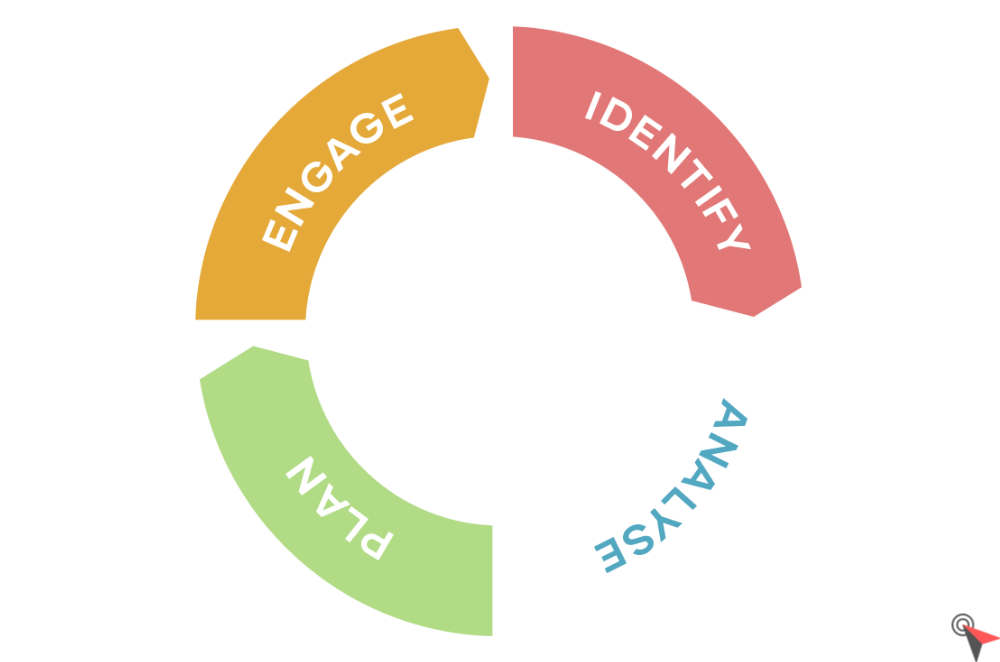
Indeed, the management of project stakeholders is divided into four processes.
1) Identify project stakeholders
This is the process of regularly identifying all project stakeholders, documenting relevant information concerning their roles, powers and interests, their contributions, their needs and expectations, as well as the communication actions to be taken in view. To engage them.
These internal and external stakeholders mainly include:
- The sponsor or sponsor of the project, who is the principal, therefore the decision-maker
- The management team
- The project team
- The support team
- Union representations
- And many other organizations, impacting or potentially impacting the project
The following is an example of the project stakeholder identification register:
2) Plan their engagement
It is the process of planning appropriate approaches for better involvement of project stakeholders.
This planning is done according to their requirements, their expectations, their interests and their potential power and impact on the success of the project.
I recommend that the project manager use the project stakeholder engagement assessment matrix below.
This matrix makes it possible to start from the current level of stakeholder engagement to define the desired level.
The project team can define the approach to adopt and the communication media to use with each project stakeholder to make sure their positive commitment to the project.
3) Analyze stakeholders and manage their engagements
It is the process of communicating and working with stakeholders to:
- Meet their expectations and interests
- Manage issues throughout the project lifecycle
- While encouraging them to participate appropriately
To make sure that the project stakeholders have understood the issues and risks, but also to see how they can contribute to the success of the project, the project manager makes sure the deployment of the following qualities:
- Involve stakeholders in a timely manner;
- Negotiate and communicate with them;
- Take into account and Control project risks Related to the management of project stakeholders;
- Resolve identified issues.
4) Control their commitment
It is the process of mastering relationships with different parties and adapting strategies to encourage and maintain their engagement.
During this process, the project manager relies on his leadership qualities, his sense of active listening and his networking skills.
Thus, he can guarantee access to information on the engagement of project stakeholders, federate them around his vision and solve problems when they arise.
Stakeholder management strategies and tools
1) Power/interest matrix
To enable the project manager to define the appropriate communication and stakeholder engagement strategies, I recommend using the Johnson and Scholes matrix.
This grid classifies the actors according to the power they hold and their level of interest in the project.
The type of relationship that the project manager will need to establish and maintain with each type of project stakeholder grouping is illustrated for each of the four areas:
- Group A : this group requires minimal effort from the project manager
- Group B : This group will need to be fully informed of major project decisions
- Establishing and maintaining good communication with this group is essential
- Group C : This group represents the most important part for the project and it must be managed as the main partner, the acceptability of the decisions for this group is a major consideration for the project management team
- Group D : this is the most difficult group to manage. The level of interest of the actors in the project remains low as long as they are satisfied. If they become dissatisfied, due to their position of power, they can easily negatively impact the project. It is therefore necessary to have a good process of dialogue with this group.
2) Prioritization of project stakeholders
Project managers must be strategic in their approaches to managing the engagement of the most influential stakeholders by prioritizing their actions.
Generally, in any population of a representative size, and empirically, the level of commitment and reluctance to change follows the distribution of a normal law.
The curve below illustrates the segmentation of a representative population into four categories.
- Group 1 : it represents 15% of the population of a project stakeholder, it is the party most committed to the project.
- Group 2 : it represents 35% of the population, its members called the early majority. They turn to Group 1 to learn more about the project.
- They spend less time doing something new, they perceive more risk, and they value those who work the first time more.
- Group 3 : it represents 35% of the population. The members of this group are called the late majority. They tend to adopt once there are more users than non-users, when adoption exceeds 50%.
- There is a great peer pressure factor on individuals in this group. They are very sensitive to risk and think a lot before trying a new approach or tool.
- Group 4 : presents the laggards, they are the last to adopt any change or novelty. They often only adopt because there is no longer any way to hold on to what they have done.
Caution: Group 4 engagement can be done in a directive mode, but shifting to “force” as an adoption or engagement tool should be used with great care.
Case study
Sylvien Is an experienced project manager, employed by a large European multinational in the oil industry.
He was commissioned to set up a project to exploit a new oil field in a foreign country.
Aware of the fact that the analysis and identification of stakeholders is a daunting exercise. He knew that it is insufficient to address only the signatory partners of the project contract.
But, the integration of the community and other parties involved who are actually or potentially disturbed by the project is necessary for the proper conduct of its mission.
1) Identification and analysis of actors
To do this, he proceeded as follows to identify the stakeholders concerned by this project:
- Map key project components, onsite and offsite, that may increase local social and environmental impacts.
- This mapping includes the project site, ancillary infrastructure such as roads, power lines, canals as well as sources of air, water and land pollution.
- After identifying all the groups, the team associated these groups with the impact areas.
- By consulting the relevant representatives of the parties, Sylvien was able to verify which groups will potentially be affected and by what impacts.
The project manager also relied on aerial photographs to well conduct part of this exercise.
The preliminary analysis of the parties’ needs led the project to take an interest in the consultation process with the municipality and three small villages where the mining work will take place.
The consultations were intense. Activists and political interests relying on NGOs deployed an anti-project campaign.
So that evaluations by independent consultancies confirmed that the project did not represent a risk in terms of health or water pollution.
The hostile reaction of local residents to the project is based on their previous experiences.
By the way, often their wishes were not heard and they were frequently dominated by the government or by certain NGOs which did not necessarily represent their interests.
In this situation, Sylvien realized that special attention to cultural aspects is necessary to make sure meaningful participation.
He brought in an experienced local specialist to help design the consultation process. Thus, it has deployed active participation workshops and focus groups.
Finally, after a few months of negotiation and negotiations, the project manager was able to have the project’s social and environmental impact plan validated by the various stakeholders.
In parallel, the project team finalized the stakeholder engagement plan.
2) Manage stakeholder engagement
Sylvien hired and trained local staff to liaise with the community and track stakeholder engagements.
The project has also invested in translating project information into languages and formats relevant to the local population.
Regular updates on the progress of the project were communicated and also open days were organized regularly for the benefit of stakeholders.
The project team also worked on personalizing relationships through informal and social interactions. A one-stop shop has been set up to collect and process stakeholder complaints. Especially those with low power.
Morality
Engaging with stakeholders from the start of the project, as part of the project management plan, builds proactive relationships that will turn into capital during difficult times.
Indeed, the parties impacted by the project are not particularly predisposed to offer a newcomer (new project) that they do not know the benefit of the doubt.
Warning: any attempt to engage with the various parties involved is far from ideal when the project adopts a reactive or crisis management mode, which can create a recurring negative perception that is difficult to overcome.
At the end of this article, I hope you have a clearer picture of the importance of project stakeholder management and the different winning strategies to put in place.
For your part, how do you manage the actors in your projects?
Do not hesitate to send me your comments, questions and feedback.
Looking forward to reading your feedback.