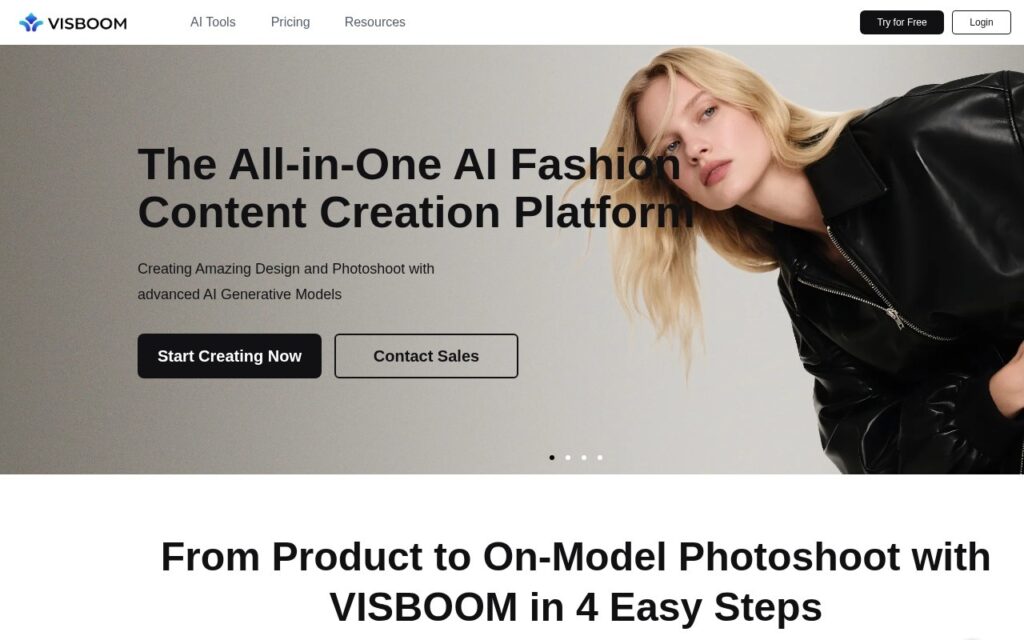
Visboom generates fashion product photography from flat garment images. Clothing try-on puts a piece on an AI model, shoe try-on does the same for footwear, and background swap and model swap change the setting and the person without another shoot. The named client list is unusually substantial for a tool at this stage – ANTA, FILA, DESCENTE, CAT, Champion, PORTS, VANS, Timberland, Pleaser and Atomic.
The economics behind this are real and not marginal. A conventional lookbook shoot means samples, a studio, a photographer, a model and a retouching pass, repeated per season and per market, and for a catalogue of hundreds of SKUs most of that cost buys images nobody looks at closely. Generating the long tail and shooting the hero pieces is a rational split, and named brands of this size using it is stronger evidence than any metric on the page.
Which brings the caution. The quantified claims – 15x reduced time to market, 92% lower asset costs, 16% higher conversion, 38% more click-throughs – carry no methodology, no baseline and no named study, and a logo on a client wall does not tell you whether that brand used the tool for its whole catalogue or one test. The substantive risk is downstream: a garment rendered onto a synthetic model drapes how the model predicts rather than how the fabric behaves, and clothing bought from a misleading image comes back. Returns are the cost centre this is supposed to help with. No rates are published; there is a free trial and a sales contact.