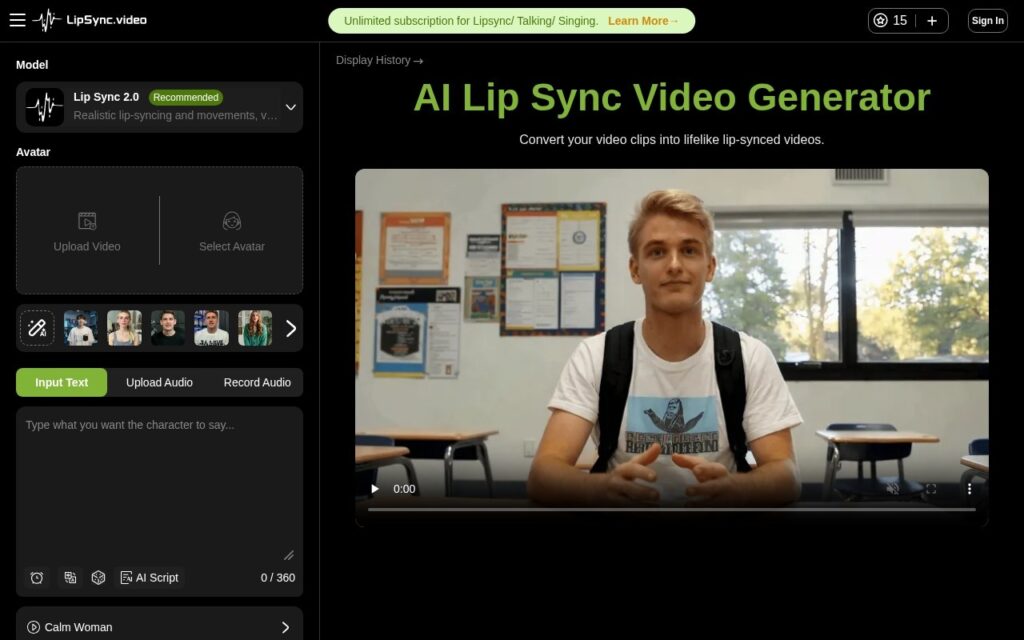
LipSync.Video matches mouth movement to an audio track, on humans, animals or cartoon characters, for talking, singing and dialogue. It runs two of its own models – Lip Sync 1.0, costing 1 credit per 90 seconds and tuned for speed on portraits, and Lip Sync 2.0 at 4 credits per 30 seconds for more realistic movement – alongside a 200-plus voice library with adjustable emotion and pace, 300-plus avatars, and integrations with external video models including Seedance 2.5 and Kling 3.0. The free tier exports without a watermark. It operates from Singapore.
Having its own models is what separates this from the six pure wrappers rejected elsewhere in this wave, and the two-tier split is honest engineering: a fast cheap pass for drafts and an expensive accurate one for the final take is how this work actually gets done, and publishing the credit cost of each before you run it lets you plan a project. No watermark on the free tier is unusually generous.
Two things to weigh. Credits are earned by checking in, sharing, following and posting as well as by paying – which means the free tier is bought with promotion rather than money, and the different credit types carry different expiry periods, so read that table before assuming a balance will still be there. More importantly, accurate lip sync is the technology that makes a real person appear to say words they never said. Used on your own footage or a cartoon it is ordinary production work; used on somebody else it is the thing legislators are currently writing laws about, and no consent policy appears on the page.