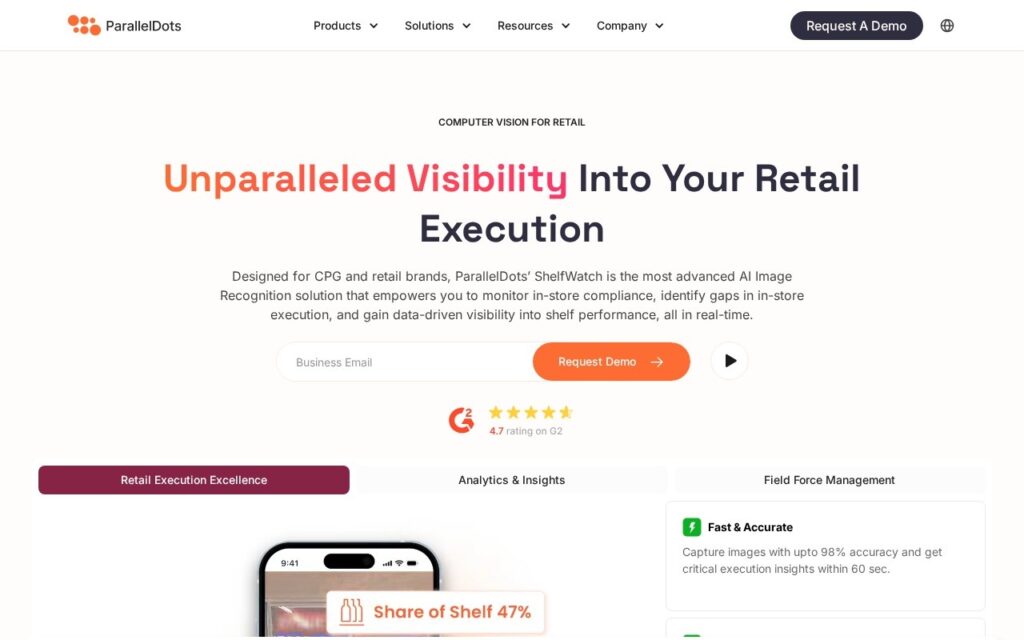
ParallelDots is a retail computer vision company, and ShelfWatch is the product most buyers come for. A field rep photographs a store shelf, and ShelfWatch reports the SKUs on it, share of shelf, planogram and price compliance, and what’s out of stock. It’s built for CPG brands auditing many outlets, not for a shop owner checking one aisle.
ParallelDots began with text-analysis APIs for sentiment and emotion detection, but its product line is now built around shelf recognition. ShelfWatch runs in a mobile app with on-device recognition that works offline, an augmented-reality audit flow called Scan and Go, and a fixed shelf-mounted ShelfWatch Camera.
Two newer products sit around it. Saarthi trains recognition models on new SKUs, which ParallelDots says it does quickly (check the vendor’s site for the current turnaround time). SmartGaze is a separate eye-tracking product for shopper and packaging research.
ParallelDots names large CPG manufacturers as customers and says it operates in many countries (check paralleldots.com for the current customer list and country count). Its headline claims are high recognition accuracy and results within a short time of capture (see the vendor’s site for the current figures).
Read those as vendor figures, not a benchmark. Your categories, store lighting and look-alike packs decide the accuracy you’ll get.
How Does ShelfWatch Turn a Shelf Photo Into Data?
ShelfWatch turns a shelf photo into store-level compliance data in four stages, from capture to a fix made in the aisle.
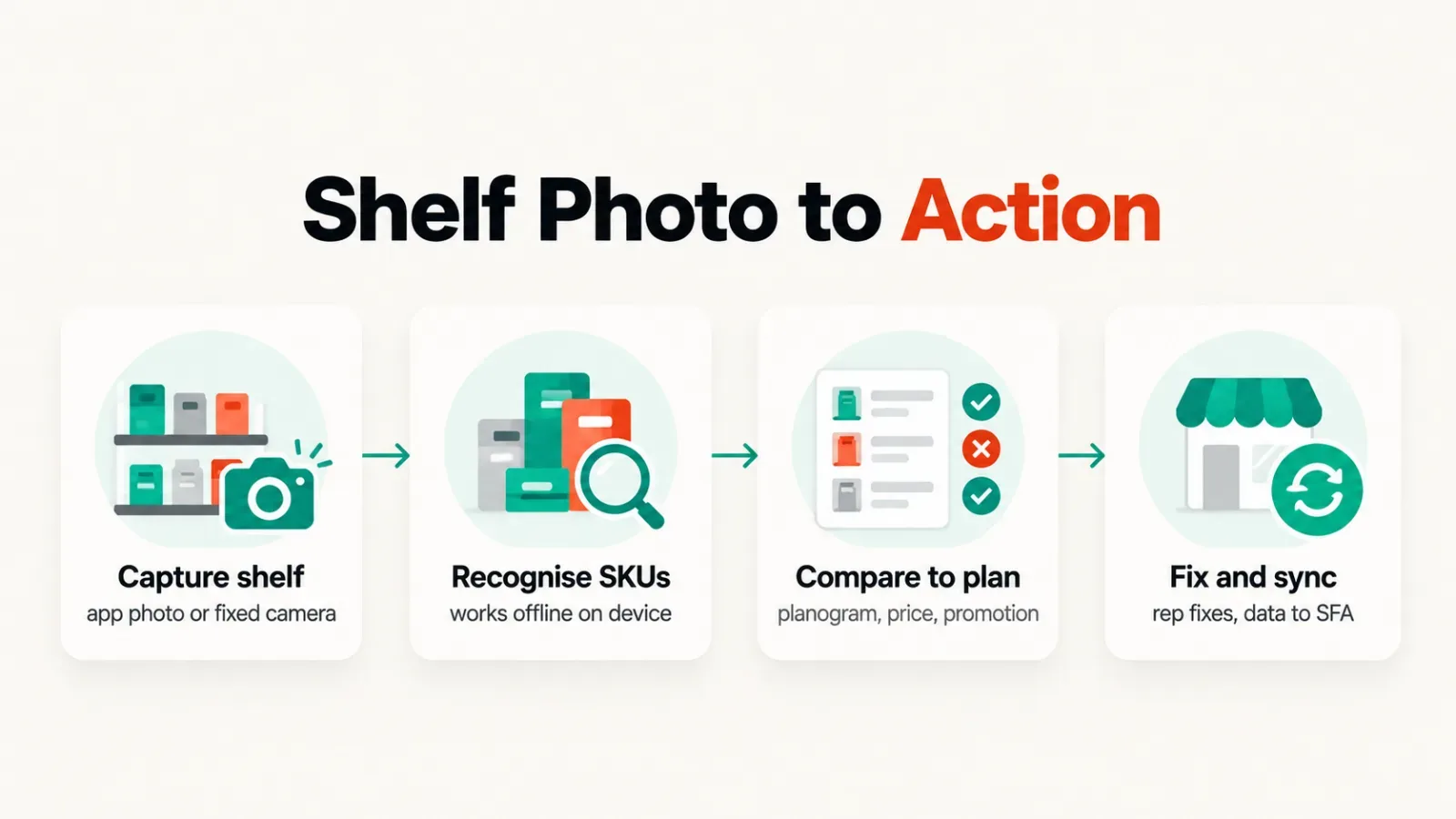
- A rep or merchandiser photographs the bay in the ShelfWatch app, or a fixed ShelfWatch Camera captures it on a schedule.
- Image recognition identifies each product facing, on the phone itself when the store has no signal.
- The result is checked against your planogram, price list and promotion plan to flag missing SKUs, wrong prices and lost facings.
- The rep fixes what’s fixable before leaving, and the data flows to sales systems such as SFA, CRM or ERP tools.
Step 2 is where deployments succeed or stall. A pack the model hasn’t seen gets missed until it’s retrained, so new-SKU turnaround matters more than the headline accuracy.
Who ParallelDots Fits, and Who Should Look Elsewhere
ParallelDots fits CPG manufacturers whose field teams or audit agencies visit many outlets. It’s a poor match for a small brand that wants a self-serve app it can switch on today.
| Your situation | Fit | Why |
|---|---|---|
| CPG brand with a field sales or merchandising team covering hundreds of stores | Strong | Photo audits on every visit replace manual shelf checklists |
| Brand that outsources store audits to an agency | Workable | ParallelDots lists integrations with field audit agencies |
| Reps working in rural or low-connectivity markets | Strong | On-device recognition doesn’t need a live connection |
| Team that wants continuous monitoring of key bays | Ask about the camera | The fixed ShelfWatch Camera needs in-store installation and retailer agreement |
| Small brand stocked in a few stores | Weak | Quote-only enterprise sales outweigh what a few manual audits cost you |
| Marketing team testing packaging attention | Different product | SmartGaze, not ShelfWatch, covers eye-tracking research |
What Should a ParallelDots Pilot Prove?
A ParallelDots pilot should prove three things in your own stores before you sign: recognition accuracy, new-SKU turnaround and how cleanly data reaches your systems. Don’t accept a demo on the vendor’s sample shelves as proof of any of them.
ParallelDots’ own case study reports a large rise in Unilever Ghana’s on-shelf availability (see the case study on paralleldots.com for the exact figures). It’s a vendor-reported result, so ask for the baseline period and how availability was measured.
Use these checks to set the pilot’s pass mark:
- Accuracy on your hardest categories, such as look-alike flavour variants and glossy packs
- Retraining time after a packaging change, measured against the 48-hour Saarthi claim
- Results landing in your SFA or CRM tool without manual exports
- Who reviews low-confidence images, and how long that review takes
Run the pilot in your toughest stores, not your tidiest ones. If ShelfWatch holds up where shelves are crowded and lighting is poor, the rollout won’t surprise you.