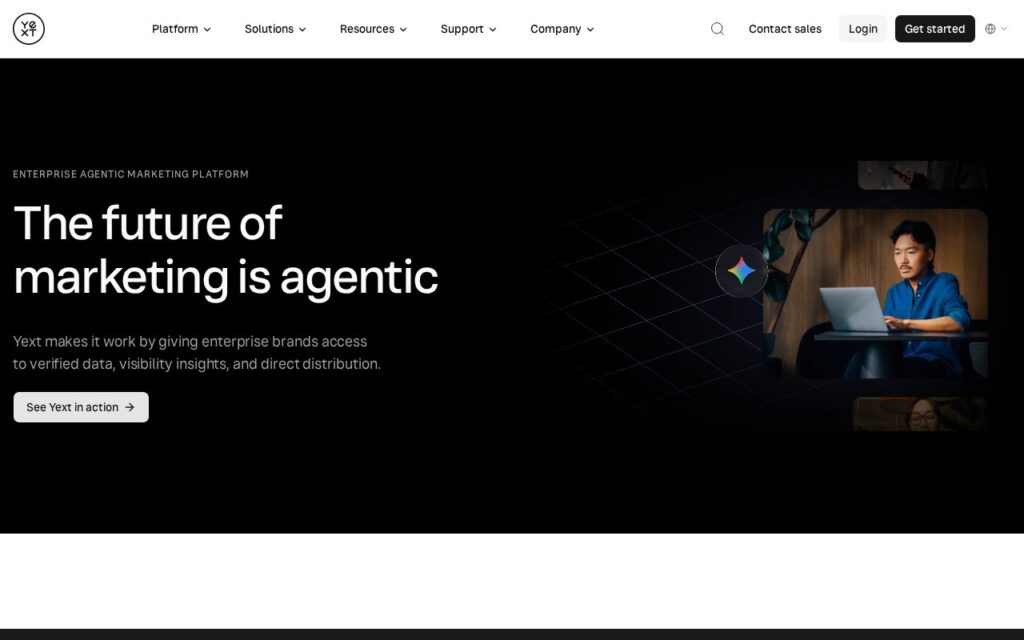
Yext centers its platform on a Knowledge Graph of verified brand data that AI agents draw from to answer questions about a business accurately, addressing the risk that outdated or inconsistent brand information gets picked up and repeated by AI search and chat tools. Content generation agents create on-brand local pages, social posts, review responses and email campaigns from that verified data, and distribution agents then syndicate the content in real time to LLMs, directories, maps, social platforms and review sites without a separate aggregator. Visibility insight tools show where a brand is losing ground to competitors in AI and traditional search, backed by the company’s own large-scale research such as a study of 17.2 million AI citations. Founded in 2006 by Howard Lerman, Brian Distelburger and Brent Metz, Yext has been a publicly traded company (NYSE: YEXT) since 2017 and states it manages data for brands with more than 4 million locations worldwide.
Yext is built for enterprise brands managing dozens of locations or a large content footprint, and its pricing is not published, so cost depends on a sales conversation scaled to a brand’s size. As with any platform managing a brand’s public data and automated content, a company should review what content its agents publish before assuming it needs no human oversight.
Pricing is not published; Yext sells its platform to enterprise brands through a sales conversation rather than a self-serve plan, sized to the number of locations and scope of data, content and distribution needed.