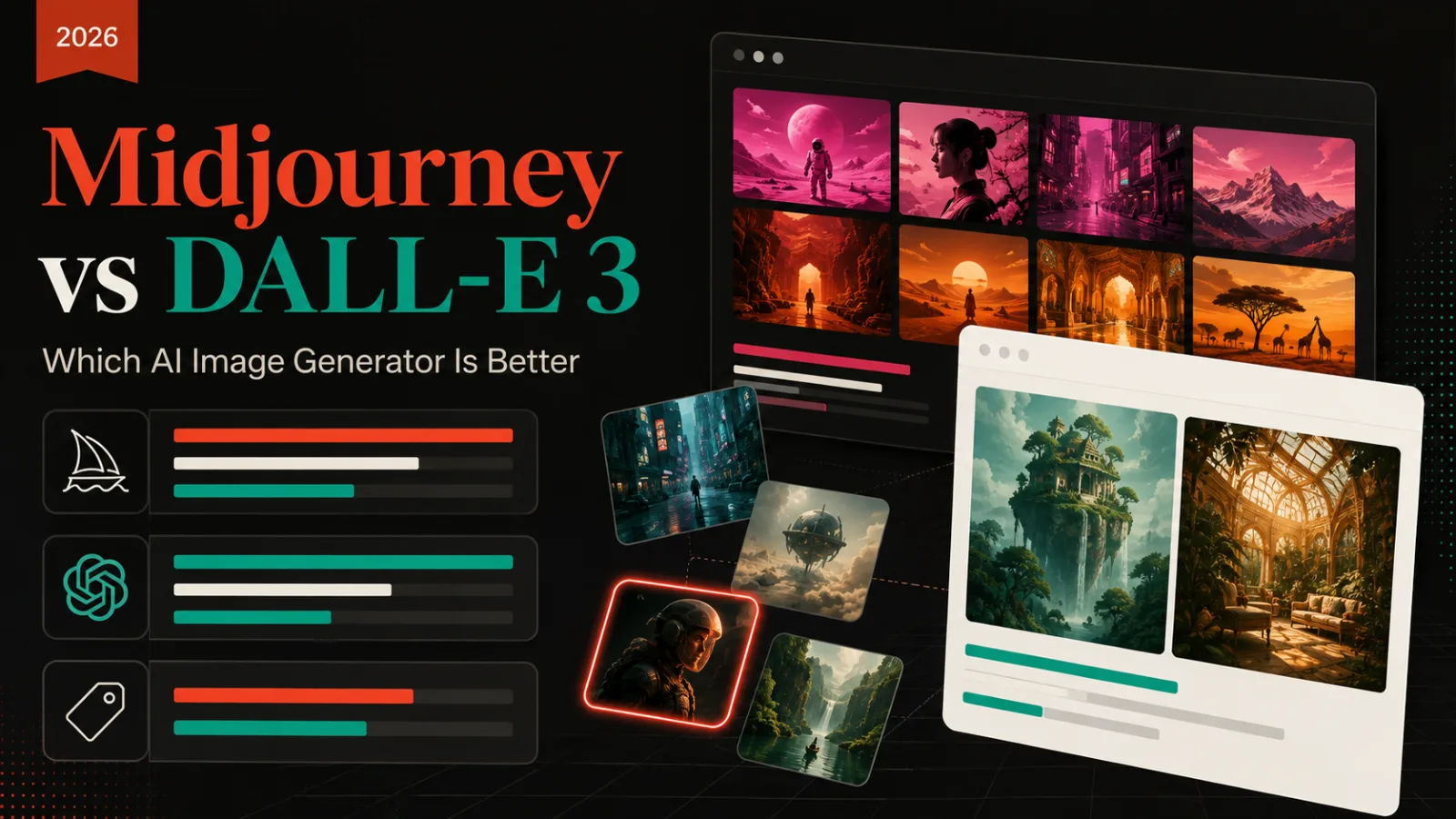
Midjourney and DALL-E 3 are two of the most recognized names in AI image generation, and for a long time they defined the choice between artistic polish and plain-language prompting. Midjourney is built for people who want striking, photorealistic, and stylized visuals. DALL-E 3, from OpenAI, was built for people who wanted to describe an idea in ordinary sentences and get a faithful result inside ChatGPT. There is one important catch in 2026 that shapes this entire comparison, and we cover it head on below.
The verdict in one line
For new work in 2026, Midjourney is the clear pick because it is actively developed and produces the highest image quality of the two, while DALL-E 3 has been retired from its main access points and replaced by OpenAI’s GPT Image models. If you specifically want the DALL-E lineage, you now use those successors rather than DALL-E 3 itself.
Midjourney vs DALL-E 3 at a glance
| Dimension | Midjourney | DALL-E 3 |
|---|---|---|
| Best for | High-quality, stylized, and photorealistic images | Plain-language prompting and short in-image text (when it was available) |
| How you access it | Web app at midjourney.com and the Midjourney Discord server, signed in with a Discord or Google account | Previously ChatGPT, the OpenAI API, and Microsoft Bing Image Creator, now replaced by GPT Image models |
| Free plan | No free plan; a paid subscription is required for ongoing use | Was reachable through the free Bing Image Creator, which is now moving to newer models |
| Paid plans | Basic $10, Standard $30, Pro $60, and Mega $120 per month, with lower annual pricing | Was included with ChatGPT Plus and billed per image on the OpenAI API; those paths now use GPT Image |
| Standout strength | Aesthetics, lighting, and photorealism | Strong adherence to long, multi-clause prompts |
| Main limitation | No public API and historically tricky character consistency | Deprecated and removed from its primary access points in 2026 |
Where Midjourney wins
Midjourney’s core strength is raw image quality. Its current V7 model, with newer V8 era updates rolling out through 2026, renders skin textures, fabric, reflections, and lighting in a way that often looks like a real photograph. V7 is Midjourney’s strongest model for photorealism so far, and portraits and product shots are where the difference from V6 shows most clearly.
Style is the other reason creators reach for it. Midjourney has a strong aesthetic point of view, so even simple prompts tend to come back looking composed and intentional. The web app adds practical control on top of that, including an in-browser editor for brushing out objects, moodboards for guiding style from reference images, and an organizer for filtering past generations. For art direction, concept work, and marketing visuals, this combination is hard to match.
Where DALL-E 3 wins
DALL-E 3’s headline advantage was prompt understanding. It followed long, multi-sentence, and multi-part instructions more reliably than most competitors of its generation, so you could describe a detailed scene without jargon and get the elements you asked for. That made it approachable for people who did not want to learn prompt syntax or parameters.
It was also notably better than earlier models at rendering short text inside an image, which helped with simple posters, labels, and mockups when kept to a few words. Its tightest advantage, though, was integration: living directly inside ChatGPT meant you could brainstorm a prompt and generate an image in the same conversation, with no separate app to learn. The honest caveat for 2026 is that this strength now belongs to OpenAI’s newer GPT Image models, which replaced DALL-E 3 in ChatGPT in late 2025.
Pricing compared
Midjourney does not offer a free plan in 2026. Its paid subscriptions are Basic at $10 per month, Standard at $30, Pro at $60, and Mega at $120, with lower effective rates on annual billing and additional fast GPU time available at $4 per hour. DALL-E 3 was previously included with ChatGPT Plus and billed per image through the OpenAI API, with API rates that started at $0.040 for a standard 1024 by 1024 image. Those DALL-E 3 paths were retired in 2026, so anyone pricing out the OpenAI route today is really pricing the GPT Image successors, not DALL-E 3.
Which should you choose?
- If you want the best possible image quality and style,: pick Midjourney because it leads on photorealism and aesthetics and is actively developed.
- If you want to start a new project today,: pick Midjourney because DALL-E 3 has been removed from ChatGPT, the OpenAI API, and is being retired from Bing.
- If you are committed to the OpenAI ecosystem,: use OpenAI’s current GPT Image models in ChatGPT or the API, since they are the official successors to DALL-E 3.
- If plain-language prompting inside a chat matters most to you, The DALL-E approach now lives on through those GPT Image successors rather than DALL-E 3 itself.
Frequently asked questions
Is DALL-E 3 still available in 2026?
Not through its main channels. OpenAI removed DALL-E 3 from ChatGPT in December 2025 and from its API on May 12, 2026, and Microsoft has signaled it is retiring DALL-E 3 from Bing Image Creator. OpenAI’s GPT Image models are the recommended replacements.
Does Midjourney have a free plan?
No. Midjourney requires a paid subscription for ongoing use, starting with the Basic plan at $10 per month. There is no standing free tier in 2026.
Do I need Discord to use Midjourney?
No. You can use the web app at midjourney.com and sign in with a Discord or Google account. Discord remains an option, but it is no longer required.
Which one is better for text inside images?
DALL-E 3 was the stronger of the two for short in-image text, typically up to a few words per element. Midjourney has historically been weaker at text. Since DALL-E 3 is now retired, OpenAI’s GPT Image successors carry that capability forward.