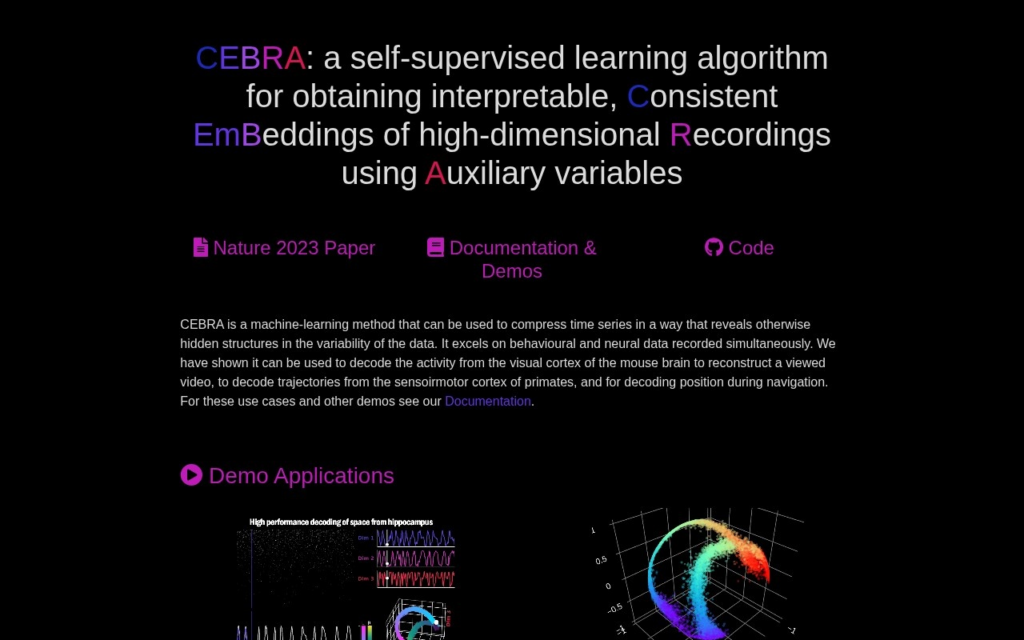
Cebra (Consistent EmBeddings of high-dimensional Recordings using Auxiliary variables) is an open-source machine learning method built at the Mathis Laboratory at EPFL (Swiss Federal Institute of Technology Lausanne) by Steffen Schneider, Jin Hwa Lee, and Mackenzie Weygandt Mathis. The underlying algorithm was published in Nature in May 2023 and has become a reference method in computational neuroscience for joint analysis of neural and behavioral recordings.
The method uses self-supervised contrastive learning to compress high-dimensional time series data, such as calcium imaging or electrophysiology recordings, into low-dimensional latent spaces that preserve underlying structure. A widely cited demonstration from the Mathis Lab used Cebra to reconstruct video frames a mouse had viewed directly from its visual cortex activity, illustrating the method's capacity to decode meaningful signal from raw neural recordings across species and experimental setups.
Cebra targets neuroscience researchers, computational biologists, and labs working with paired behavioral and neural datasets rather than business users. The core algorithm ships free and open source under an Apache 2.0 license on GitHub, installable as a Python package, with documentation and interactive demos hosted at cebra.ai; EPFL has filed a patent covering the technology, so organizations pursuing commercial, non-academic applications need to contact EPFL's Tech Transfer Office for licensing.