
List your tool
Freemium

Parseur

AI and OCR-based data extraction platform that turns emails, PDFs, and images into structured data.

4.4 Data and Analytics
4.4 Very good 4.4
Nearly a decade of operating history and a proven 100M-plus document track record Volume-based pricing can get higher-priced fast for high document counts
Reviewed by Challenging Voice Editorial · Updated Jul 2026 How we rate
PricingFrom $39/mo
Free planYes
CompanyParseur
PlatformsAPI, Web
CategoryData and Analytics
Founded2016
Last reviewedJul 2026

Is this your tool?

  • Claim this listing. Sign in with an email at parseur.com to manage it. Claim Parseur
  • Get into the top 5 of Data and Analytics. 5 of 5 spots open, from $159/month. See positions
  • Something out of date? Owners can request edits from My listings; anyone can tell us.
Ask AI about Parseur ChatGPT Claude Perplexity

Overview

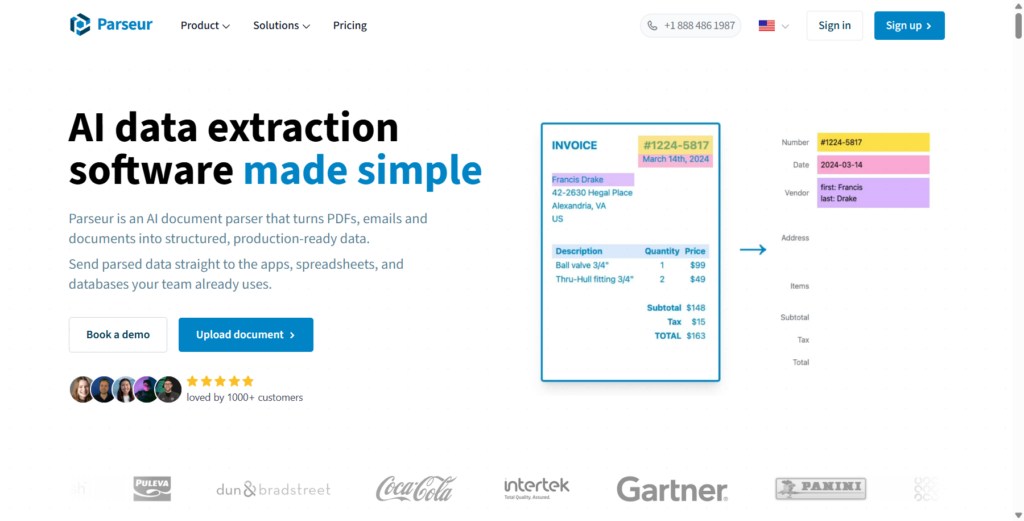
Parseur is a data extraction platform that pulls structured information out of emails, PDFs, images, spreadsheets, and HTML documents. Founded in 2016 by Sylvestre Dupont and Sylvain Josserand, the company is headquartered in Singapore and reports having processed more than 100 million documents as of 2025.

The platform runs three extraction engines in parallel: an AI engine for automatic field identification, zonal OCR for template-based capture, and a text-parsing engine for structured emails and HTML content, with handwriting recognition across more than 60 languages and scripts. Extracted data routes out through direct integrations or webhooks, and a Python SDK released in 2025 added programmatic mailbox management for teams building automation around the parser.

Parseur fits operations and back-office teams that receive repetitive documents such as invoices, orders, or booking confirmations by email and need the fields extracted without manual entry. Pricing is volume-based, starting near $39 per month for 100 pages on annual billing, with a permanent free tier covering 20 pages per month and per-page costs dropping as volume scales.

Key features

  • Three parallel extraction engines: AI, zonal OCR, and text parsing
  • Handwriting recognition across 60+ languages and scripts
  • Volume-based pricing with cost per page dropping at scale
  • Python SDK with webhook and mailbox management support
  • Support for PDFs, images, spreadsheets, emails, and HTML
  • Permanent free tier for low-volume use

Screenshots & demo

Demo video

Screenshots

Parseur screenshot 1

Pricing

Free
$0
  • 20 pages a month
  • 1 user; 90-day document retention
Base tier
From $49/mo, or $39/mo billed yearly (100 pages), to $269 or $199 (3,000 pages)
  • 1 user; 1-year retention
  • Chat and email support
Scale tier
From $499/mo, or $399/mo billed yearly (10,000 pages), to $3,699 or $2,799 (100,000 pages)
  • Up to 100 users; unlimited retention
  • Advanced post-processing and priority support
Enterprise
Quote only
  • Up to 10 million pages a month
  • Bank transfer, purchase orders and custom terms

Checked against Parseur’s pricing page on 24 September 2026. Prices change, so confirm on the official site before you buy.

Is Parseur expensive?

Parseur starts at $39, which is 50% above the Data and Analytics median of $26 a month across the 66 priced tools we list in that category.

The cheapest paid option in Data and Analytics starts at $2.99 and the most expensive at $2,700.

39% of Data and Analytics tools in the directory offer a free tier, and this is one of them.

Compared against every priced listing in Data and Analytics, recalculated as the catalogue changes. Method and the full market breakdown are in our AI tool pricing study.

Pros & cons

Pros

  • Nearly a decade of operating history and a proven 100M-plus document track record
  • Free tier lets small operations test extraction without payment
  • Three-engine approach handles both templated and unstructured documents
  • Per-page pricing drops as usage scales, rewarding growing accounts

Cons

  • Volume-based pricing can get higher-priced fast for high document counts
  • Zonal OCR templates need setup work for non-standard document layouts
  • Credits expire each billing period on monthly plans, unlike annual plans
  • AI extraction accuracy still requires spot-checking on unfamiliar document types

How it compares

ToolRatingFreeFromBest known for
Parseur (this tool)4.4Yes$39/moThree parallel extraction engines: AI, zonal OCR, and text parsing
Parsio4.1Yes$24/moFour parser types: template-based, AI OCR, AI, and GPT-powered
Kudra3.8Yes$209/moAI extraction of fields, tables, and summaries from documents
PDF Parser3.6No$9/moGPT-4-class vision models for context-aware extraction

Alternatives to Parseur

4 tools matched to Parseur on what they do, their category and their price.

PDF Parser

3.6

GPT-4-class vision models read PDFs and images with no templates required – adapting to structured forms or messy free-text layouts alike, JSON or CSV back in under 30 seconds.

Frequently asked questions

What is Parseur?
Parseur is a data extraction platform that pulls structured information out of emails, PDFs, images, spreadsheets, and HTML documents.
Is Parseur free?
Yes, Parseur offers a free plan. Paid plans unlock more features and higher usage limits, starting at $39/month.
How much does Parseur cost?
Parseur plans: Free $0; Base tier From $49/mo, or $39/mo billed yearly (100 pages), to $269 or $199 (3,000 pages); Scale tier From $499/mo, or $399/mo billed yearly (10,000 pages), to $3,699 or $2,799 (100,000 pages); Enterprise Quote only. Checked against the vendor's pricing page on 24 September 2026.
What are the best Parseur alternatives?
The closest matches in the directory are Parsio, Kudra, and PDF Parser, compared side by side above.

Reviews

4.4 Editorial rating No reviews yet

Write a review

More tools like Parseur

Kadoa

3.4

Describe the dataset you need in plain language – AI subagents discover, navigate, extract, and validate it from websites, PDFs, and spreadsheets, with every value traced back to its source.

Contact for Pricing Data and Analytics