Contact for Pricing

TextQL

Builds a governed ontology over enterprise data so agents answer from the same definitions.

4.1 Data and Analytics
4.1 Very good 4.1

Bottom line: TextQL is a strong data and analytics tool, best known for governed ontology over enterprise data.

A governed ontology stops agents inventing their own definitions No published pricing
Reviewed by Challenging Voice Editorial · Updated Aug 2026 How we rate
PricingContact for Pricing
Free planNo
CompanyTextQL Technologies
PlatformsAPI, Web
Best forData and Analytics
Visits12
Last reviewedAug 2026
UpdatedAug 2026
Ask AI about TextQL ChatGPT Claude Perplexity

Overview

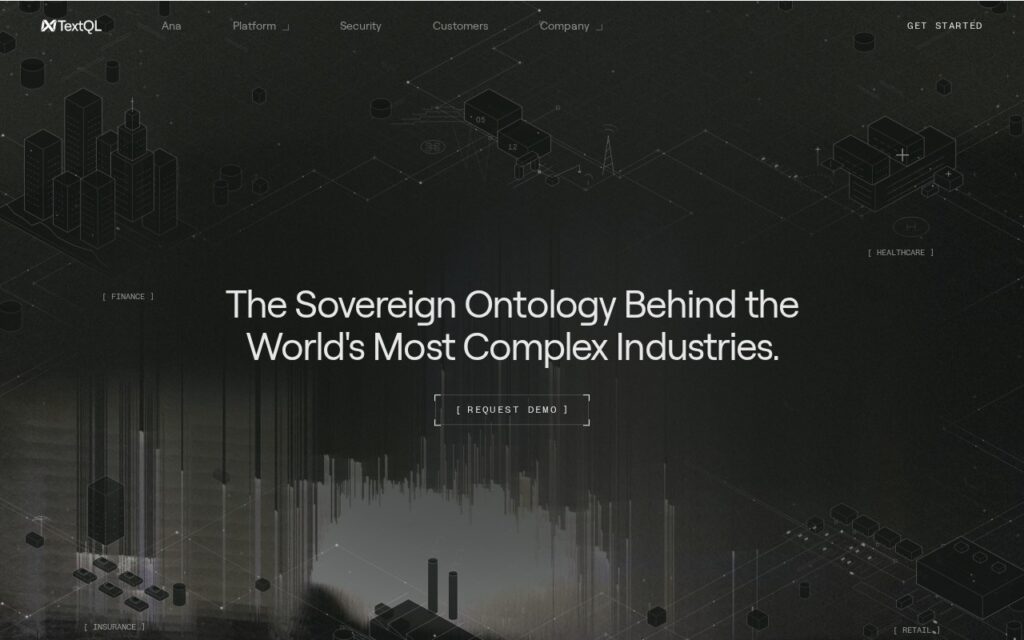
TextQL maps data across enterprise systems into an ontology, a governed knowledge graph that improves with each task, and then lets agents work on it. Ana answers complex questions including against legacy systems like SAP, Oracle and Teradata, Data Apps package answers into shareable applications, and Agents write back into source systems.

The ontology is the argument. Every organisation has three definitions of revenue and four of active customer, so an agent querying the warehouse directly produces confident answers from whichever table it found first. A governed semantic layer makes the definition explicit, and in healthcare and financial services it also carries the HIPAA, PII and 42 CFR Part 2 boundaries that make agent access permissible at all.

Blackstone, Dropbox, Amazon, Scale AI and the NBA are named, with 50-plus connectors. No pricing is published. Building an ontology is a substantial project before value appears, a self-improving semantic layer needs governance so it does not drift, and agents writing back into source systems is a permission model to design deliberately.

Key features

  • Governed ontology over enterprise data
  • Ana conversational agent across legacy systems
  • Data Apps built from the ontology
  • Agents that write back into source systems
  • 50-plus connectors including Snowflake, BigQuery and Salesforce

Screenshots & demo

TextQL screenshot 1

Pricing

TextQL uses custom pricing. Contact their team for a quote based on your needs.

  • Pricing modelContact for Pricing
  • Starting priceCustom
  • Free planNo
Visit TextQL

Pricing is provided as a guide. Check the official site for the latest plans.

Pros & cons

Pros

  • A governed ontology stops agents inventing their own definitions
  • Reaches SAP, Oracle and Teradata, not just modern warehouses
  • Regulatory boundaries encoded in the semantic layer

Cons

  • No published pricing
  • Building an ontology is a substantial project before value appears
  • Agents writing back into source systems need a deliberate permission model

How it compares

ToolRatingFreeFromBest known for
TextQL (this tool)4.1NoGoverned ontology over enterprise data
Celonis4.6NoAutomated process reconstruction from ERP and CRM event logs
FiftyOne4.5YesFreeInteractive visual interface for exploring images, videos, and their labels
Vanna4.4YesFreeOpen-source RAG framework for text-to-SQL

Our verdict

4.1 / 5 4.1

TextQL is a strong data and analytics tool, best known for governed ontology over enterprise data.

What makes it different: TextQL stands out for governed ontology over enterprise data.

How we score it
Overall 4.1
Value for money 4.2
Feature depth 4.9
Popularity 4.0
Best for ProfessionalsTeamsCreatorsCurious learners

Frequently asked questions

What is TextQL?
TextQL is a data and analytics tool listed in the Challenging Voice directory. Builds a governed ontology over enterprise data so agents answer from the same definitions.
Is TextQL free?
TextQL does not offer a free plan.
What are the best TextQL alternatives?
Popular alternatives to TextQL include Capalyze, PublicAI, and Tabscanner. Browse them all in the Data and Analytics category.
Is TextQL any good?
TextQL scores 4.1 out of 5 based on our editorial review.

Reviews

4.1 No reviews yet

Write a review

Similar tools you might like