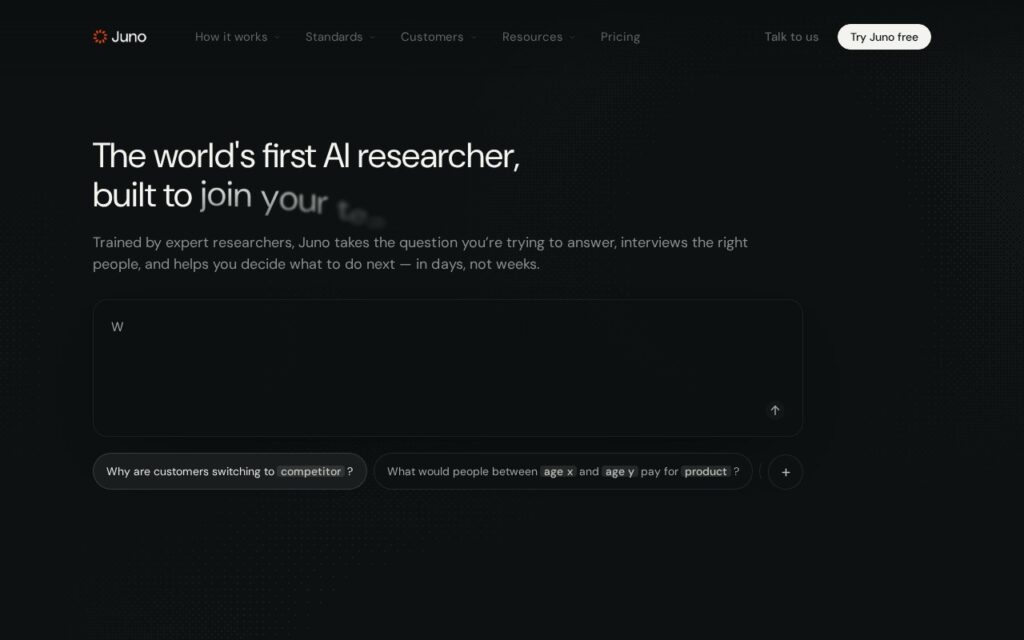
Juno automates qualitative customer research in three stages: Brief turns a plain-language description into a study design, Interview runs adaptive conversations that follow up on what a participant actually says, and Reveal synthesises the findings while exposing the evidence behind each one. It reaches a 21 million person panel across 56 countries and 100-plus languages.
Adaptive follow-up is what separates this from a survey with open text boxes. The value of a qualitative interview is almost entirely in the second and third questions, the ones a researcher asks because of what they just heard, and a fixed questionnaire cannot produce them. Exposing the evidence under each synthesised finding matters just as much: a themed summary nobody can trace back to a transcript is an opinion.
Interviews run through Slack, Teams, WhatsApp, Messenger, SMS or embedded in a web or app flow, with image, video and prototype stimulus, an API, SOC 2 Type II, GDPR compliance and PII redaction. Pricing is a flat $45 per interview with no subscription or minimum. People answer an AI interviewer differently from a human one, panel participants are a self-selecting population whatever its size, and synthesis across interviews is where a researcher’s judgement is hardest to replace.