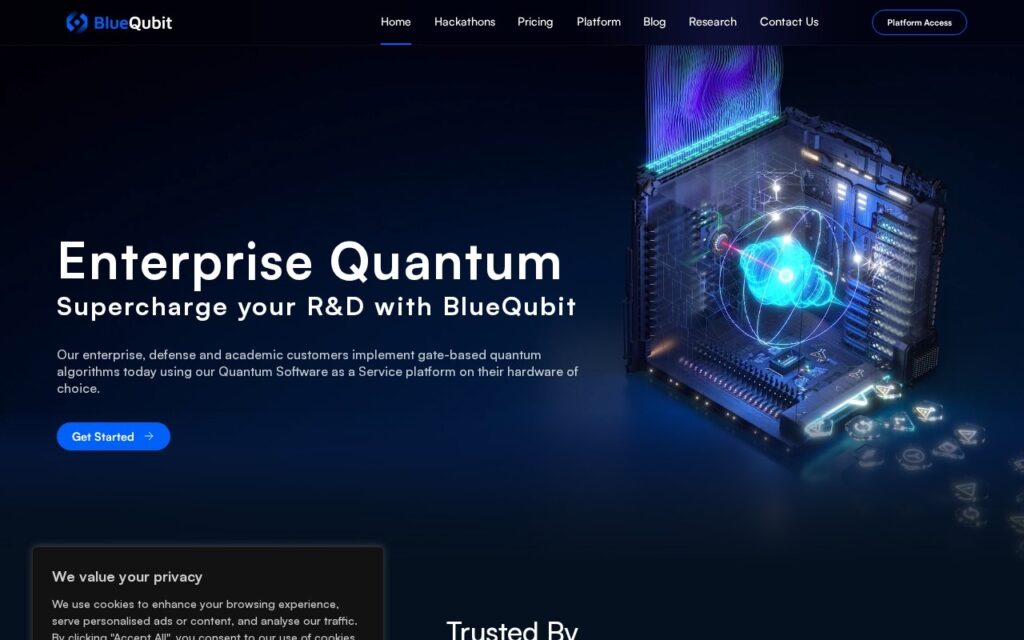
BlueQubit is quantum software as a service for gate-based computing. It provides access to IBM Heron at 156 qubits and Quantinuum H2 at 56, alongside Rigetti and IonQ processors and NVIDIA GPU-based emulators for work that does not need real hardware. A Python SDK and PennyLane integration are the entry points, and the named applications are quantum Monte Carlo for risk, portfolio optimisation and fraud detection.
Pairing real QPUs with GPU emulators in one platform is the practical decision. Almost all quantum development is debugging circuits that will never need a quantum computer to run, and paying for hardware time to find a logic error is a bad use of a scarce resource. Being able to develop against a simulator and promote the same circuit to a real processor without changing the code is what makes the workflow usable.
It sells to enterprise, defence and academic customers, runs a Quantum Advantage challenge with a $20,000 award, and offers free access with no pricing published beyond that. Read the AI framing carefully: this is quantum computing infrastructure with machine-learning applications on top, not an AI product. Current hardware is still in the noisy intermediate-scale era, so results need error mitigation and careful interpretation, and quantum advantage over classical methods remains unproven for most of the named use cases.