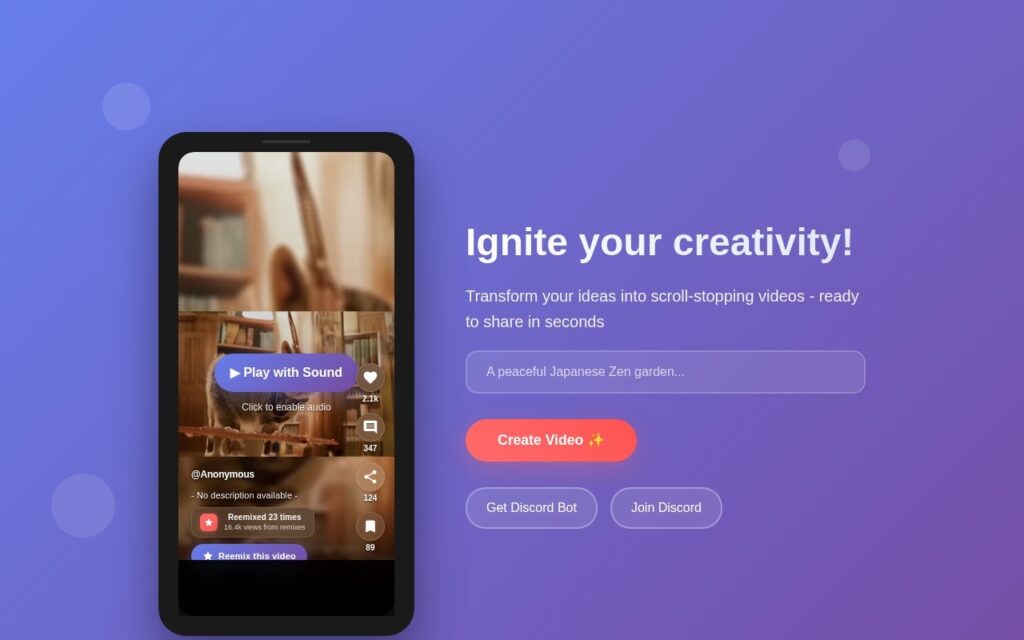
Reemix does AI video transformation: take a video you already have and describe how you want it changed, rather than generating footage from nothing.
That framing suits how most people actually make short-form content – they have the clip, they want it to look better. The site surfaces its common modifications directly: slow motion, golden hour, particles, cinematic. Working from a written description rather than a timeline of effect parameters is the whole appeal for anyone who is not a video editor.
Worth knowing before you evaluate it: the web experience is a preview, and the full feature set lives in the mobile app. If you plan to work on a desktop this is not the tool – but short-form video is shot and posted on a phone anyway, so mobile-first is a defensible choice rather than a gap.
Key features
Transforms existing video from a written description
Preset modifications – slow motion, golden hour, particles, cinematic
Interactive web preview before installing
Full toolset in the mobile app
Aimed at short-form creators rather than editors
Screenshots & demo
Pricing
Reemix offers a free plan, with paid upgrades for higher limits and more features.
Pricing is provided as a guide. Check the official site for the latest plans.
Is Reemix expensive?
Reemix has no advertised paid tier. Among the 144 priced tools we list in Video, the median entry price is $15.95 a month.
64% of Video tools in the directory offer a free tier, and this is one of them.
Compared against every priced listing in Video, recalculated as the catalogue changes. Method and the full market breakdown are in our AI tool pricing study.
Pros & cons
Pros
Describing a change in words is far easier than learning effect parameters
Works on footage you already have instead of generating from scratch
Mobile-first fits how short-form video is actually made
Cons
The web version is a preview – the real product is the mobile app
No desktop editing workflow
Preset-led, so unusual transformations may not be achievable
Remote video production app that records studio-style footage from a guest's iPhone, with AI multicam shots from one phone, lighting detection, cinematic bokeh, virtual camera moves and AI-generated edits.