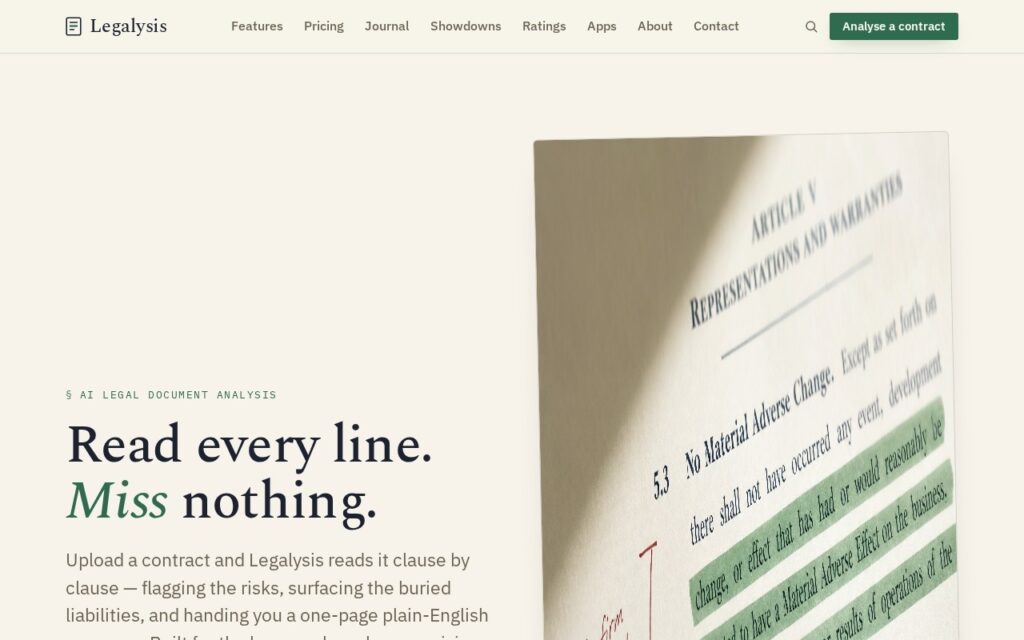
Legalysis analyses contracts clause by clause, flagging risks, surfacing buried liabilities and producing a one-page plain-English summary.
The plain-English summary is the part that matters for its likely audience. Most people who sign contracts are not lawyers, and the risk is rarely in the clause they read carefully – it is in the indemnity, auto-renewal or liability cap they skimmed. A clause-by-clause pass with a readable summary at the end is a genuinely different proposition from a search tool, because it does not require you to know what to look for.
The site publishes ratings and comparison “showdowns” alongside the product, and pricing is public. The necessary caveat: this is an aid to understanding a contract, not legal advice, and anything consequential still warrants a lawyer who knows your circumstances.
Key features
Clause-by-clause contract analysis
Risk flagging and buried liability detection
One-page plain-English summary
Upload and analyse without legal training
Published pricing
Comparison and ratings content alongside the product
Screenshots & demo
Pricing
Legalysis offers a free plan, with paid upgrades for higher limits and more features.
Pricing is provided as a guide. Check the official site for the latest plans.
Is Legalysis expensive?
Legalysis has no advertised paid tier. Among the 20 priced tools we list in Legal AI, the median entry price is $99.5 a month.
12% of Legal AI tools in the directory offer a free tier, and this is one of them.
Compared against every priced listing in Legal AI, recalculated as the catalogue changes. Method and the full market breakdown are in our AI tool pricing study.
Pros & cons
Pros
Plain-English summary suits people who sign contracts but are not lawyers
Clause-by-clause reading catches what skimming misses
Public pricing rather than a sales conversation
Cons
An aid to understanding, not legal advice
Anything consequential still warrants a lawyer who knows your situation
Analysis quality varies with contract complexity and jurisdiction
AI reviews contracts, explains redlines, suggests fallback wording and generates an updated draft from your selected recommendations – choose the underlying model from Claude, GPT-5 or Gemini.