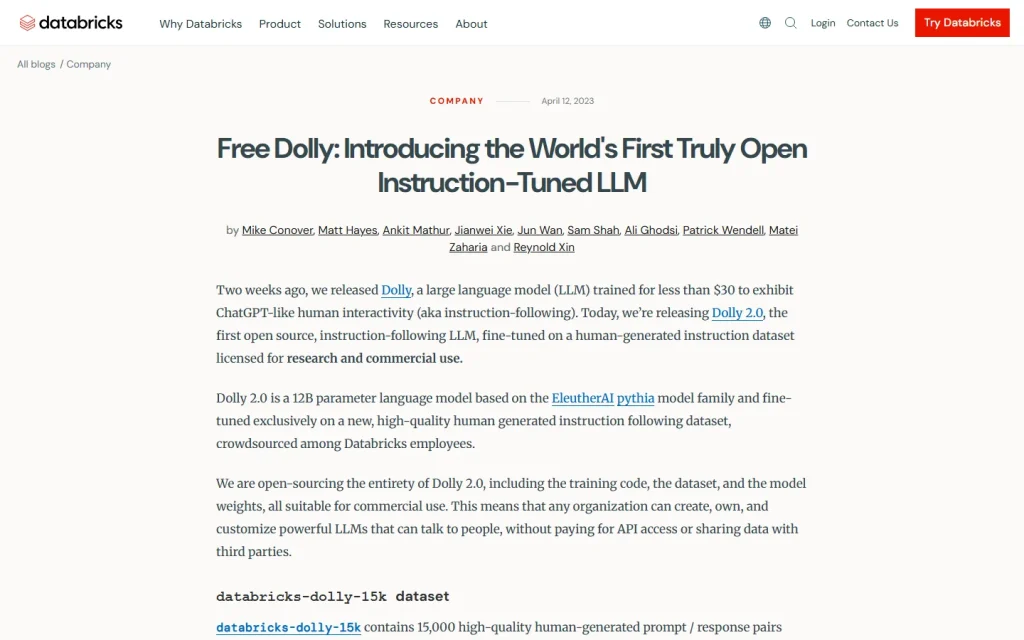
Dolly by Databricks is an open-source, instruction-following language model released in 2023. It lets teams run a ChatGPT-style assistant on their own infrastructure, with weights they can download for free. It was built to show that a small, openly licensed model could be taught to follow instructions cheaply.
Which Dolly This Listing Covers
Dolly came in two releases, and the names get confused. The first Dolly was a 6 billion parameter model fine-tuned on the Stanford Alpaca dataset, which carried licensing limits on commercial use. Dolly 2.0 fixed that.
Dolly 2.0 sits on EleutherAI's Pythia base model, with a 12 billion parameter flagship and smaller versions. It was fine-tuned on databricks-dolly-15k, a set of 15,000 prompt and response pairs written by Databricks employees. That human-written, openly licensed dataset is arguably Dolly's most useful legacy. This listing covers Dolly 2.0.
How You Can Use Dolly
Dolly is a model, not an app. You download the weights from Hugging Face, load them with the transformers library, and run them on a GPU you control. Inside a Databricks workspace it's quicker, since the company published notebooks for it. If you already run the Databricks Unified Data Analysis Platform, that's the shortest path to a working demo.
Tasks it handles passably: brainstorming, summarising short text, rewriting, simple question answering and extraction. It's weaker at multi-step reasoning, code and long documents. And the 12B version needs a large GPU for responsive output, so budget for compute even though the weights cost nothing.
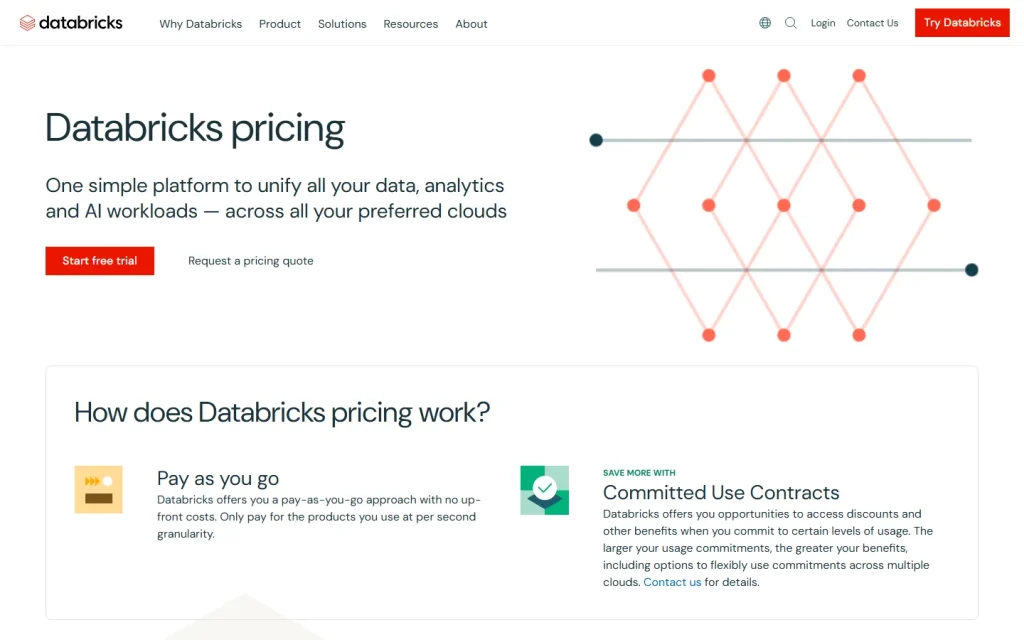
Pricing is simple: the model is free, and your bill is hardware or cloud time. Check the license on the model card before shipping it in a product.
Who Should Still Pick Dolly
Pick Dolly if you want a small, inspectable model for learning, for fine-tuning experiments, or as a baseline, or if you want to reuse the databricks-dolly-15k dataset to train your own. It's also a fair teaching example of how instruction tuning works.
Skip it for production quality. Newer open models answer better, and Databricks has since released larger models of its own, such as DBRX. If your goal is asking questions of company data in plain English, look at Databricks Genie instead, which is a product rather than a raw model.