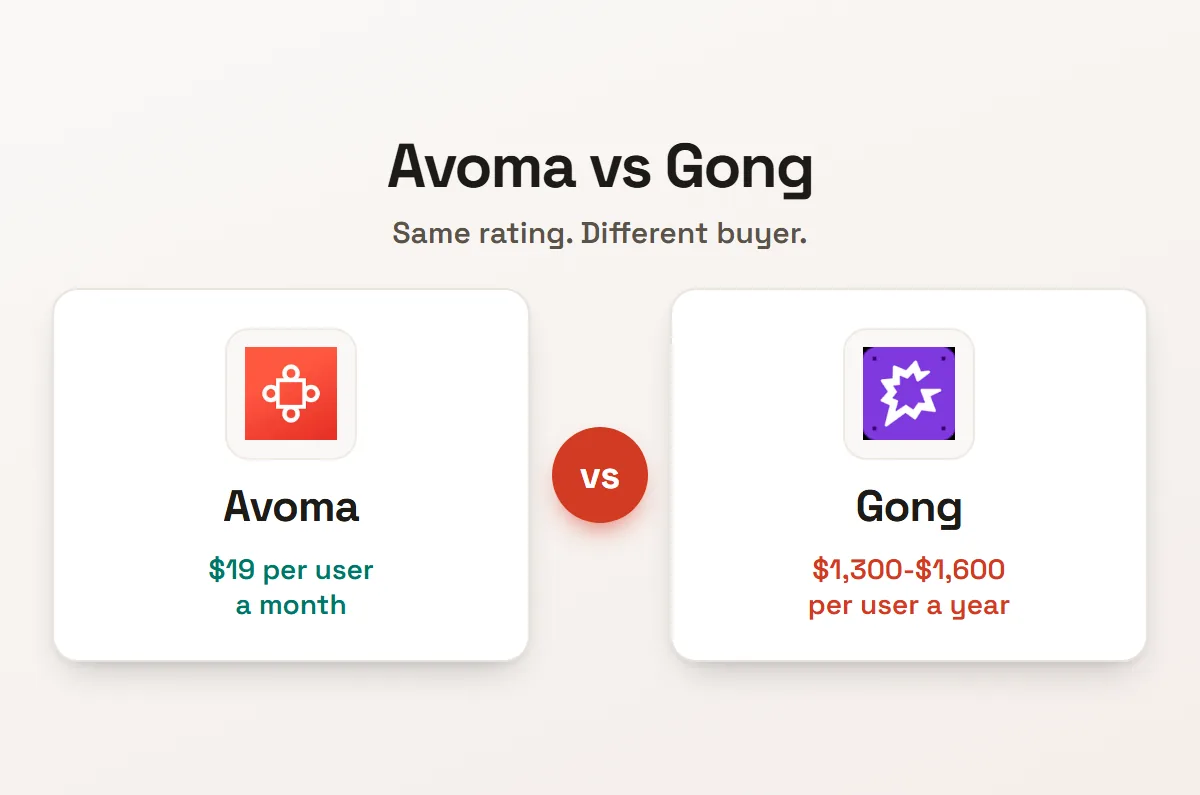
The short answer on Avoma vs Gong: Avoma at $19 per user a month suits a team buying its first conversation intelligence. Gong suits an organisation with sales managers whose job is coaching.
Both hold an editorial rating of 4.4 in our catalogue, and they aren’t close on price. That combination is the whole decision, so this compares them on what the money buys rather than ranking one above the other.
| Avoma | Gong | |
|---|---|---|
| Our rating | 4.4 | 4.4 |
| List price | $19 per user a month | $1,300 to $1,600 per user a year |
| Free tier | No | No |
| Running since | 2017 | 2015 |
| Sold to | Sales and customer success teams | Sales managers |
| Covers | Meetings, deal health, coaching | Calls, meetings, email threads |
| Pricing published | Yes | No, through sales |
The price gap, in comparable units
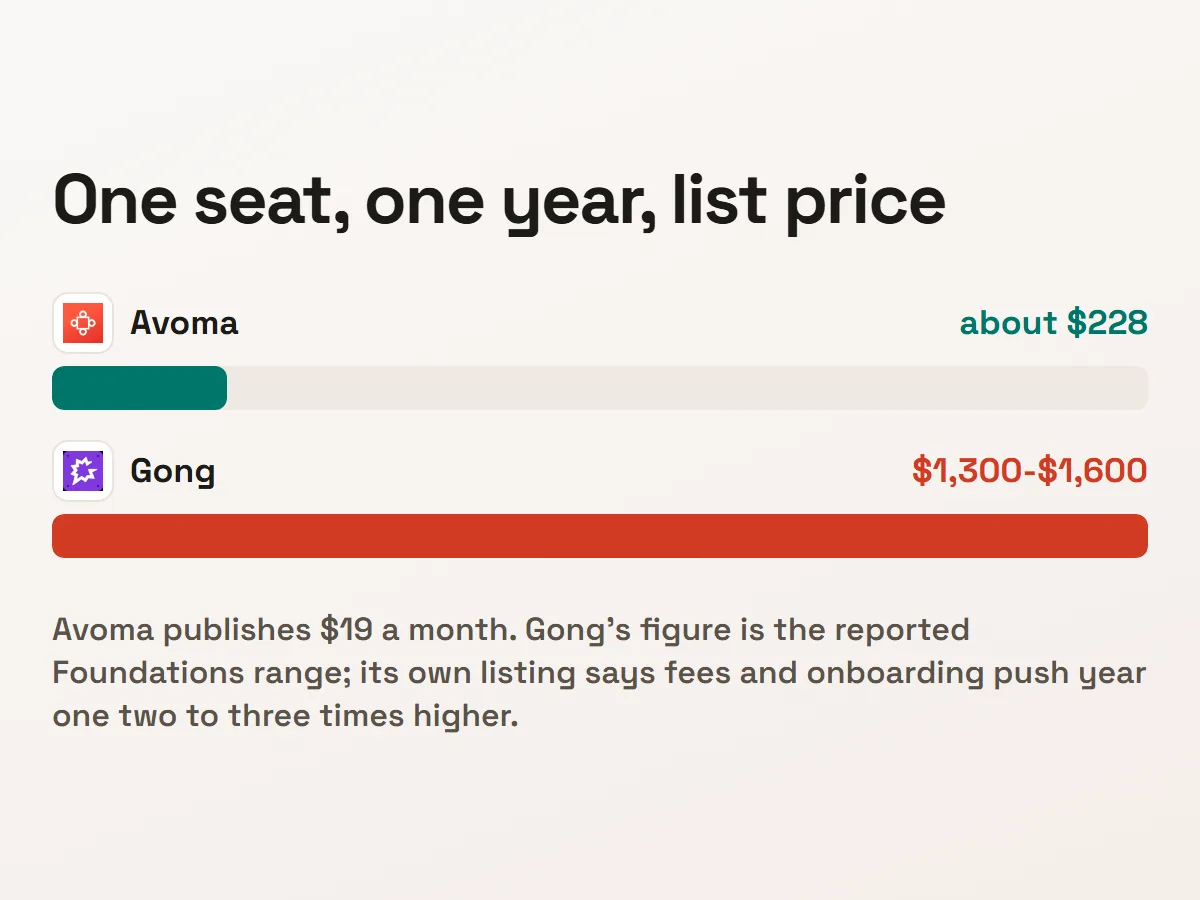
The two products quote in different units, which makes the headline numbers useless side by side. Avoma publishes $19 per user a month. That works out at roughly $228 per user a year.
Gong doesn’t publish a price. Reported figures put its Foundations tier at $1,300 to $1,600 per user annually. On list alone that is about six times what Avoma costs for the same seat.
The real gap is wider. Gong’s own listed limitation says platform fees, onboarding and add-on modules commonly push the effective first-year cost two to three times higher than the advertised seat rate.
So the honest framing is not six times but somewhere past twelve in year one. A ten-person team is comparing about $2,300 a year against a five-figure commitment, before anyone has recorded a call.
What both of them do
Both record and transcribe sales conversations, then read the transcript for signals rather than handing back a wall of text. Both track talk-time, objections and competitor mentions across calls.
Both aim at the same underlying problem. A manager can listen to perhaps three calls a week while a team of ten runs hundreds. Anything unsampled stays invisible unless software reads all of it.
Both also ground coaching in patterns rather than incidents. A single bad call tells you little; the same objection landing badly across thirty calls tells you what to fix in the pitch.
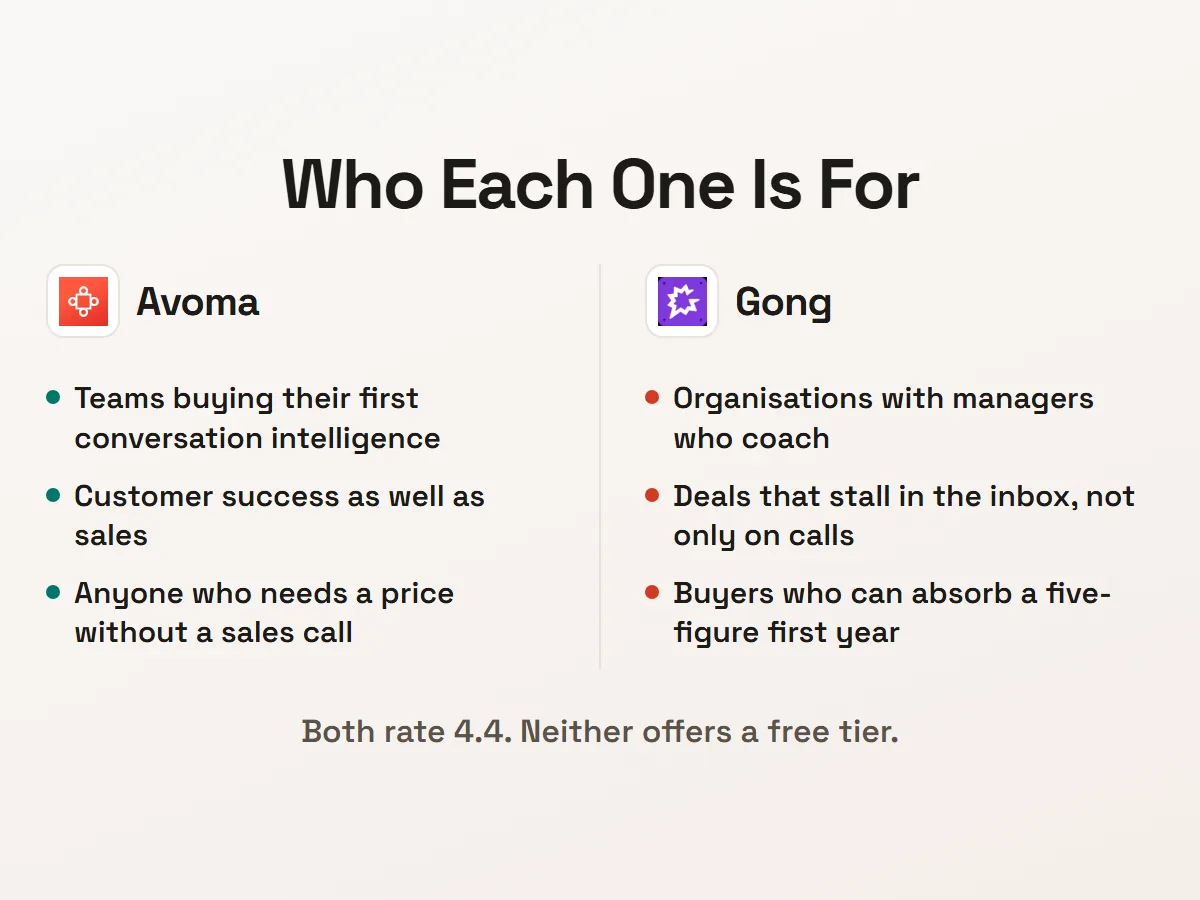
And neither has a free tier. You cannot try either one without a commercial conversation, which matters more for Gong, where that conversation is the only route to a price at all.
The case for Avoma
Avoma has run since 2017 with one audience in mind: sales and customer success teams where a conversation connects to a deal. That focus decides what it surfaces from a call.
Beyond what was said, it flags whether a deal looks likely to close and whether a customer looks at risk of leaving. Customer success is a first-class use case rather than an afterthought bolted onto a sales product.
The published price is the other half of the argument. You can size the cost from the website and start at a team size that would not clear a procurement threshold anywhere.
Its own limitation is honest about the ceiling: full value needs enough call volume for patterns to appear. Below a certain number of calls a month, both products are guessing, and the cheaper guess is the sensible one.
The case for Gong
Gong reads email threads alongside calls and meetings. That’s a genuine difference rather than a feature-list line, because a deal stalls in the inbox as often as on a call.
It sells to sales managers specifically, and the product reflects who signs off. The output is aimed at answering which reps need developing and which deals are slipping, at a team level rather than a rep level.
Scale is the other argument, and it’s a real one. $500 million in annual recurring revenue at a $4.5 billion valuation, up from $332 million in 2024, with $583 million raised across seven rounds.
That matters because conversation intelligence is a long commitment. A vendor holding years of your call history needs to still exist in five years, and Gong’s numbers make that a safer bet than most.
What changes at ten reps
Team size decides this more cleanly than any feature does. Below roughly five reps, neither product has enough calls to find a pattern, and the cheaper one is the only defensible choice.
Between five and twenty, Avoma’s economics are hard to argue with. Twenty seats runs about $4,560 a year at list, where the same twenty on Gong starts near $26,000 before platform fees and onboarding land on top.
Past twenty reps with dedicated managers, the calculation flips. Email analysis and manager-level rollups start paying for themselves once someone is employed to act on them daily rather than occasionally.
The threshold is a person, not a headcount. Gong is worth its price when a manager’s job description includes coaching, and it is an expensive transcript service when it does not.
The cost that isn’t on the invoice
Both products need connecting to your calendar, meeting tool and customer records before they return anything useful. That is setup work somebody owns.
Gong’s own limitation names onboarding as part of why the first year runs high, which is unusually candid. Budget the internal time as well as the fee, because a half-configured rollout produces transcripts nobody reads.
Avoma asks less at setup and gives less back at the top end. That trade is consistent: it is the lighter product in both directions, which is the reason it suits a team without an operations function.
What it feels like for a rep
Both products are bought by a manager and lived with by everyone else, which is the part procurement forgets. Every call a rep takes becomes reviewable, and that lands differently depending on how the numbers get used.
Used well, the same pattern-matching cuts both ways. A rep sees which of their own objections keep failing without waiting for a quarterly review. Talk-time ratios are easier to accept from software than from a person.
Used badly, it becomes surveillance with a dashboard. Neither vendor can prevent that, and no feature comparison will tell you which way your organisation will go. The manager decides that, not the tool.
It is worth naming because adoption fails here more often than on features. A rep who thinks the recording exists to catch them out schedules the difficult conversations off the platform. Then the data is wrong as well as resented.
What neither tells you up front
Both record people, and neither buying page leads with that. Your staff and the people they call have to be told, and the rules differ by country and by state rather than by vendor.
Neither publishes what happens to that recording afterwards in the place you’d look for it. Ask both, in writing, before a pilot rather than after.
Add-ons are the other gap. Gong’s forecasting and engagement modules are separate purchases, so the quoted seat price describes a narrower product than the demo did.
Who should buy neither
If your problem is meeting notes rather than deal coaching, both are the wrong shape and the wrong price. A general meeting assistant does that job for a fraction of either.
If the question is whether the number gets hit rather than how the calls went, that’s forecasting. Clari sells toward revenue leadership and answers a different question from either of these.
And if nobody currently reviews calls at all, software will not create that habit. Both products assume a manager who already coaches and wants better inputs, not one who needs persuading to start.
How we rate these
Our rating comes from reading each product’s features, pricing and positioning against the rest of our sales tools catalogue. We then check the product is still live and still sold as described. It isn’t a lab score.
Both landing on 4.4 is the point rather than a coincidence. Each is good at what it set out to do. A single ranking would hide that they set out to do it for different buyers.
What we can’t tell you is which produces better coaching in your team. That depends on your managers, and no vendor benchmark measures it. Every price above came from the listing, each of which carries its own last-reviewed date.
What to settle before you sign
Five questions decide this more reliably than a feature comparison does.
- Volume: the number of calls a month your team runs, since patterns need a sample
- Coach: whether a manager already reviews calls, or you’re hoping to start
- Total: the first-year number including platform fees, onboarding and add-ons
- Consent: what your staff and their contacts are told, and where that’s recorded
- Exit: who owns the call history if you leave, and in what format
Questions buyers ask
Is Gong worth six times the price?
It depends on whether you have managers who coach. Gong’s advantages, email analysis, manager-level rollups and scale, all pay off through someone acting on them. Without that person, you’re buying a more expensive transcript.
Does either have a free trial?
Neither lists a free tier. Avoma at least publishes its price, so you can size the cost before contacting anyone. Gong requires a sales conversation to reach a number at all, which is worth budgeting time for.
What about Clari?
Clari sells toward revenue leadership and forecasting rather than call coaching. It answers whether the quarter lands, where these two answer what happened on the calls. Teams do run Gong and Clari together for that reason.
Can we run one and switch later?
You can, and the friction is the call history rather than the contract. Ask both vendors what you get on the way out and in what format. Years of recordings are the thing that makes leaving expensive, not the notice period.
Which is better for customer success?
Avoma, on its own positioning. Customer success is a named audience there rather than a sales product stretched sideways, and churn-risk signals sit alongside deal-health ones. Gong aims squarely at the sales manager.
Will our reps object to being recorded?
Some will, and how you introduce it matters more than which product you pick. Both record every call once connected. Teams that frame it as coaching input see less resistance than teams that frame it as oversight, and the software is identical either way.
Do we need to tell people we’re recording?
Yes, and the requirement comes from where you and the other party are, not from the software. Both products record by default once connected. Settle the policy before the pilot rather than discovering it during one.