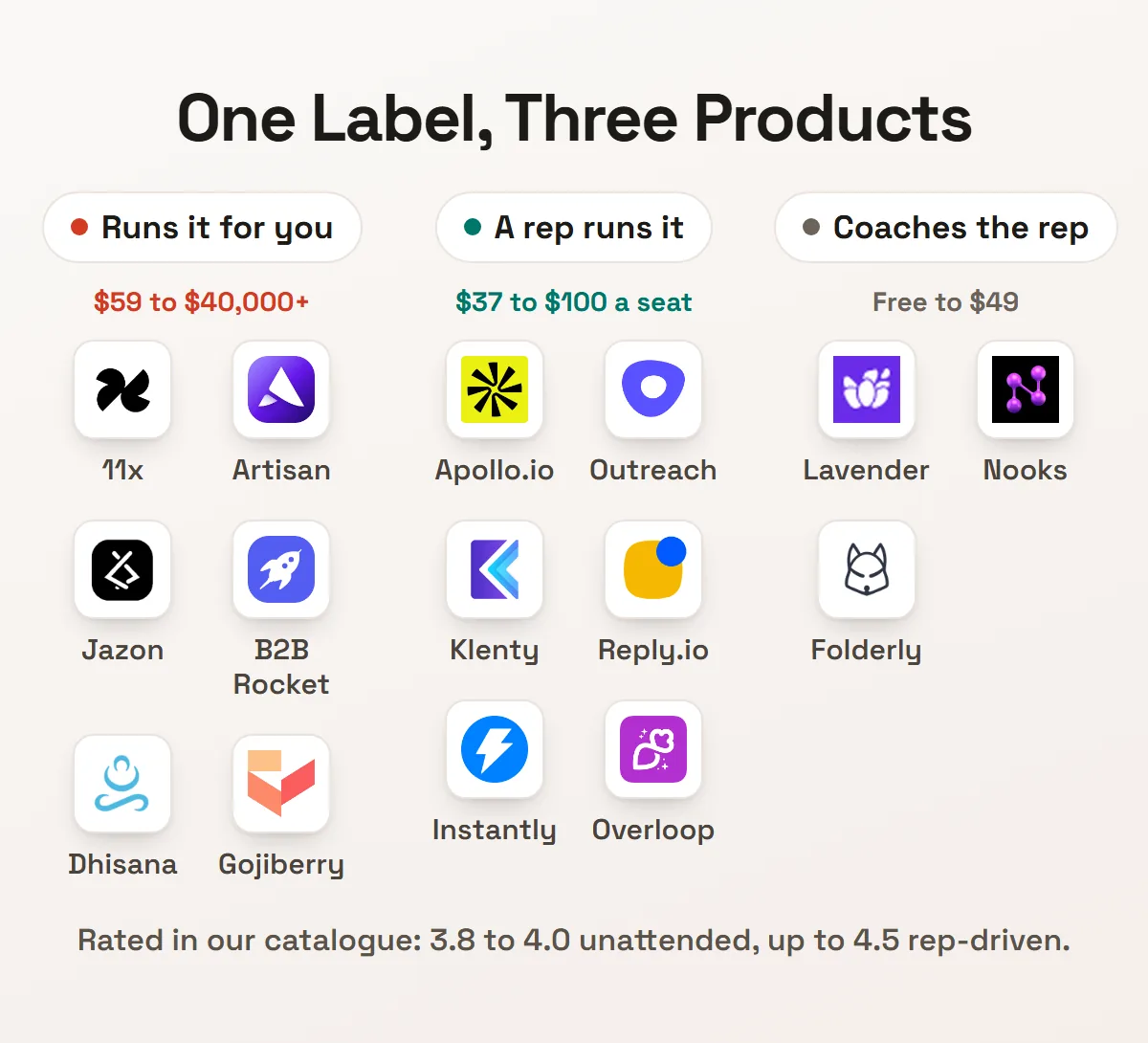
An AI SDR tool is three different products wearing one label. 11x sells a digital worker on an annual contract.
Apollo.io sells a seat a rep drives for $49 a month. Lavender coaches the writing and sends nothing.
Our catalogue holds 41 listings doing some version of this job. Sorted by rating, everything above 4.0 is a tool a person operates, and nothing that runs outbound unattended clears that line.
So the first decision isn’t which vendor. It’s which of the three layers you’re short of, because buying the wrong one costs between $348 and $65,000 a year and fixes a problem you didn’t have.
| Layer | Who does the sending | Entry price | Our ratings |
|---|---|---|---|
| Autonomous agent | Software, unattended | $59 a month to $40,000 a year | 3.8 to 4.0 |
| Sales platform | A rep, at scale | $37 to $100 a seat monthly | 3.9 to 4.5 |
| Writing coach | A rep, message by message | Free to $49 a month | 4.0 to 4.3 |
| Inbound responder | Software, on your own site | Not published | 3.7 to 3.8 |
Layer one: software sold as a headcount
These products are priced against a salary rather than against other software. 11x ships two named workers, Alice and Julian, covering email, phone, WhatsApp, text and LinkedIn between them.
The contract reflects the framing. 11x runs $40,000 to $65,000 a year on its own listed pricing, which is a hiring decision routed through procurement, not a subscription somebody expenses.
Artisan takes the same idea cheaper. Ava works email and LinkedIn only, from around $999 a month, dropping the phone and messaging channels that push the broader products into five figures.
B2B Rocket starts at $59 and Gojiberry at $99, which tells you the label alone predicts nothing about the bill. Same promise, two orders of magnitude apart.
Dhisana is the one you can try without a call, on a free starter tier, with paid plans from $199. Its listed limit is worth reading first: the lower tiers meter agent work, and the professional plan caps the team at three people.
Jazon, from Lyzr, publishes no price at all. That’s the norm at this layer rather than the exception, and it’s the practical reason these products are slow to evaluate.
Layer two: the platform a rep drives
Here the software finds and sequences, and a person decides and sends. Apollo.io carries 230 million contacts and 30 million companies with sequencing on top, from $49 a seat with a free tier underneath.
These are older companies. Apollo has run since 2015, Outreach since 2014, Klenty since 2016. Every autonomous product in the layer above launched in 2023 or later.
Outreach is the enterprise end and prices like it. Its listing puts enterprise plans past $160 a user monthly and a 50-seat deployment near $72,000 a year, which lands in the same bracket as a digital worker.
Klenty at $50 to $100 a seat and Overloop at $69 sit in the middle. Overloop’s own control is the interesting part: campaigns need team review before they launch, a deliberate brake on the thing layer one removes.
Instantly at $37 solves a narrower problem than the others: inbox capacity and warm-up, so cold mail arrives at all. It’s infrastructure rather than a place a rep works.
Reply.io sits across both layers. It runs the sequencing platform and also ships Jason, an agent doing the layer-one job, which is where this category is heading.
Layer three: the coach that sends nothing
Lavender scores an email while you write it, for tone, length and personalisation, and hands back specific edits. It has no sending infrastructure and doesn’t want any.
At 4.3 it’s the highest-rated tool in this post after Apollo, from $29 with a free tier. The cheapest layer holds the best-rated products, which is the opposite of what the pricing suggests.
Its listed weakness is honest and structural. Coaching only works if the rep applies it, so the tool improves nothing on a team that ignores the suggestions and keeps sending.
Nooks does the same for calls, having grown from a parallel dialler into coaching and account research on roughly $70 million raised. Its reported $4,000 to $5,000 per user a year is a layer-one price for a layer-three product.
Folderly drafts rather than coaches, from $49, with a free tier and templates carrying performance benchmarks. Its listing warns the output still reads generic without a human pass, which is the whole problem in one line.
Inbound is a separate product
Two of the tools here answer people who already raised a hand, which is a different job from cold outreach and an easier one to defend.
SchedX talks to website visitors, answers product questions, qualifies against your criteria and books into a rep’s calendar. Setter AI does the calendar half for inbound leads at any hour.
Neither publishes a price, and both rate below 4.0 here. The case for them rests on response time rather than on cost, since an enquiry answered at 2am converts better than one answered on Monday.
What a year costs at each layer
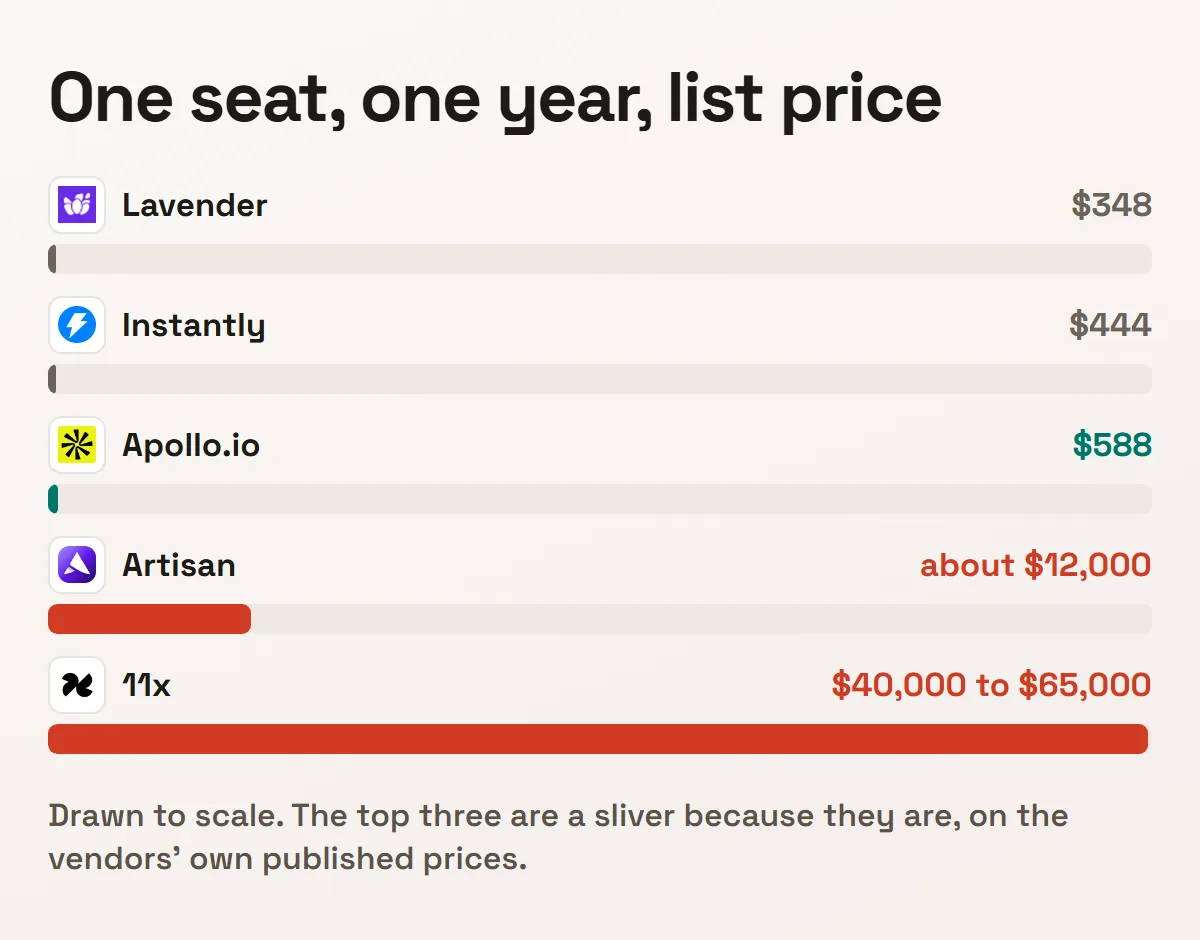
Compared over twelve months for one seat, the layers separate cleanly. Lavender at $29 a month is $348 a year.
Instantly comes to $444 and Apollo to $588. Both sit inside what one rep costs in a fortnight.
Artisan at $999 a month is about $12,000, before anyone counts the data and mailbox costs it assumes you already carry. 11x lands between $40,000 and $65,000 on its own listed range.
So the gap between the cheapest and the dearest option is over a hundredfold, for products that describe themselves in near-identical language on their homepages.
Costs sit outside every quote, too. Bella’s listing names one: it requires a live LinkedIn Sales Navigator subscription on top of its own fee, and that pattern repeats across the layer.
The rating pattern is the finding
Line the 41 listings up by editorial rating and the top of the list holds no autonomous products at all. Apollo 4.5, Lavender 4.3, Outreach and Instantly 4.2, Reply.io, Klenty and Nooks 4.1.
The tools promising to replace the seat cluster at 3.8 to 4.0, and none break past it. That’s a pattern in our own scoring, so it deserves an explanation rather than a victory lap.
Part of it is age. Published pricing, a track record and a documented limit all lift a score, and a 2023 startup with a demo-only price has none of the three.
Part of it is that the promise is harder. Replacing a rep’s judgement is a bigger claim than helping a rep write, and the listed cons at layer one are candid about oversight still being needed.
Which layer fits which team
The symptom points at the layer more reliably than the budget does. Six common situations, and where each one lands.
| Where you are | Layer | Worth shortlisting |
|---|---|---|
| No outbound running yet | Platform, plus a coach | Apollo.io, Lavender |
| Reps sending, replies are thin | Coach | Lavender, Folderly |
| Reps at capacity, list is fine | Platform | Klenty, Outreach |
| Mail isn’t arriving | Infrastructure | Instantly |
| No reps, and budget for one | Agent | Dhisana, Artisan |
| Inbound sitting unanswered | Inbound responder | SchedX, Setter AI |
Two of those rows are worth arguing with. If replies are thin, the coach is the cheap test, but a weak offer will survive any amount of rewriting and keep the numbers flat.
And the agent row assumes you already know the pitch converts. Hiring software instead of a first rep skips the stage where somebody learns what works, and no product on this page will hand that back to you.
What none of them fix
Deliverability is the first. Instantly exists as a product because inbox placement is a standing problem, and no amount of writing quality helps a message that lands in spam.
List quality is the second. Gojiberry watches 30 buying signals and Overloop carries 450 million contacts, and both are still guessing at whether this company wants this thing this quarter.
The offer is the third, and nobody sells it. If the reply rate is low because the pitch is weak, volume makes the problem bigger and faster rather than smaller.
Compliance is the fourth and it stays yours. Reply.io’s listing says so directly, and the rules covering contact with people you’ve never met depend on where they live, not on which vendor you picked.
Who should buy none of this
If you’ve never run outbound, find out whether the message works before automating it. Software makes a bad sequence arrive at scale, which is worse than it arriving slowly.
If your pipeline is inbound, layer one is aimed elsewhere. The inbound responders cost less and answer the problem you have, and a decent form with a fast reply beats both.
And if you already have reps who hit quota, the upgrade is usually layer three. Coaching a team that already sells is cheaper than replacing one that doesn’t, and our ratings happen to agree.
Adjacent question, different product: if you want to know how the calls themselves went, that’s conversation intelligence. Our Avoma and Gong comparison covers that end.
How we rate these
Our rating comes from reading each product’s features, pricing and positioning against the rest of our sales tools catalogue. We then check the product is still live and still sold as described. It isn’t a lab score.
That’s why the 4.0 ceiling needs care. It measures how well a product is documented, priced and positioned, not the meetings it books, and no benchmark we can run would measure the second thing.
Every price above came from a listing, each carrying its own last-reviewed date. Where a vendor publishes a range rather than a number, the range is what you see here.
One correction worth making in public: Outreach moved to outreach.ai, and our listing still carried the old domain until this post was written. Same company, same product, corrected now.
What to settle before you sign
Six answers decide this faster than a feature comparison does.
- Layer: whether you lack a sender, a system, or better messages
- Proof: what your current reply rate is, before software changes it
- Total: the year-one number including mailboxes, data and seats
- Mailboxes: who owns warm-up and what happens to your domain reputation
- Review: whether a person sees messages before they send, and who
- Exit: who keeps the sequences and contact history when you leave
Questions buyers ask
Can an AI SDR replace a person?
It replaces the sending, not the judgement. The listed cons across layer one say the same thing in the vendors’ own words: autonomous outreach still needs oversight on tone and targeting. Budget for the person who does that.
Why do so few of these publish a price?
It’s because the contract is sized against a salary. Jazon, Reply.io’s agent, SchedX and Setter AI all route through a call, so the number depends on your headcount and volume rather than on a plan you pick.
Is the cheapest option ever the right one?
Often, at layer three. A $29 coaching tool applied to a team already sending 200 emails a week changes the reply rate on those 200. A $12,000 agent applied to an untested pitch scales the pitch, and that isn’t the same win.
Do these tools need a CRM?
Most assume one. Klenty, Dhisana and the enterprise platforms all describe syncing back to customer records. Without that link nobody can tell what the outreach produced.
What about deliverability at volume?
Treat it as a separate line item. Instantly sells inbox capacity and warm-up because that’s a product on its own, and an agent writing well into a burnt domain still gets filtered.
Are these different from general AI agents?
They’re the same idea sold into one function. Our AI agents roundup covers the general-purpose builders, where these arrive with the sales workflow, the contact data and the channels already wired up.
How long before this pays back?
Long enough that the contract length matters. Meetings booked in month one tell you little, since the first sequences are the least tuned. Ask what happens if you stop after a quarter, and get that answer before you sign.