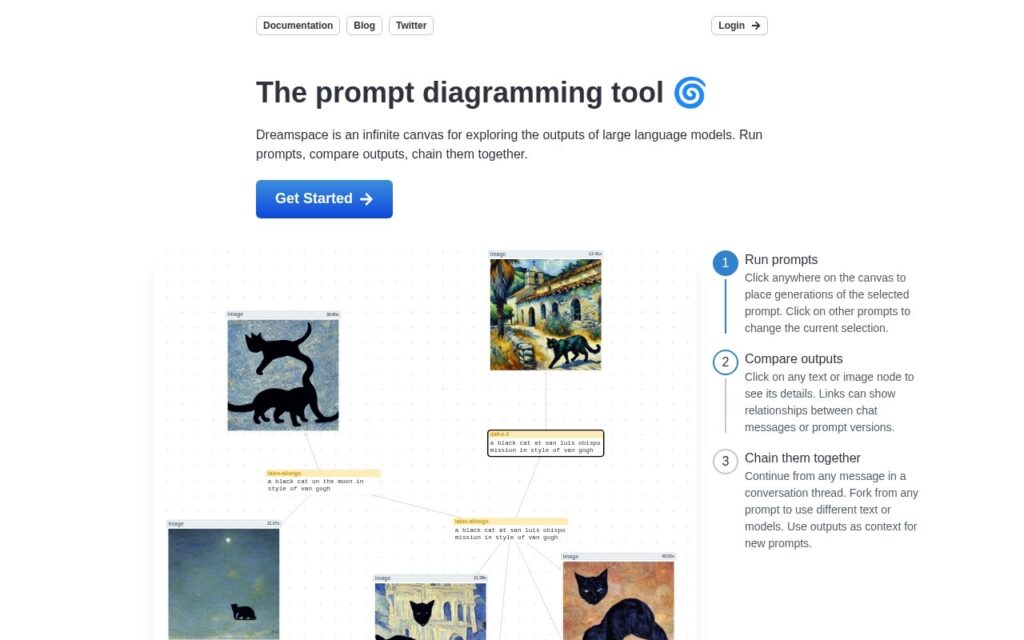
Dreamspace is a prompt-diagramming tool built by developer Noah MacDonald. Instead of a single chat window, prompts and their outputs become nodes on an infinite canvas: a user places a prompt, inspects any text or image node it produced, and chains a new prompt from that output using a different model or a different set of parameters. Conversation threads, prompt forks and the relationships between them are all shown as connected nodes in a private workspace called a space, and a live demo lets a visitor try the canvas before signing up. It connects to models with a user’s own API key, supporting OpenAI and Replicate-hosted models, including Stable Diffusion and LLaMA, directly, with Anthropic’s Claude added by request.
The documentation itself shows its age: it names Claude 3 Opus and Sonnet as the most recently added Anthropic models, both several generations behind Anthropic’s current lineup, so confirm which models actually work before relying on the tool for current work. Because a user supplies their own API key, all model usage is billed directly by the provider on top of whatever Dreamspace itself charges, and mixing multiple providers’ keys into one third-party tool is worth a privacy and security check before connecting anything tied to a paid account. The company or team behind the product beyond its developer is not named on the pages reviewed.
The site states plainly that Dreamspace is a paid digital subscription product, with a Pro tier aimed at individuals and teams that includes consulting from the company’s own prompt engineers and early access to new tools, but no specific price is published anywhere on the pages reviewed. A live demo is available without signing up.