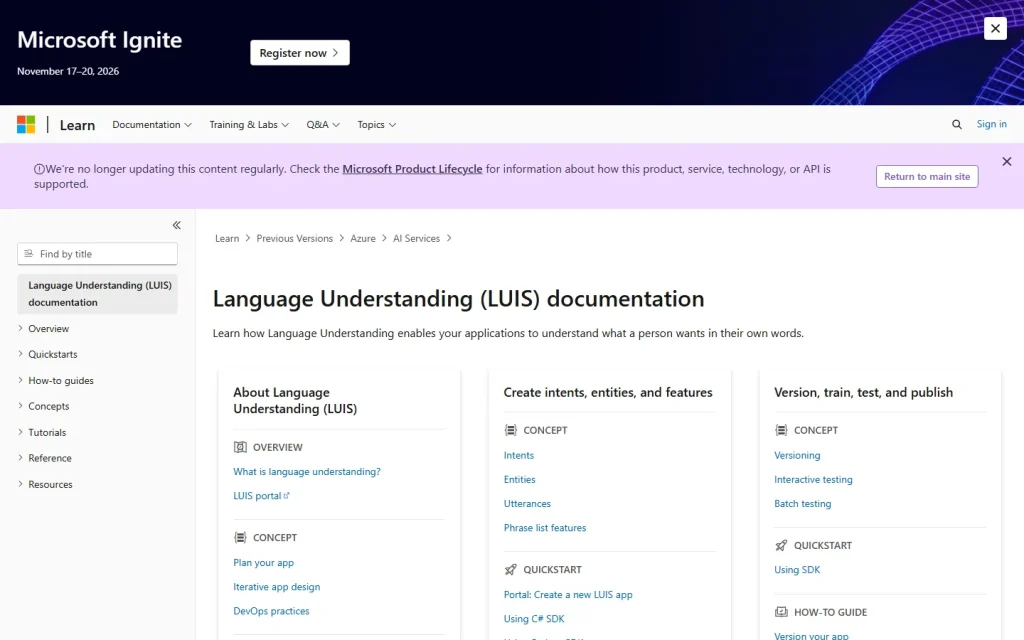
LUIS (Language Understanding Intelligent Service) is Microsoft's cloud service for reading a user's sentence and returning what they want, called an intent, plus the details inside it, called entities. Its status matters most: Microsoft has announced LUIS's retirement and points developers to Conversational Language Understanding in Azure AI Language. Check Microsoft's documentation for the current availability and retirement date.
How LUIS Turns Sentences Into Intents
LUIS maps free-form text to a small set of intents you define, then pulls out entities from the same sentence. Say a user types "book a flight to Rome on Friday." LUIS returns the intent BookFlight, with Rome as a destination and Friday as a date.
The model rests on three pieces. Intents are the actions your app supports. Utterances are example sentences you label for each intent. Entities are the values to extract, either custom or prebuilt, such as dates and numbers.
It's classic supervised NLU (natural language understanding), not a chat model. LUIS doesn't write replies or reason. It classifies and extracts, and your code decides what happens next.
How Developers Built With LUIS
Developers followed a short loop: define intents, label example utterances, train, publish, and call the prediction endpoint over REST. Your app reads the top intent and its confidence score, then branches.
Two habits separated good builds from bad ones. First, keep a "None" intent with off-topic examples, or the model will confidently misroute noise. Second, review real user utterances the service flags through active learning, then label them. That feedback step improves accuracy more than adding synthetic examples.
LUIS paired most often with Azure Bot Service for dialogs. Teams already running on Azure will find the same patterns in the Azure Machine Learning Services stack, though that product covers custom model training rather than packaged language understanding.
Should You Start a New Project on LUIS?
No. Starting a new build on a service Microsoft has announced it is retiring means a forced migration later. Use Conversational Language Understanding in Azure AI Language, which keeps the same intent and entity idea with a newer authoring experience. Check Microsoft's documentation for whether LUIS apps can still be created or called.
If you already run a LUIS app, treat the retirement as a product lifecycle event: export your labeled utterances, since that data is the real asset, and plan the move early. Pricing was usage-based per transaction; check Microsoft's pricing page for current rates.
If you want open-ended conversation instead of fixed intents, a large language model fits better. For a narrow, predictable command set where you want deterministic routing, the intent-and-entity approach LUIS pioneered is still sound. Keep exploring in our AI tools directory for the options that fit your build.