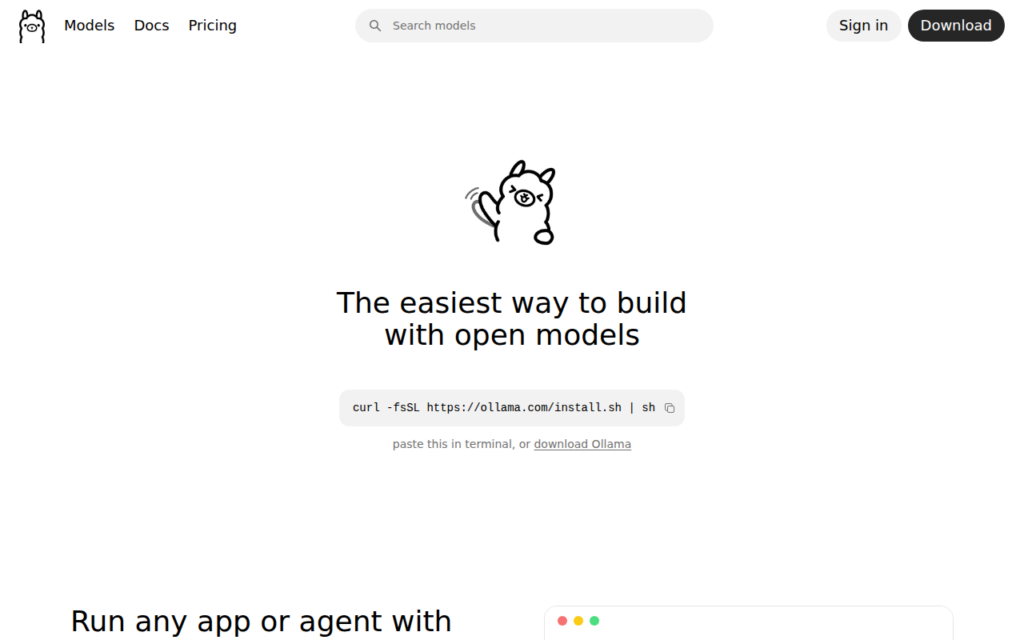
Ollama made running open models locally a single command, and that simplification is the reason it became a default. Before it, using an open model meant resolving Python dependencies, quantisation formats and GPU drivers; afterwards it meant pulling a model and running it, the same way you would pull a container image.
Local execution is the substance, not a feature. Data never leaves the machine, there is no per-token cost, and the model works offline, which matters for confidential material, for cost control at volume, and for anyone who does not want a third party logging their prompts. The platform now adds cloud scaling for workloads that outgrow local hardware, so the same interface covers both.
The honest constraint is hardware. Model quality scales with what your machine can hold, and a laptop will run smaller models than a workstation. For privacy-sensitive work, offline use, or high-volume tasks where API costs accumulate, the trade is usually worth it.