Free

OpenEvidence

Used by 40% of US physicians, doubling its valuation to $12B in under a year

4.4 Healthcare AI
4.4 Very good 4.4

Bottom line: OpenEvidence is a strong healthcare ai tool, best known for point-of-care clinical answers grounded in peer-reviewed literature with citations. It has a free plan.

Free access for physicians removes cost as a barrier to point-of-care use Monetized through pharmaceutical advertising, which some clinicians may view with caution
Reviewed by Challenging Voice Editorial · Updated Jul 2026 How we rate
PricingFree
Free planYes
CompanyOpenEvidence
PlatformsAPI, Web
Best forHealthcare AI
Founded2022
Visits21
Last reviewedJul 2026
UpdatedJul 2026
Ask AI about OpenEvidence ChatGPT Claude Perplexity

Overview

OpenEvidence, founded in 2022 by Daniel Nadler, who previously built and sold Kensho Technologies to S&P Global for roughly $700 million, and Harvard AI researcher Zachary Ziegler, gives physicians point-of-care answers grounded in peer-reviewed medical literature with citations included, rather than a general-purpose chatbot's unsourced responses.

That evidence-grounded design drove what the company calls the fastest-growing physician application in history: OpenEvidence reached 760,000 registered US physicians, about 40% of all US doctors, handling roughly 18 million clinical consultations monthly, and its valuation doubled to $12 billion on a $250 million Series D in January 2026, up from a $3.5 billion valuation less than a year earlier.

OpenEvidence is free for verified physicians and healthcare providers, monetized instead through pharmaceutical advertising and sponsored content shown alongside evidence-based answers. For a physician who wants point-of-care clinical answers grounded in peer-reviewed literature with citations, rather than a general AI chatbot's unsourced response, OpenEvidence's evidence-first design addresses that directly.

Key features

  • Point-of-care clinical answers grounded in peer-reviewed literature with citations
  • 760,000 registered US physicians, roughly 40% of all US doctors
  • Approximately 18 million clinical consultations handled monthly
  • Free for verified physicians, monetized through pharmaceutical advertising
  • $12B valuation after a $250M Series D in January 2026
  • Backed by Google Ventures, Nvidia, Sequoia, and Mayo Clinic

Screenshots & demo

Demo video

Screenshots

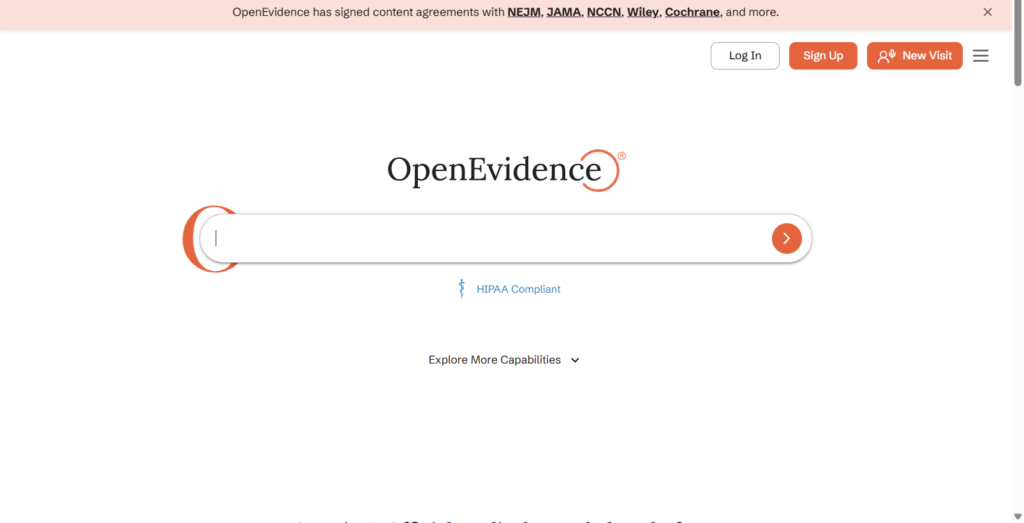
OpenEvidence screenshot 1

Pricing

OpenEvidence offers a free plan, with paid upgrades for higher limits and more features.

  • Pricing modelFree
  • Starting priceFree
  • Free planYes
Visit OpenEvidence

Pricing is provided as a guide. Check the official site for the latest plans.

Is OpenEvidence expensive?

OpenEvidence has no advertised paid tier. Among the 16 priced tools we list in Healthcare AI, the median entry price is $34.5 a month.

18% of Healthcare AI tools in the directory offer a free tier, and this is one of them.

Compared against every priced listing in Healthcare AI, recalculated as the catalogue changes. Method and the full market breakdown are in our AI tool pricing study.

Pros & cons

Pros

  • Free access for physicians removes cost as a barrier to point-of-care use
  • Citations grounded in peer-reviewed literature build clinical trust
  • Extraordinarily fast physician adoption validates genuine day-to-day utility
  • Backed by an unusually strong group of both tech and healthcare investors

Cons

  • Monetized through pharmaceutical advertising, which some clinicians may view with caution
  • Built for point-of-care physician use, not a full clinical documentation platform
  • Extremely fast valuation growth invites scrutiny over long-term sustainability

How it compares

ToolRatingFreeFromBest known for
OpenEvidence (this tool)4.4YesFreePoint-of-care clinical answers grounded in peer-reviewed literature with citations
Abridge4.5NoAmbient listening that turns patient-clinician conversations into structured notes
Suki AI4.2NoVoice-first AI assistant for documentation, coding, and clinical Q&A
Hippocratic AI4.3NoPatient-facing AI agents for pre-visit intake, follow-up, and check-ins

Alternatives to OpenEvidence

4 tools our editors picked as direct alternatives to OpenEvidence.

Our verdict

4.4 / 5 4.4

OpenEvidence is a strong healthcare ai tool, best known for point-of-care clinical answers grounded in peer-reviewed literature with citations. It offers a free plan.

What makes it different: OpenEvidence stands out for point-of-care clinical answers grounded in peer-reviewed literature with citations.

How we score it
Overall 4.4
Value for money 4.7
Feature depth 4.9
Popularity 4.0
Best for ProfessionalsTeamsCreatorsCurious learners

Frequently asked questions

What is OpenEvidence?
OpenEvidence is a healthcare ai tool listed in the Challenging Voice directory. Used by 40% of US physicians, doubling its valuation to $12B in under a year.
Is OpenEvidence free?
Yes, OpenEvidence offers a free plan. Paid plans unlock more features and higher usage limits.
What are the best OpenEvidence alternatives?
Popular alternatives to OpenEvidence include MediSearch, Rayscape, and Hairgen.ai. Browse them all in the Healthcare AI category.
Is OpenEvidence any good?
OpenEvidence scores 4.4 out of 5 based on our editorial review.

Reviews

4.4 No reviews yet

Write a review

Similar tools you might like