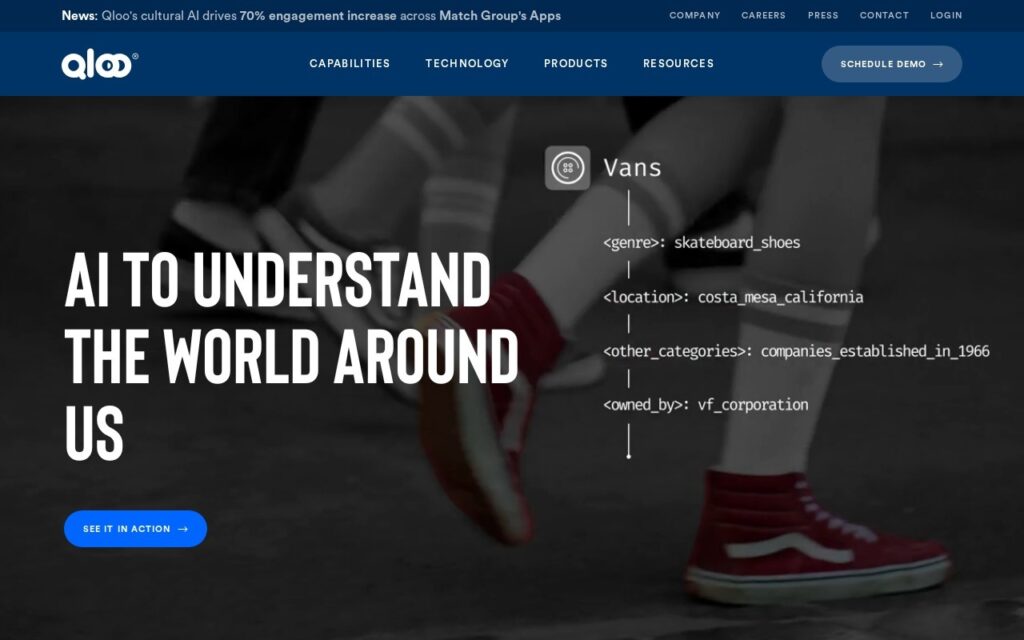
Qloo maps taste. Its knowledge graph holds around 3.7 billion cultural entities, restaurants, hotels, music, films, brands and destinations, connected by more than ten trillion preference signals, and the useful trick is crossing between categories: inferring what somebody will want to eat from what they listen to.
That cross-domain inference is what conventional recommendation cannot do. A system trained on your purchases in one category knows nothing about you in another, which is why every recommender starts cold with each new customer, and a graph of how tastes correlate across culture answers a question that behavioural data alone cannot.
It licenses the graph, offers audience intelligence and taste analysis, and integrates with LLMs and agents including on-device deployment. Netflix, PepsiCo, Match Group and Michelin are named as customers, with a 273 percent booking increase cited for Michelin’s Tablet Hotels. Nothing is priced publicly, the graph reflects the cultures its data came from, and taste inference across categories is probabilistic in a way that individual predictions will not always survive.