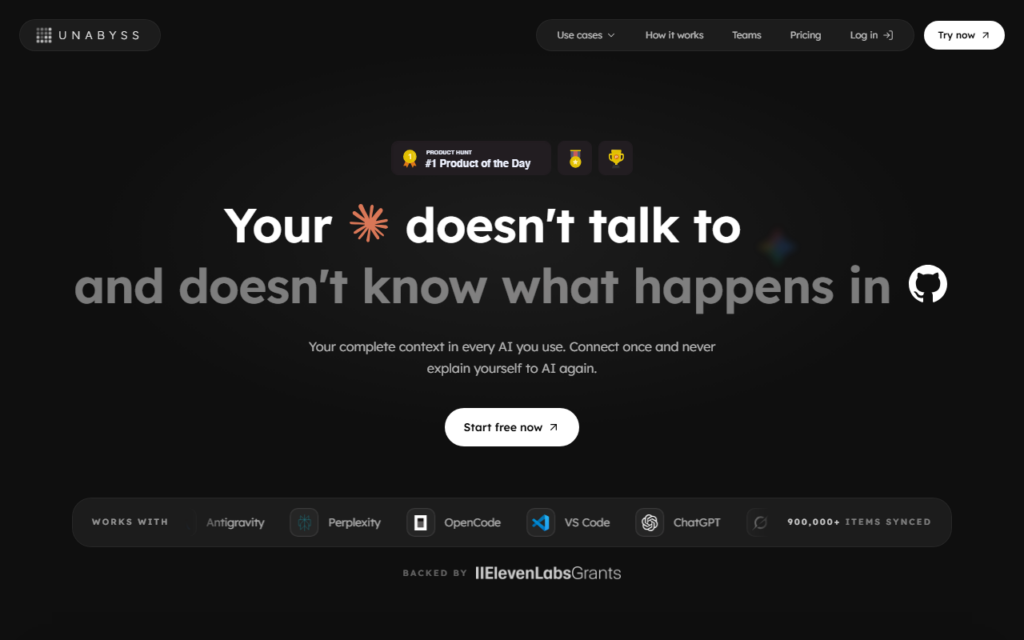
Unabyss builds a memory layer from the tools someone already uses — Gmail, Slack and others — and makes it portable across assistants over MCP. The problem is stated plainly on its own site: a coding agent has no idea what happened in a Slack thread, and each assistant starts from nothing.
Building memory from real work rather than asking users to write it down is the sound design decision. Manual memory files decay within weeks because nobody maintains them; memory derived from live tool data stays current on its own.
Connecting mail and chat history to a third-party memory service is a significant data decision that deserves a proper review of retention, isolation and deletion before rollout, particularly for company accounts. A free trial covers evaluation.
Key features
Memory built automatically from Gmail, Slack and other tools
Portability across assistants over MCP
Support for Claude, ChatGPT and coding agents
Two-step connection into an assistant
Continuously updated context without manual upkeep
Free trial before paid tiers
Screenshots & demo
Demo video
Screenshots
Pricing
Unabyss has a free plan, and paid plans start at $13/mo.
Pricing is provided as a guide. Check the official site for the latest plans.
Is Unabyss expensive?
Unabyss starts at $13, which is 55% below the AI Infrastructure & Agent Tooling median of $29 a month across the 65 priced tools we list in that category.
The cheapest paid option in AI Infrastructure & Agent Tooling starts at $0.2 and the most expensive at $1,250.
54% of AI Infrastructure & Agent Tooling tools in the directory offer a free tier, and this is one of them.
Feeds your team's own conventions to Claude Code, Cursor, and Copilot before code review – plus DORA-metric delivery dashboards – for $12 per developer a month.