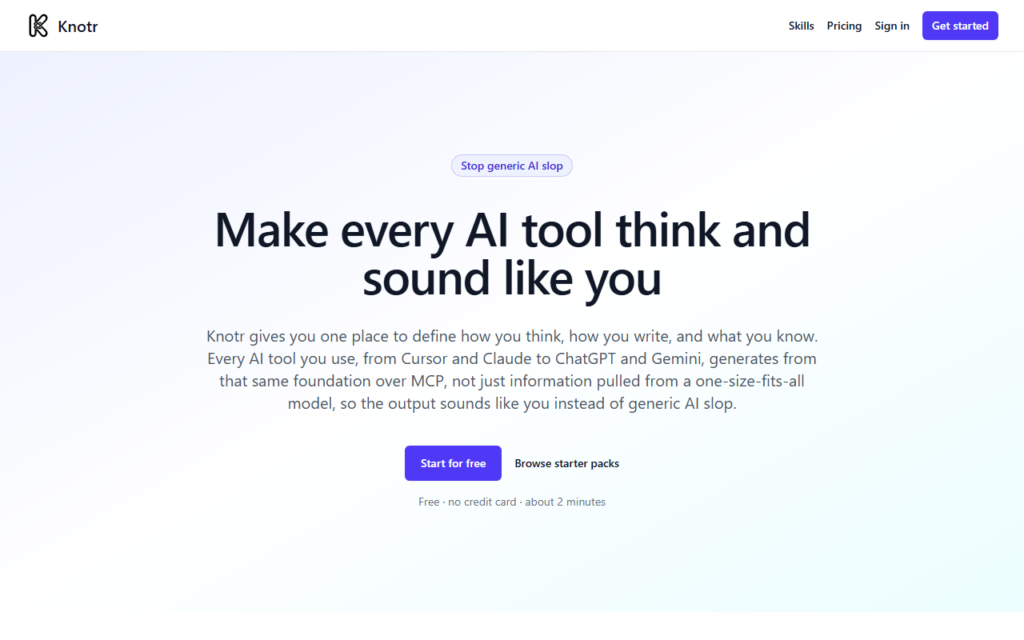
Knotr AI stores how a person or team writes, thinks and defines their domain, then exposes that definition to every assistant they use over MCP. The problem it addresses is fragmentation: a developer configures Cursor one way, keeps a different set of custom instructions in ChatGPT, and gets a third tone from Claude, so output drifts between tools.
Using MCP as the delivery mechanism matters, since it means the context is served through a protocol the assistants already speak instead of being pasted into each tool’s settings screen. One update propagates everywhere.
The benefit scales with the number of assistants someone uses. A single-tool user gains little over that tool’s own instructions; someone moving between an editor, a chat assistant and a research tool daily gains consistency that is otherwise manual. Free and paid tiers are available.
Key features
Single definition of voice, knowledge and preferences
Delivery to assistants over the Model Context Protocol
Support for Cursor, Claude, ChatGPT and Gemini
Role-based starting templates
One update propagating across every connected tool
Free tier with paid plans for larger context sets
Screenshots & demo
Pricing
Knotr AI has a free plan, and paid plans start at $20/mo.
Pricing is provided as a guide. Check the official site for the latest plans.
Is Knotr AI expensive?
Knotr AI starts at $20, which is 31% below the AI Infrastructure & Agent Tooling median of $29 a month across the 65 priced tools we list in that category.
The cheapest paid option in AI Infrastructure & Agent Tooling starts at $0.2 and the most expensive at $1,250.
54% of AI Infrastructure & Agent Tooling tools in the directory offer a free tier, and this is one of them.
Feeds your team's own conventions to Claude Code, Cursor, and Copilot before code review – plus DORA-metric delivery dashboards – for $12 per developer a month.
Developer communications platform (formerly MessageBird) for email, SMS, WhatsApp, Apple Messages and voice, with AI agents and an MCP server for AI-driven operations.