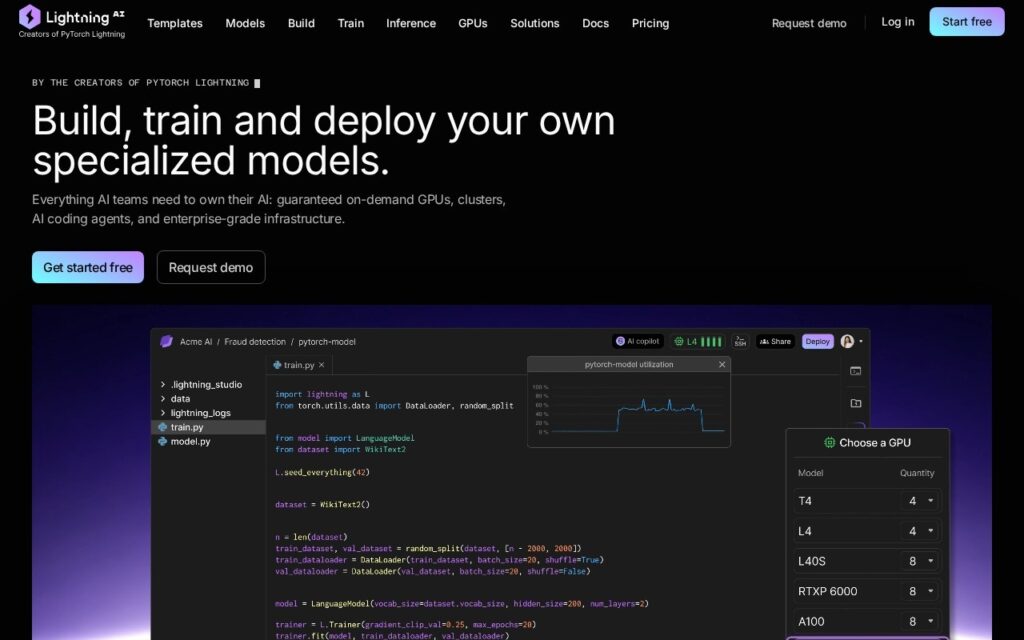
Lightning AI is a cloud platform from the creators of PyTorch Lightning that lets ML engineers and research teams code, train and serve models from the browser without local setup. It handles checkpointing and multi-GPU or multi-machine distributed training automatically, so teams spend their time on the model rather than the infrastructure.
Manually configuring distributed training and making sure a long run survives an interruption is infrastructure work that has little to do with the modeling problem itself. Lightning AI automates both. Built-in logging and visualization show training progress, and APIs cover the surrounding work: data ingestion, preprocessing, version control and resource monitoring.
Lightning AI is aimed at ML engineers and research teams building and deploying models at any scale. Pricing is freemium: a free tier with monthly credits, paid individual and team plans, and custom Enterprise plans. Check Lightning AI’s official pricing page for current plan names, prices and credit amounts.
Who Lightning AI fits best
Lightning AI suits teams that already use PyTorch or PyTorch Lightning and want to move from a notebook to multi-GPU training and deployment without managing servers. If you only run small experiments on a single local GPU, the platform adds less value.
Training and serving models depends on compute, storage and networking behind the scenes. For background on how that layer works, read our guide to AI infrastructure behind every AI tool. If you are comparing ways to connect AI steps into repeatable processes, see our comparison of AI automation tools.