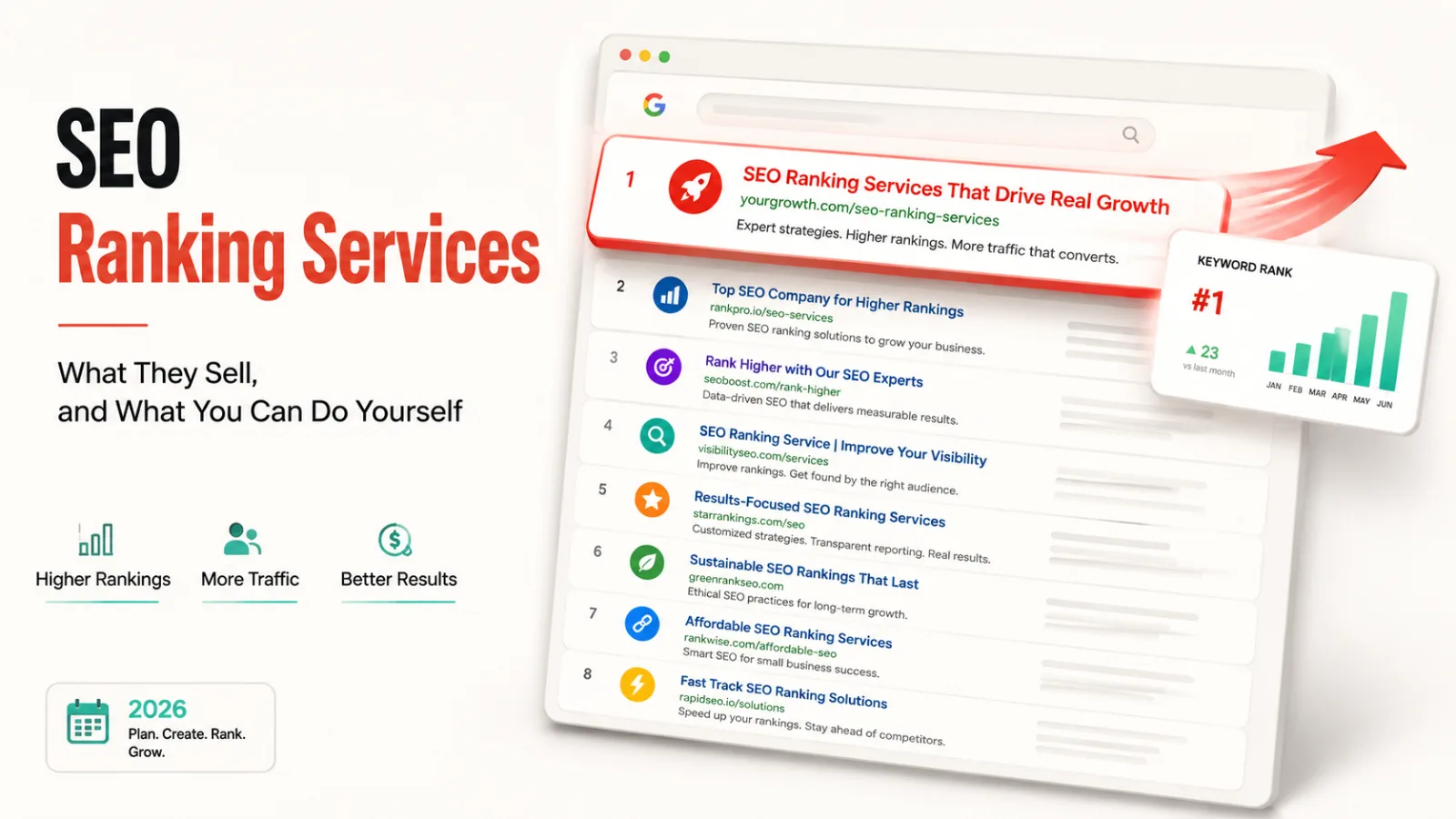
SEO ranking services are agencies and freelancers you pay to move your pages up the results. The honest short answer: if a handful of pages matter and someone in-house can write, tools cost less and move faster. If the problem is technical debt across thousands of pages, a service earns its fee.
This guide covers the buying decision only. It won’t explain what SEO is, because our guide to search engine optimization already does that in more depth than a buyer’s page should.
What an SEO ranking service sells
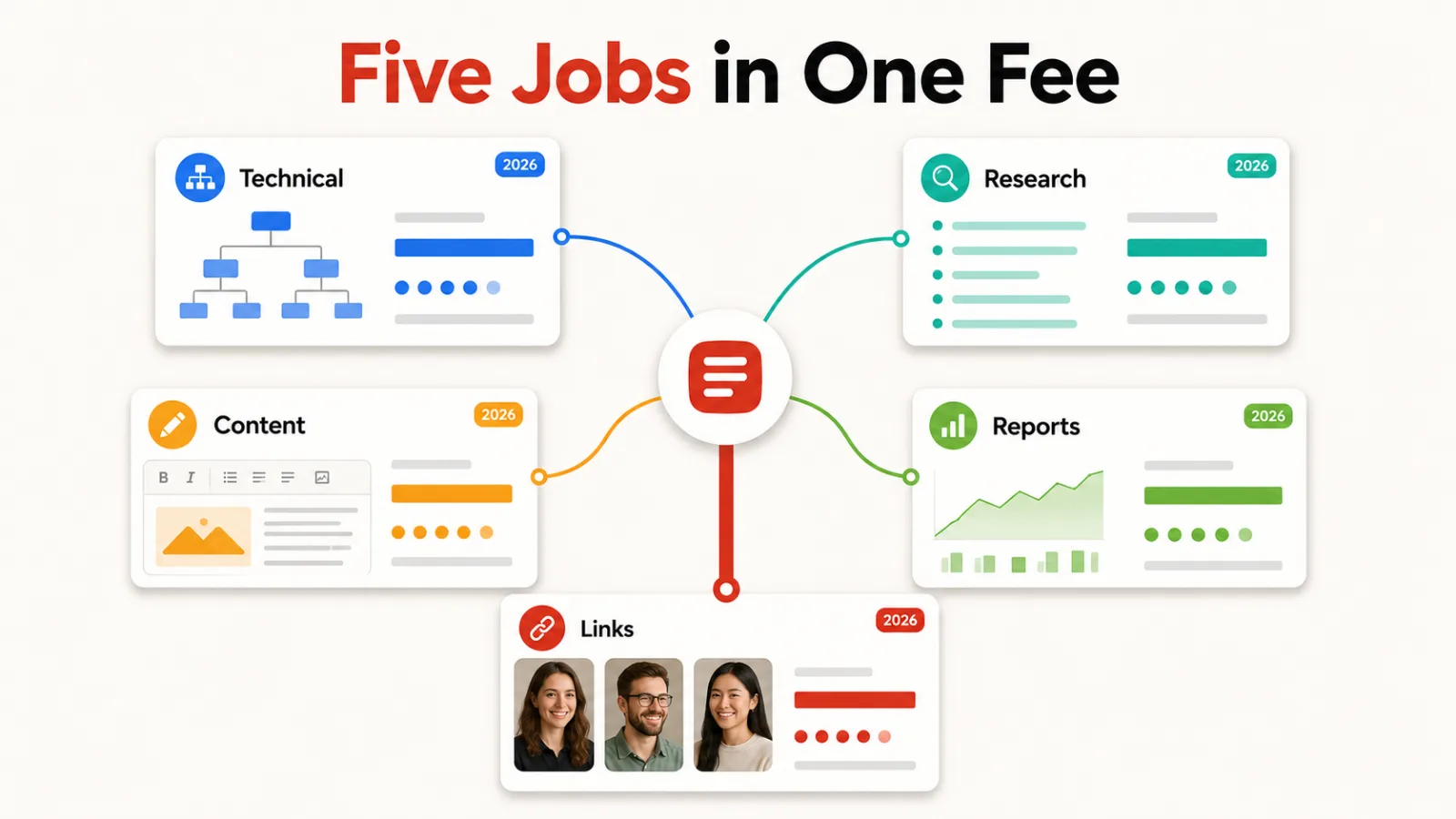
Most retainers are the same five jobs in a different order. Knowing which one you’re buying is the difference between a fee that pays back and one that doesn’t.
- Technical fixes: crawl errors, site speed, indexation, structured data.
- Keyword and intent research: deciding which pages deserve to exist.
- Content production: writing and updating those pages.
- Link acquisition: earning mentions from other sites.
- Reports: telling you what changed and why.
Four of those five are now cheaper to do with software than to outsource. Link acquisition is the exception, and it’s the one that most often justifies a retainer.
The label on the invoice tells you little. A firm calling itself a ranking service, an SEO agency or a growth partner might sell any mix of those five. Two proposals at the same price often describe different work entirely.
Ask for the split before comparing quotes. A proposal that won’t say how the hours divide across those five jobs isn’t a proposal, and the answer usually explains the price gap on its own.
Watch for a service that sells reports as though they were work. A monthly deck showing position changes isn’t a deliverable, it’s a receipt, and Nightwatch produces the same thing from $39 a month.
The three ways they charge
We hold no sourced pricing data on agencies, so you won’t find fee benchmarks from us here. The shape of the deal matters more anyway, because each model fails in its own way.
Monthly retainers buy a block of hours. They suit ongoing content and technical work, and they go wrong when nobody defines what the hours produce. Fix that by agreeing deliverables per month, not hours per month.
Project fees buy one defined outcome, usually an audit or a migration. They’re the easiest to judge, because you can read the deliverable before paying the balance. The risk is a thorough audit nobody then implements.
Performance deals tie payment to positions reached. They sound safest and rarely are: the incentive becomes chasing phrases that move easily rather than phrases that sell. Check which phrases the deal names before signing it.
How to tell a working service from a churn shop
To separate the two, listen to the sales conversation rather than reading the proposal document. Six things give it away.
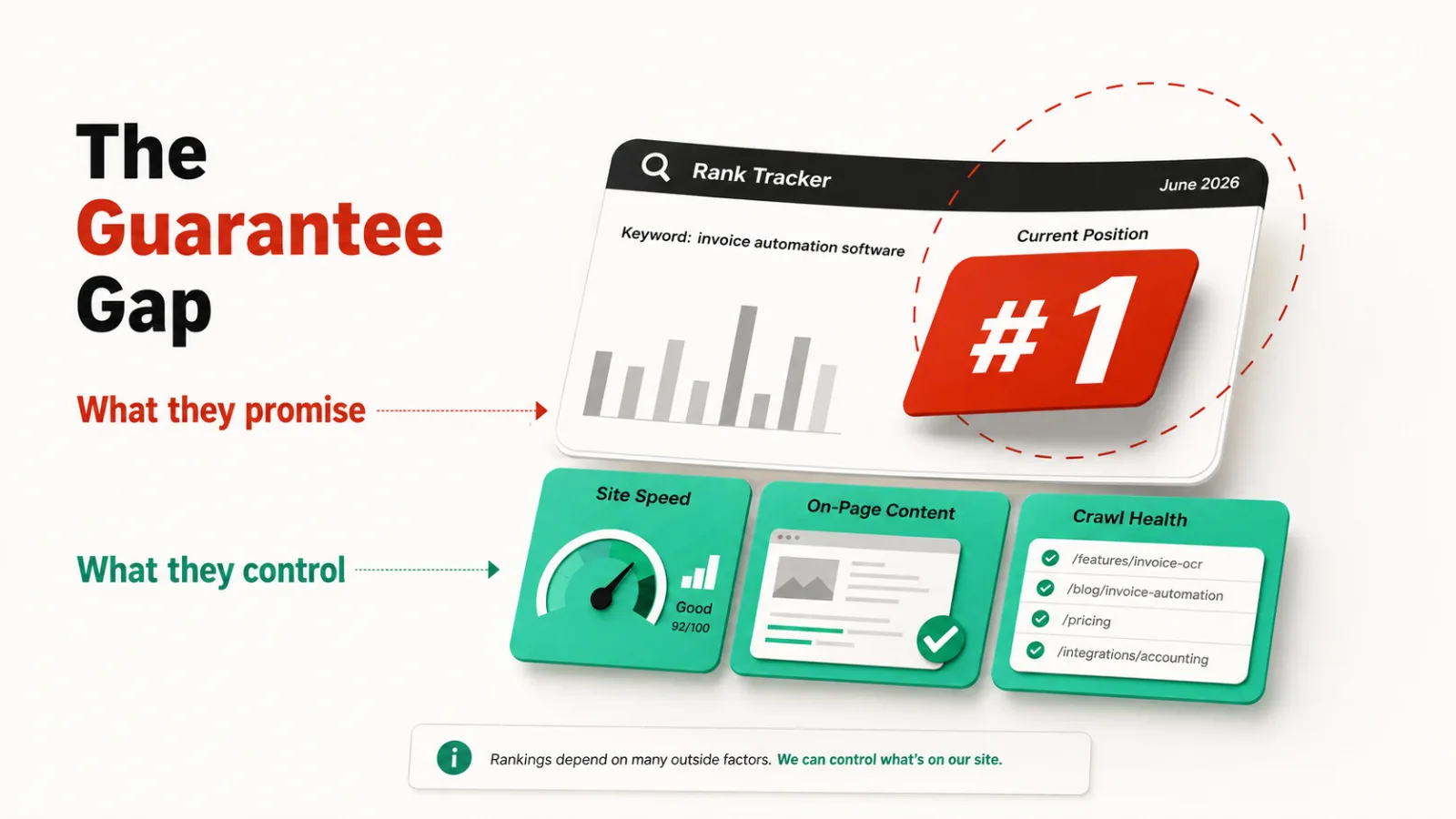
- Guarantees: a promised position is a promise about something they don’t control.
- Access: a real service asks for analytics and console access before quoting.
- Priorities: good ones ask what you sell before what you want to rank for.
- Links: ask where they come from, and expect a straight answer.
- Reports: traffic and revenue, not position screenshots alone.
- Exit terms: who keeps the content and the accounts when you leave.
The exit question catches more bad deals than the rest combined. If your pages live on their platform, you’re renting your own rankings.
The link answer is the second most useful. A service that describes relationships, digital coverage or original research is doing different work from one that won’t name a source at all.
What to hand over on day one
A slow start is usually a handover problem rather than a competence problem. Have four things ready before the first call and the first month stops being setup.
- Access: analytics, search console, and whoever can deploy code.
- Brand rules: what you sell, who buys it, words you avoid.
- Current content: which pages already earn, so nobody rewrites a winner.
- Approver: one person who signs off published pages.
The last one costs more time than the other three. A service that can’t publish without three approvals bills the same hours and ships a fraction of the work.
How to measure whether it’s working
To judge a service fairly, agree what you’re measuring before the first invoice. Positions alone are the weakest signal available, and they’re the one most reports lead with.
Track impressions and clicks on the pages the service touched, not sitewide totals. A sitewide number moves for reasons nobody in the room caused, and it hides a page that lost ground.
Set the review point at the start too. Six months is a fair first checkpoint for content work and far too long for a technical fix, which should show up in crawling and indexation within weeks.
Keep a note of what changed on your side during the engagement. A pricing change, a redesign or a competitor going quiet all move the same numbers, and none of them are the service’s doing.
What you can now run yourself
The calculation has shifted here. Work that needed an agency five years ago now runs on a subscription, and our SEO tools catalogue holds 85 of them.
For crawling and technical audits, Screaming Frog has a free tier and Sitebulb starts at $15 a month. Both produce the same issue list an audit invoice describes.
For research and tracking, Mangools starts at $29 and Ahrefs at $129. The gap between them is data depth, and a small site rarely needs the deeper one.
For writing pages that match what already ranks, Surfer SEO starts at $79. Our roundup of AI SEO tools compares fifteen of these on price and fit.
One caveat worth stating plainly. A tool doesn’t do the job, it removes the manual part of it. Someone still has to decide which pages deserve to exist, and then write them.
Budget the time, not only the subscription. A crawler that surfaces two hundred issues has moved the work rather than finished it, and the fixing is where the hours go.
When a service is still the right answer
You should still pay for one in three situations, and they’re about capacity rather than knowledge.
The first is scale. A catalogue of thousands of pages has technical problems that repeat, and fixing them is a development project rather than a subscription.
The second is links. No tool earns a mention on a publication you have no relationship with, and that work is outreach and relationships.
The third is nobody to write. Software shortens research and grading, but a page still needs an author, and buying the tool changes nothing if the writing never happens.
A mixed arrangement often beats both. Buying the tools in-house and paying a service for links alone keeps the recurring fee small and the work visible.
How we rate the tools named here
Our rating for each tool comes from comparing published features, pricing and positioning against the rest of the catalogue. It isn’t a lab score, and we don’t run one shared site through every platform to produce it.
Every price above is the starting price on that tool’s own listing, and each listing carries the date we last verified the product was live. We hold no sourced pricing data on agencies, which is why this guide describes charging models instead of quoting fees.
What would be worth measuring is how much of a ranking change came from the work itself. Neither agencies nor tools publish that honestly, because the alternative explanation is usually a competitor who stopped trying.
Questions buyers ask
What are SEO ranking services?
SEO ranking services are agencies or freelancers paid to improve where your pages appear in search results. The work is usually five jobs: technical fixes, keyword research, content, links and reports. Four of the five now have software equivalents.
How long before rankings move?
You should expect months rather than weeks, and anyone promising faster is describing a phrase nobody competes for. A new site waits longer than an established one, and a technical fix shows up sooner than new content does.
Are ranking guarantees ever legitimate?
No. Nobody selling the service controls the ranking, so the guarantee is either meaningless or aimed at a phrase with no competition. Ask which phrase is guaranteed, then check how often anyone searches it.
Can tools replace an agency entirely?
For a small site with someone who writes, often yes. Crawling, research, tracking and content grading all run on subscriptions now. Link acquisition and large technical projects are the two parts that still tend to need people.
What should I ask for before signing?
You should ask where links come from, what happens to your content if you leave, and which business outcome the reports track. A service that answers all three plainly is worth talking to further.
Is a cheap monthly retainer ever worth it?
Sometimes, if the scope is one job rather than all five. A small fee covering links alone, or technical work alone, can pay back. The same fee spread across everything buys a few hours of attention split five ways.
Does any of this apply to AI answers?
Partly. Being cited inside an AI answer is a different measurement problem from position tracking, and most ranking services don’t cover it yet. Our roundup of AI visibility tools covers that side.