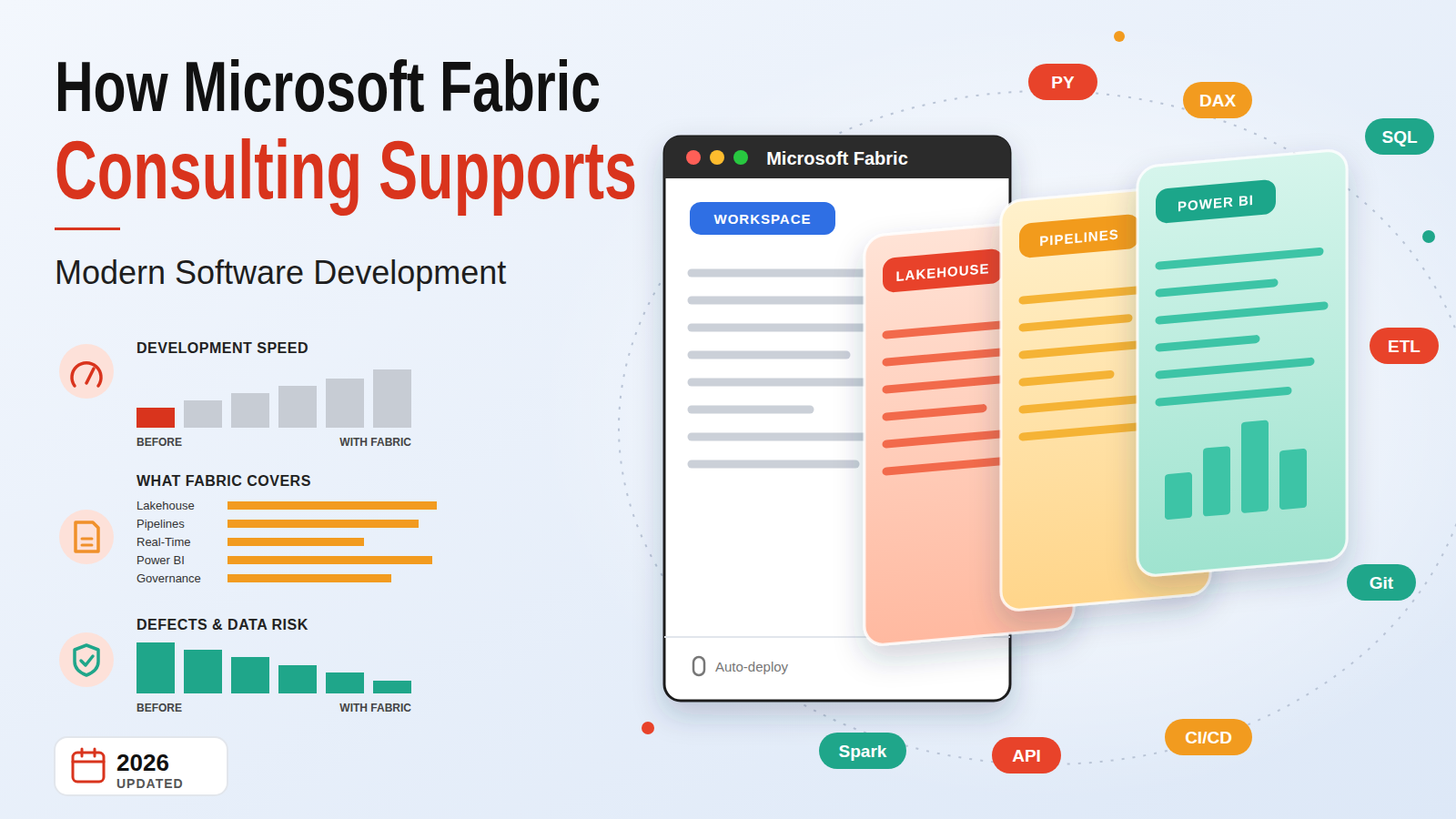
Software development is not just about the code anymore. It’s about your team having the right data, in the right place, the analytics, and the software that allows them to make decisions more quickly. In today’s environment, applications with siloed data make developers go and find the data, try to clean up the data, and build multiple versions of reporting.
Fabric is a comprehensive end-to-end analytics platform that combines the complete range of data engineering, data science, real-time analytics, data integration, and business analytics. Customers can govern their data across all sources and get insights.
The problem is, it’s not easy to get to the new platform without a plan. Microsoft Fabric Consulting can help. Through platform planning, data architecture, integration, security, and implementation, consultants take clients through the process. They’ll guide the development team to build data-driven applications and improve data usage.
But, if you’re determined to get the best possible experience and’re looking to scale your app, then a trusted Microsoft Fabric consulting company can take the pain away. Keep on reading to discover how Microsoft Fabric will make a difference in the way you develop software and why you need a consulting partner.
What Is Microsoft Fabric Consulting?
Data tools in one platform: Fabric brings together six data services-Data Factory, Data Engineering, Data Warehouse, Real-Time Intelligence, Data Science, and Power BI-into a common workspace. This shared workspace will enable teams to work together more efficiently by harnessing data and analytics without having to build the entire process from scratch.
Developers building demands, analytics teams using Microsoft Fabric to develop data pipelines, or reporting teams can leverage Microsoft Fabric. Microsoft Fabric can help you set up a well-structured data ecosystem for future projects.
What Microsoft Fabric consultants can do for you:
- Reviewing current data systems and business needs.
- Designing a suitable data architecture.
- Building and managing data pipelines.
- Connecting data from different sources.
- Setting up reporting and analytics.
- Improve data quality and security.
- backing testing, launch and continuous optimisation.
If you are looking for a solution to the challenges, here is how Microsoft Fabric Consulting can help you in the right way you want to.
How Microsoft Fabric Supports Modern Software Development
The data for most of the applications today comes from a wide array of sources like CRM, POS, website, mobile app, cloud database, business applications, and many others. It is difficult for the developers to handle and manage all these sources because they end up doing the same work thousands of times by building data pipelines, providing support to the various reporting tools, and troubleshooting. Microsoft Fabric is a one-stop platform for data engineering, data integration, data analysis and reporting.
Powerful Benefits for Development Teams
Give your teams access to valuable data from connected sources.
More Analytics: Share reporting and analysis over a shared platform.
In a nutshell: Simplification of application data analysis.
Better collaboration: Give data analysts, data engineers, and developers a joint working area.
If anything, Microsoft Fabric for Software Development can actually manage all software which require reliable, complete, and real-time data when it is properly built.
Improving Data Integration Across Applications
Microsoft Fabric Data Integration makes it easy to find, transfer and prep data from anywhere. Microsoft Fabric Data Factory features power data pipelines and data movement. Built on connectors and transform tools for specific sources, teams can streamline data for analytics depending on the source and deployment.
How Data Integration Assists Software Development
- Connect and display relevant information from supported apps, services, and databases.
- Automate repetitive data movement and preparation.
- Apply standard rules to standardize and bring together the data.
- Arrange information for dashboards, reporting and business intelligence.
- Implement individual roll tables for the export data flows allowing the teams to see the flow and make improvements.
Assist Developers in Creating Data-Driven Apps
Data is used by a wide range of today’s software applications, to provide a personalised service, to track and record activity and to improve quality of service. Yet, those features rely on there being strong sources of data and well-defined data-processing rules.
Microsoft Fabric can be used to enable development teams to get ready and analyse the data which enables these features. Microsoft Fabric’s data engineering and analytics capabilities can enable it to take input from different sources and enable it for reporting and downstream supported usage.
Microsoft Fabric Applications:
- Analysing application usage and performance.
- Tracking customer behaviour and product trends.
- Supporting business dashboards and reports.
- Preparing data for machine learning workflows.
- Identifying patterns in sales and operations.
- Improving product decisions through data analysis.
A trusted Microsoft Fabric consulting company can assist companies determine the best placement of Fabric within their software stack and how fabric might integrate with current applications.
Enabling Real Time Insights and Faster Decisions
Some business decisions require dynamic data. Delivery teams monitor vehicle activity, online sales teams keep an eye on transactions, and support teams observe service events.
This enables teams to learn of operational changes earlier.
- Real Time Data Application Examples
- Monitoring application events and service activity.
- Reviewing transaction patterns.
- Tracking logistics and delivery events.
- Identifying unusual operational behaviour.
- Monitoring selected business execution signs.
- Supporting alerts and dashboards for time-sensitive data.
But real-time processing is not so simple. Teams need to think about how many events they expect and how long it will take to process them, as well as how long the data will be held, and what users will want to do with it. Microsoft Fabric for Software Development has the right architecture to enable such applications and analytics pipelines.
Strengthening Data Security and Governance
Today’s software processes valuable data, such as customer records, financial records and business activity. Teams must be able to access the information too, not just ensure the right teams have access to it.
Microsoft Fabric offers security and governance but it needs to be set up for each organisation. Industry wants visibility over who can see data, understand how data is being shared and what controls are in place for each workload.
Essential Security Measures
- Apply role-based access where right.
- Review consent for users and workspaces.
- Protect sensitive data.
- Check data access and sharing.
- Establish clear data ownership.
- Review governance policies regularly.
- Test security settings before deployment.
How Microsoft Fabric Consulting Can Reduce Development Costs
Costly software projects. Separate data tools, integration issues, or rebuilt reports can add up to significant time, and money, while bad design can mean additional development and support costs.
Microsoft Fabric Consulting for Modern Software Development enables your company to analyze these problems before you choose a solution. Your consultants can determine valuable workloads, coordinate integration, and prevent added complexity.
Ways Consulting Can Assist with Cost Control
Better Planning:- Define requirements before implementation begins.
Less repetition:- Find ways to leverage existing data pipelines and assets.
Improved the Quality:- Decrease the amount of time spent fixing duplicate data problems.
Platform Design:- Select architecture based on business requirements and technical considerations.
Capacity Management:- Revisit usage and capacity requirements to determine if there’s an opportunity to control costs.
Continuous Optimisation:- Highlight workflows requiring enhancement post-launch.
Why Choose a Trusted Microsoft Fabric Consulting Company?
Choosing a Microsoft Fabric consulting partner can be the difference-maker in your project. It’s about more than just getting the tech set up. It’s finding the right partner who gets your development goals, your data issues, your security needs and your infrastructure.
The trusted Microsoft Fabric consulting company should always begin with the business problem, then recommend an architecture, and finally the value, drawbacks, and expenses of that recommendation.
Consider these when selecting a partner:
- Technical Skills: data engineering, fusion, analytics and Microsoft technology.
- For example, translating technology decisions into business value.
- Security Awareness: Access control knowledge, ownership of Data. Usage of Data for other purposes.
- Transparent Communication: Direct interpretation of technical designs and project risks.
- Continued Support: Support in monitoring, optimization, and for evolving needs.
Simplifying Software Testing with Reliable Data
Software testing enables developers to identify bugs before a demand goes live. However, testing is more challenging when teams are using data that is limited or isolated. Microsoft Fabric for Software Development can prepare and analyze data for testing and performance reports.
Businesses can use Microsoft Fabric to:
Analyse Test Results: Look at testing data for patterns.
Track Application Performance:- Use appropriate data sources to spot trends.
Improve Data Quality:- Detecting and resolving data anomalies or data missing.
Support Better Decisions:- Leverage reports to inform decisions about software enhancements.
Conclusion
Microsoft Fabric is designed to allow modern software teams to access data, data-driven applications, analytics, and enhanced knowledge. But companies will need to understand the platform they’re entering into. We support organisations to plan architecture, Microsoft Fabric Implementation, and facilitate development teams to collaborate more effectively. By partnering with a Microsoft Fabric Consulting company, businesses can select the right solutions, reduce complexity and help facilitate their long-term growth strategy. When done right, Microsoft Fabric for Software Development can be a powerful tool in an organisation’s modern data strategy.