The NVIDIA Deep Learning SDK is a collection of GPU-accelerated libraries, led by cuDNN, TensorRT and NCCL, that speeds up training and deployment of neural networks. It's built for developers and ML engineers, not casual users. Most teams already use it indirectly through PyTorch or TensorFlow.
What Is the NVIDIA Deep Learning SDK?
The NVIDIA Deep Learning SDK is not one download. It's a family of libraries from NVIDIA that sit on top of CUDA, the company's GPU programming platform, and handle the heavy math behind deep learning. NVIDIA has since folded these under its broader CUDA-X branding, and its developer site now presents them as the CUDA-X AI stack, including libraries such as cuDNN, TensorRT, NCCL, DALI and NeMo.
Think of it as plumbing. You rarely call it directly, but every training run on an NVIDIA GPU leans on it.
How the Libraries Fit Together
Each library in the NVIDIA Deep Learning SDK owns one stage of a model's life. cuDNN accelerates layers such as convolutions. NCCL moves data between GPUs. TensorRT shrinks and speeds up a trained model, and Triton Inference Server serves it.
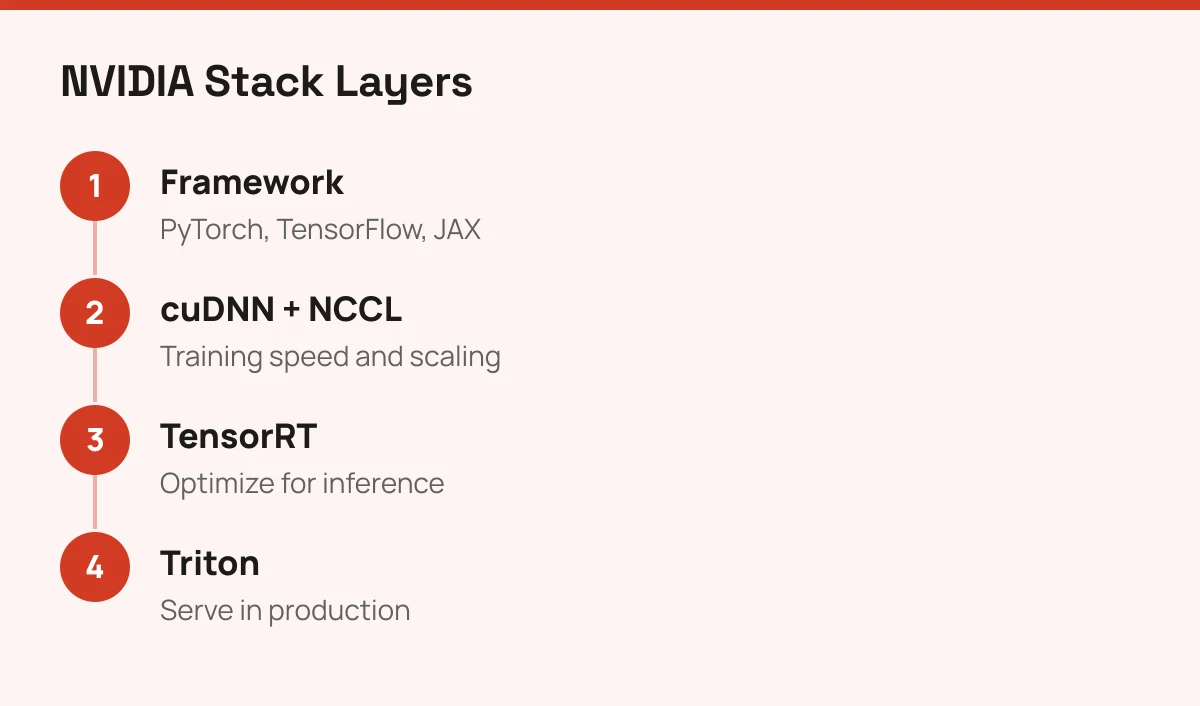
That split is the useful part. You can adopt one stage without the others.
- cuDNN: primitives that frameworks call during training and inference.
- NCCL: collective communication for multi-GPU and multi-node jobs.
- TensorRT: optimization and runtime for low-latency inference.
- DALI and RAPIDS: faster data loading and GPU data science.
Who Should Use It Directly
Most readers should skip direct use. If you train in PyTorch on an NVIDIA GPU, cuDNN is already working for you, and installing a matching version is the only task.
Go direct when inference cost or latency is your problem. TensorRT is the usual first step: export a trained model, optimize it, and measure. Teams scaling beyond one machine should learn NCCL's behavior, because it decides how well extra GPUs actually pay off.
If you want a visual, no-code route instead, look at Deep Learning Studio. For the wider picture of where these libraries land in practice, see what machine learning is used for and our ranking of machine learning software.
Where It Runs and What It Locks You Into
The SDK runs on NVIDIA GPUs only. That's the real cost of choosing it: your optimized engines, kernels and tuning don't move to AMD or other accelerators without rework.
The libraries are free to download from NVIDIA's developer site, but you pay for hardware, and production support comes through NVIDIA AI Enterprise. For current pricing, check NVIDIA's AI Enterprise page. Check each library's license before bundling it in a product.
How to Start
Install a framework build that matches your driver and CUDA version first. Version mismatches cause most first-day failures.
Then benchmark one model before and after TensorRT. If the gain is small, stay with your framework. NVIDIA's own site at nvidia.com lists current developer resources, and our machine learning software ranking helps if you're comparing platforms around the SDK.