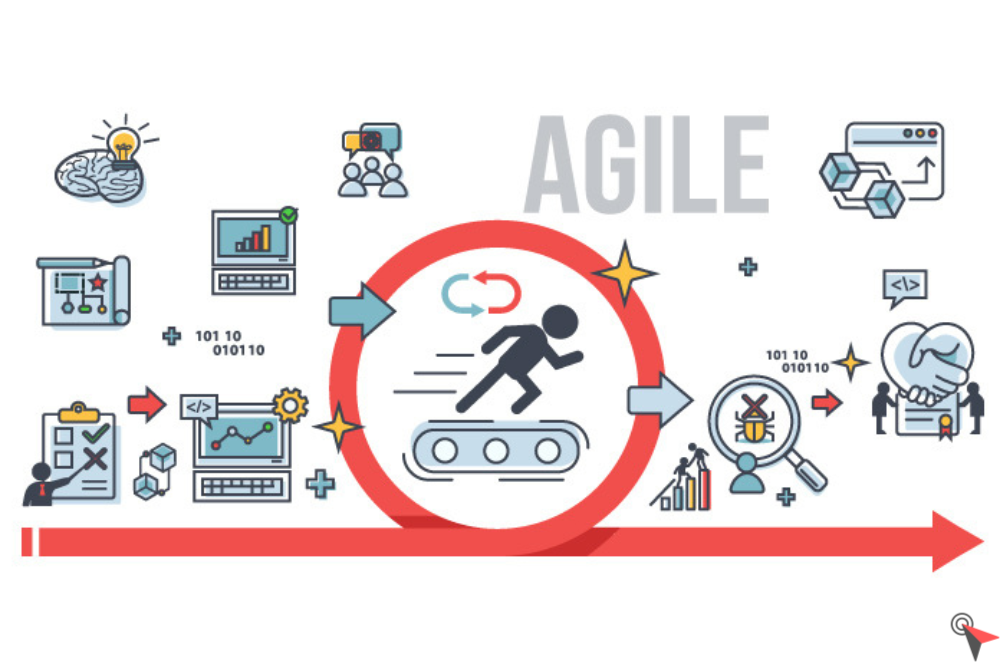
Today, the Agile Project Management method is the most popular project management methodology in the business world. This is explained by its rather particular functioning. It treats each phase of the project independently of the others. Each step in itself is considered a sub-project and the whole is developed iteratively and incrementally. This promotes better collaboration between team members and between teams, and allows for more flexible and efficient management.
What is the Agile Project Management Method?
As already said, the Agile method is the process that is characterized by the decomposition of a project into several autonomous phases. Its particularity lies in the role played by the customer or the end users of the product to be delivered.
These intervene upstream, before everything begins. They define precisely (and in detail) the nature of the product he is looking for and the problem that it must solve. They are also consulted throughout the implementation of the project so that they can judge its proper execution.
Why use an Agile Approach?
Using an Agile approach reduces the risk of the final product not conforming to customer expectations. They are placed at the very heart of the project, which promotes more flexible, more interactive and faster management.
As soon as something goes wrong, corrective measures are taken. If customers believe that changes could improve the product, these are tested. This is not the case with other traditional project management methods: V cycle, cascade cycle…
As part of these traditional project methods, customers are only consulted at the end of the project to validate the delivered product. It is therefore quite possible that the latter does not correspond to the expected result. And since project phases are handled sequentially, one unforeseen change can disrupt the entire process. Questioning and misunderstandings multiply when customer needs change. The approach is not flexible enough, which makes management more or less difficult.
Advantages and disadvantages of the agile method
Like any other work methodology, the Agile method has its strengths and weaknesses.
Advantages
The Agile method has 4 major advantages:
- Quality: at the end of each phase of the project, the product is delivered to the customer for evaluation. If changes need to be made, they are taken into account. If everything is in line with the client’s expectations, the teams move on to the next step and so on until the end of the project. By operating in this way, there is very little chance that the quality of the final product will not meet the expectations of the customer.
- Flexibility: each phase of the project is autonomous, so it is easier to go over certain elements without turning everything upside down.
- Competitiveness: adopting the Agile method makes it possible to produce new products and new functionalities more quickly and more efficiently. This is a significant competitive advantage for customers.
- Empiricity: the active participation of the client makes the project comparable to an experiment. The product is tested at each stage of its development and is modified over time according to the appreciation of the customer.
Disadvantages
Despite its performance, agile project management has some drawbacks:
- Less detailed and less complete documentation: the project is often reinvented following customer feedback. Updating the related documentation is therefore quite difficult.
- A lack of predictability: since modifications are frequently made, it is difficult to estimate the cost of the project from the start. The same goes for its duration and the resources necessary for its implementation.
- Complex request management: when there are too many customer requests, it can be difficult to take them all into account.
Steps of the Agile method
The Agile methodology takes place in 5 distinct stages:
The Framework of the Project
It is a question of determining, initially, the objectives, the context and the reasons for the project. In a second step, it is necessary to define the requirements of the customers or end users in relation to the products to be produced.
Preparing the Backlog
Preparing the backlog consists of listing the actions to be taken and classifying them in order of priority. The backlog is the priority action that will be the subject of the first sprint. It will then be necessary to list all the tasks relating to the execution of the priority action to be well fixed.
The actions and tasks to be done must allow the achievement of the final objectives and be in line with the requirements of the customers.
Execution of Sprint Tasks
This phase is the one in which the resources are implemented. The idea is to complete all the tasks listed during step 2. Also, the action to which these are attached will be executed at the end of the sprint.
15 min meetings are held every day for the duration of the sprint.
Reminder: an action = a sprint = a list of tasks to do.
Consideration of Customer Feedback
At the end of the sprint, a finished and usable product is delivered to customers. They will test it and issue their opinions. They may like it, hate it, or want to make some changes. It is this step that will then determine the tasks to be done right after. It is also here that the retrospective assessment of the sprint is carried out in order to be able to draw lessons from it.
Resumption of the Process After Integration of Customer Feedback
If comments or improvements have been made by customers following product testing, adjustments must be made. It is therefore necessary to repeat the same process, list and prioritize the actions to be done, list and execute the tasks, etc. When the product is validated, the team moves on to the next sprint and so on until the end.
Training on the agile method exists both online and face-to-face.
The Scrum Method
The Scrum method is one of the most used methods. The English word “Scrum” means “melee” in French. It refers to the collaborative and interactive functioning conveyed by the methodology as described above. The principle remains the same, the client actively participates in the progress of the project. This allows a more empirical approach: the project is considered more as an experiment.
The Scrum method is based on a multidisciplinary group dynamic. This helps in optimizing productivity and creativity. In general, a Scrum team has around 3 to 9 people, including:
- A Scrum Master: he is the one who coaches the development team. He ensures that the basic values and principles of the Scrum method are respected. It promotes communication within the team, boosts productivity and ensures the development of the potential of each member.
- A Product Owner: he is the one who has the vision of the product to be delivered. It prioritizes the tasks to be carried out and designates the functionalities to be improved, developed and validated. He is in a way the Project Manager responsible for steering activities and quality control.
- A development team: it is its members who implement the tools and resources necessary for the design and development of the product. It is made up of testers, developers, architects, etc.
The organization of a Scrum project is based on sprint’s lasting from 1 to 4 weeks. A sprint is a period after which a usable version of the product is produced. And as soon as it comes to an end, another is started and so on until the end of the project.
All Scrum projects have several Sprints and each Sprint has specific goals. As in any other project, a Sprint goes through planning and requires control, monitoring and retrospective assessment. What sets it apart is the scrum or daily 15-minute meeting held throughout the period. This allows you to take stock of what was done the day before, the objectives of the day and the obstacles encountered.
We made this comparison of project planning software to make it easier to track your projects.
For a Scrum project to be successful, it requires the implementation of several tools and artifacts. These are Product Backlog, Sprint Backlog, Product Increment, and Progress Chart. It also integrates resources such as:
- The “User Scenario”: the sheet which details the characteristics of the tasks to be carried out.
- “Story points”: ratings given to user scenarios according to their complexity.
- The DoD or “Definition of Done”: the criteria for determining that a user scenario is addressed.
As you have seen, a Scrum method is very structured. This makes it more efficient. It is a guarantee of success for any business.
Note: the application of the Scrum method is generally done within the framework of an IT project.
What is the Difference Between Agile and Scrum?
Below is a small summary table of the differences between the Agile method and the Scrum method.
| Agile method | Scrum method |
| Leadership based | Based on the dynamics of a multidisciplinary and self-organized team |
| Very flexible and responsive to changes | Very structured, less sensitive to changes |
| Intra-team and inter-team collaboration and interaction | Collaboration and intra-team interaction under the watchful eyes of the Scrum Master and the Product Owner |
| The initial organization can be changed and expanded as many times as needed | The Scrum process remains the same |
| The project manager oversees everything | There is no project manager, no hierarchy. The whole team is responsible. |
| Regular product update and delivery | Organization based on a sprint system |
| Simple process | Innovative and experimental process |
| More focused on face-to-face communication | More focused on creating business value |
Other Key Project Management Methods
It’s not just the Scrum method when it comes to Agile project management. There are others, including Kanban and Safe.
The Kanban Method
The Kanban methodology generally complements the Scrum method. Its principle is as follows: identification of obstacles in the project development process to better avoid them.
To do this, you must:
- List the tasks in progress constituting the work chain and present them in a table. This allows you to have an overall and detailed view of all the phases of the project (tasks in rows and phases in columns).
- Optimize the completion times of each task or feature by eliminating/improving what can be eliminated/improved.
- Reducing the number of tasks to be carried out within the same phase: this makes it possible to lighten the workload of the teams and thus make them more productive.
The Kanban method is what the Scrum team uses to manage activities. The combination of the 2 methods is called Scrumban.
The SAfe Method
The SAfe method or Scaled Agile Framework is a combination of the Scrum method and the Agile method adapted to the scale of the company. It is considered to be the most comprehensive methodology. Management directs operations and sets strategies. Teams operate in Scrum mode and support the executive part of operations.
It incorporates 2 new concepts, namely:
- The ART or Agile Release Train: a team of Agile groups made up of more than 100 people and led by an RTE or Release Train Engineer. The latter is the Scrum Master of Scrum Masters. He coaches the Scrum Masters of all the teams.
- The PI or Program Increment: a period during which 5 sprints (on average) are started to allow the realization of several functionalities at the same time. Before the start of the PI, a 2-day melee is organized. It brings together all the teams to discuss the objectives and the distribution of the various missions.
FAQ – Agile Project Management
Agile method and traditional method the main differences?
The major difference between the traditional method and the Agile method lies in the iterative nature of the management process. In the first case, the projects are conducted in a linear fashion. The client delivers the specifications which will serve as a reference for all the missions to be carried out. The product is thus designed and developed. If customers change their minds or want to add other features, you have to start all over again from the beginning (waste of time and energy).
In the second case, the projects are divided into several independent phases. At the end of each phase, end users are consulted for their opinions on the product. If they are satisfied, the stage is closed and the team moves on to the next one. This avoids back and forth.
What is an Agile sprint?
The sprint corresponds to an event of 1 to 4 weeks during which a set of activities must be carried out. The activities in question are attached to a particular mission that must be completed at the end of the sprint.
Sprint planning comes with several goals. Its execution is then controlled and monitored to ensure compliance with customer requirements. A revision of the sprint is carried out if modifications must be made before proceeding to the final assessment.
As you have understood, the sprint is an autonomous sub-project within the project itself.