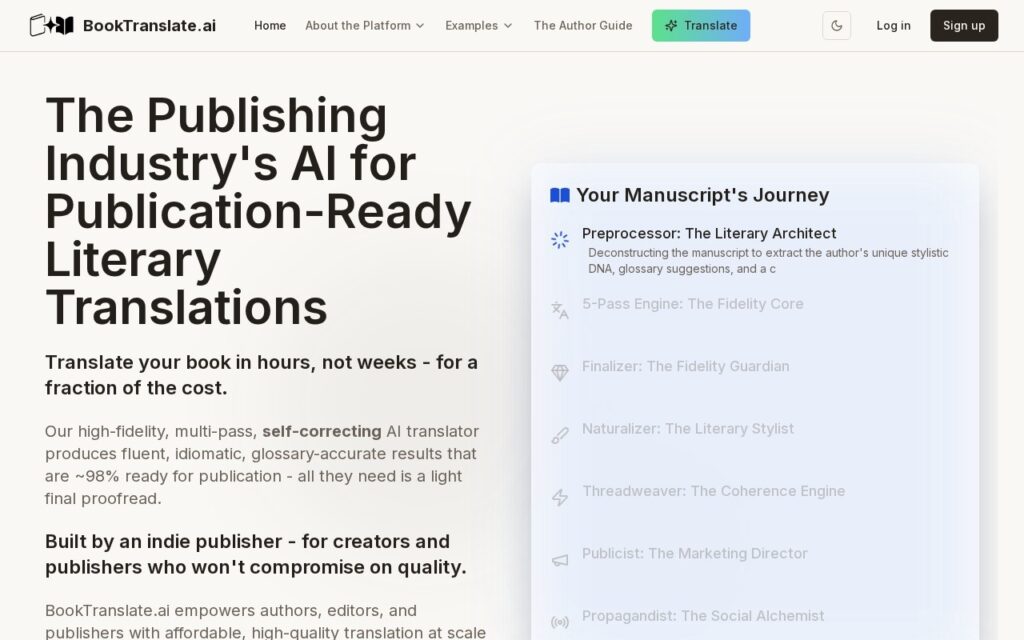
BookTranslate.ai is built specifically for literary and manuscript translation, not general documents: it analyzes an entire book before translating to build an “AI Literary Blueprint” of authorial style and themes, then applies a five-pass iterative refinement engine, a fidelity-audit pass for error detection, and a book-wide consistency tool (“Threadweaver”) to keep terminology and voice stable across chapters. An integrated editorial suite and a marketing-kit module round out a full self-publishing translation workflow.
Whole-book style analysis before translation begins, rather than translating chapter-by-chapter in isolation, is what separates this from a general document translator pointed at a manuscript: tone, recurring motifs and character voice carry across an entire book, and losing consistency between chapters is the specific failure mode literary translation is most vulnerable to. At roughly $390 versus a traditional $10,000-$20,000 human literary translation, the price gap is large enough to open translation to authors who could never have justified the traditional cost.
A 90%+ cost reduction against professional human literary translation is a real trade-off, not a free upgrade – literary translation involves cultural judgment and creative choices that a self-correcting engine approximates rather than replaces, and a serious publishing project should still budget for a human editorial pass on the output before release.