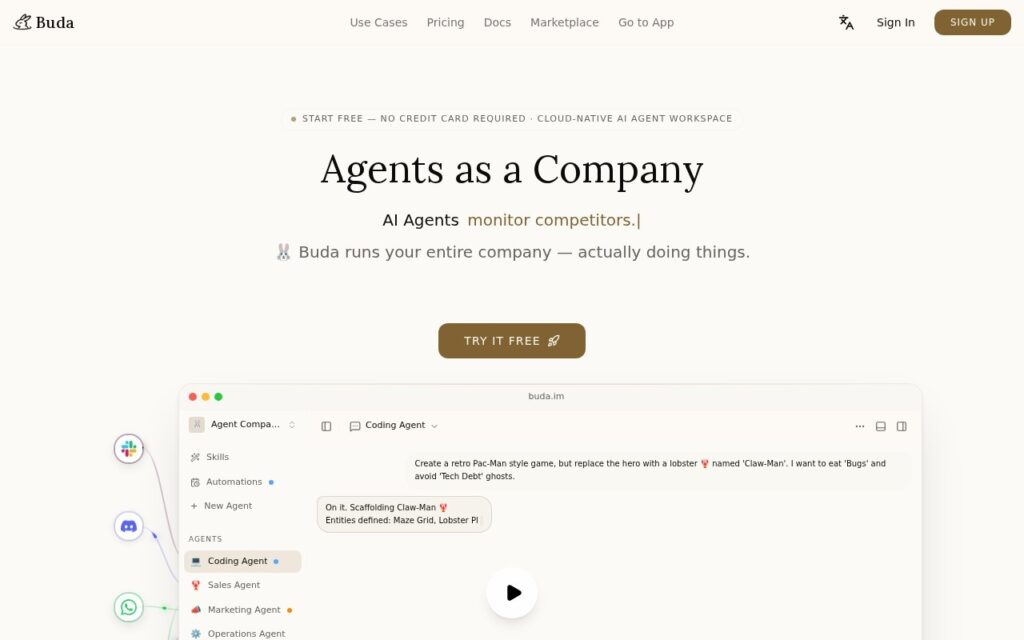
Buda is a workspace for running several AI agents at once across a company. Agents are deployed per function – HR, sales, operations – and handle knowledge-base support, outreach, content, code, websites, media and data processing. Each gets an Agent Computer as an isolated sandbox and an Agent Drive for working files, with a shared Space Drive for team knowledge, a Marketplace of pre-built agents and skills, and a Buda Organizer distributing work between them.
Reviewable output is the part that decides whether multi-agent tooling is usable. Buda shows the steps taken, a browser preview of what the agent saw and version control over what it produced – and without that, an agent that worked for twenty minutes hands back an artefact nobody can audit, which is precisely why most teams quietly stop trusting these systems after the first plausible-looking mistake.
Separating per-agent drives from shared team space is the right structure for the same reason: it keeps one agent’s working scratch out of the knowledge base everyone else reads. It starts free with no card and no pricing figures are published, and no company is named beyond the product. Coordinating multiple agents multiplies the failure surface rather than dividing the work, sandboxed computers per agent is a real cost someone is paying, and a marketplace of pre-built agents is only as good as its least-maintained entry.